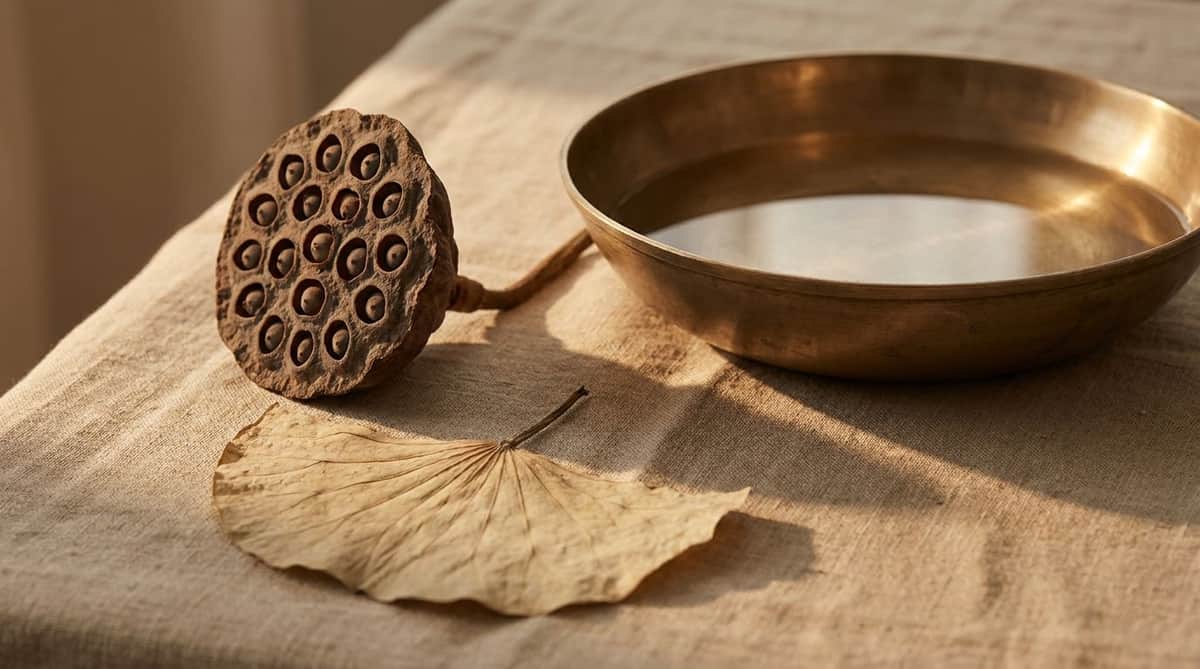
The lotus, also called a lotus blossom, is one of the oldest symbols still worn today, and almost every tradition that adopted it noticed the same detail: the flower spends its nights closed and submerged, then opens again each morning with no trace of the mud it grew out of. That single, repeatable fact of botany is the root of nearly everything the lotus is said to represent — purity, rebirth, and the idea that something clean can come out of a difficult start. This guide covers where that symbolism comes from in Hindu, Buddhist and ancient Egyptian tradition, what each flower color is said to mean — including the colors outside the classical four — and how the symbol shows up in jewelry today.
Why the Lotus Became a Symbol of Purity and Rebirth
The sacred lotus, Nelumbo nucifera, grows rooted in the mud at the bottom of ponds and shallow lakes across South and Southeast Asia. Its stem pushes up through murky water, and the flower opens above the surface each day, closing again at night and re-opening the next morning, largely unmarked by the water or mud it came through. Ancient observers across several unconnected cultures read that daily cycle the same way: a flower that rises clean out of dirty water, morning after morning, looks like proof that clarity and mud are not opposites, they can share the same root.
That reading is where the two ideas most attached to the lotus today come from directly. Purity, because the bloom itself never seems to carry the mud with it. And rebirth, because the flower appears to die back into the water each night and return intact each morning, a small daily resurrection long before any single religion formalized it into doctrine.
Lotus Symbolism in Hindu Tradition
In Hindu tradition the lotus is called padma, and it is one of the most consistently used symbols across the religion's major deities. Brahma is traditionally shown seated on a lotus that grows from Vishnu's navel, part of the creation story. Lakshmi, the goddess of wealth and prosperity, is almost always depicted holding or standing on a lotus, and the flower is treated as one of her core attributes rather than decoration. Saraswati, goddess of knowledge and the arts, is shown seated on a white lotus specifically, tying the flower to wisdom as well as prosperity.
The lotus also appears throughout the chakra system, where each of the seven energy centers is traditionally visualized as a lotus with a specific number of petals — the crown chakra, sahasrara, is described as a thousand-petaled lotus, the symbolic endpoint of the whole system. Across all of these uses, the throughline is the same: the lotus stands for something that unfolds toward clarity, whether that is a goddess, a form of consciousness, or a stage of spiritual practice.
Lotus Symbolism in Buddhist Tradition
Buddhism carried the same flower forward with its own emphasis: purity of body, speech and mind. The Buddha is very commonly depicted seated on a lotus throne, and the eight-petaled lotus is one of the Ashtamangala, the eight auspicious symbols used across Buddhist art and ritual objects. The mantra most associated with Tibetan Buddhism, Om Mani Padme Hum, is often translated to include "the jewel in the lotus," linking the flower directly to the idea of something precious held inside something ordinary-looking.
Buddhist teaching also leans on the mud imagery more explicitly than Hindu tradition does: a well-known teaching attributed to Thich Nhat Hanh puts it directly, that a lotus needs mud to grow, meaning the practice is not to avoid difficulty but to grow through it. That is a meaningfully different emphasis from "purity" alone, and it's part of why the lotus reads slightly differently depending on which tradition's version you're referencing.
Lotus Symbolism in Ancient Egypt
Ancient Egypt had its own lotus tradition, though with an important botanical wrinkle worth being upfront about: what Egyptians called the blue lotus and white lotus were, botanically, water lilies (genus Nymphaea), not the true lotus (Nelumbo nucifera) that Hindu and Buddhist symbolism is built around. The two plants are unrelated species that happen to share a common name and a similar growth habit, which is a common source of confusion in modern write-ups that treat all "lotus" symbolism as one continuous tradition.
That said, the Egyptian flower carried real symbolic weight on its own terms. The blue lotus, Nymphaea caerulea, opens with the sunrise and closes at dusk, which tied it directly to the sun god Ra and to creation myths in which a lotus was said to have emerged from the primordial waters, opening to reveal the sun itself. It appears throughout tomb paintings, temple columns carved in lotus form, and funerary art, generally standing for rebirth and the sun's daily return — the same underlying idea as the Hindu and Buddhist versions, arrived at independently through a different, related flower.
What Each Lotus Color Is Said to Mean
Color symbolism for the lotus comes mostly out of Buddhist tradition, where different colored lotuses are associated with different qualities. These meanings are a belief system, not a botanical fact, and different sources don't always agree on the fine details, but the broad associations are consistent enough to be worth knowing if you're choosing a lotus motif for a specific reason.
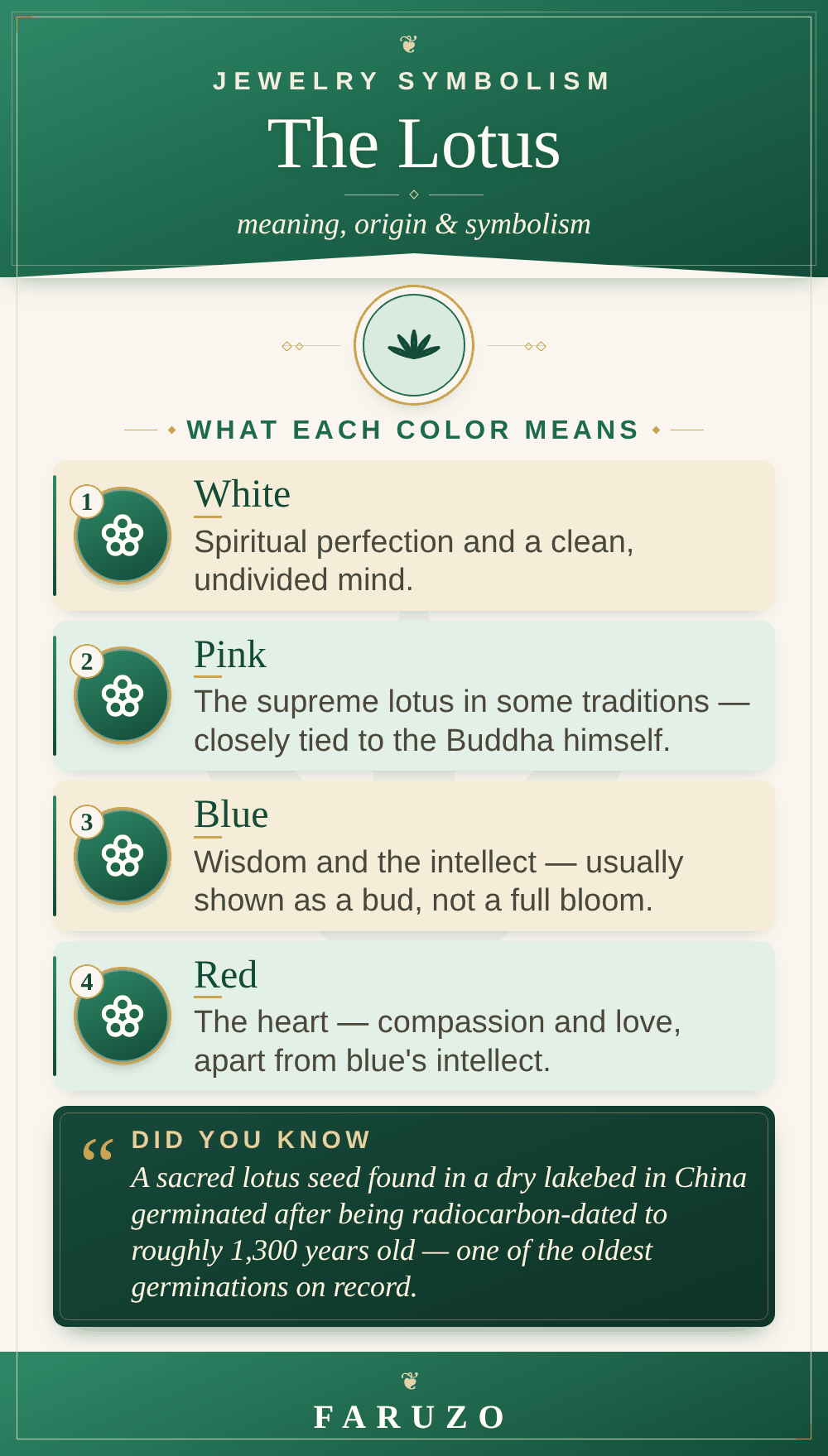
White lotus is generally read as the purest form: spiritual perfection, mental purity, a clean and undivided mind. Pink lotus is treated as the supreme lotus in some Buddhist traditions, closely associated with the Buddha himself and reserved for the highest deities in certain iconographic systems. Blue lotus is tied to wisdom, knowledge and victory of the intellect over the senses, and it's typically shown as a partially closed bud rather than a full bloom, suggesting wisdom still in progress. Red lotus is associated with the heart, compassion, and love, standing apart from the more intellectual associations of blue.
Searches also turn up less traditional colors — black, purple, orange and golden-yellow lotus — and it's worth being straightforward about those: they fall outside the classical Hindu and Buddhist color system above, which is really built around white, pink, blue and red. What circulates for black, purple, orange or yellow lotus online is mostly modern color association layered onto the same flower: black read as mystery or individuality, purple loosely tied to spirituality in general color lore, orange to energy and warmth, and yellow or gold to prosperity. None of that traces back to a named religious tradition the way the four core colors do, so it's closer to decorative preference than inherited meaning.
The Lotus in Jewelry Today
The lotus shows up in modern jewelry mostly as an outline or open-petal pendant, and the appeal tracks pretty directly with the symbolism above: it reads as a personal note about resilience or a fresh start rather than a religious statement, which is part of why it's worn widely by people outside any specific faith tradition. It sits in the same broad category of belief-based jewelry symbols as the hamsa hand or the tree of life — pieces people choose for what the shape is said to represent, not for a certification or a material claim. If you're weighing it against other meaningful shapes, the feather carries a similarly personal significance, and the rest of what we've covered sits in our meanings & symbols archive.
If you're picking a lotus piece by color rather than just shape, the meanings above give a reasonable starting point, and our guide to what gemstone colors are said to represent covers the same idea applied to stones instead of flowers, in case you're pairing a lotus motif with a colored stone rather than leaving it plain metal. For a related rebirth-and-transformation symbol that pairs naturally with a lotus piece, the butterfly carries a closely related but distinct story. If a name feels like the more personal route than a symbol, FARUZO's personalized necklaces turn a name or initial into the pendant instead. And if you want the fuller map of what other symbols on this list mean, the full jewelry symbolism guide is the place to start.
Interestingly, several birth-flower charts list the water lily (alongside larkspur) as July's traditional birth flower, a separate tradition from the twelve modern birthstones covered in our birthstones by month guide. Chart sources vary on this point more than they do for birthstones, so treat it as a loosely held tradition rather than a fixed standard the way the birthstone list is.
Frequently Asked Questions
What does the lotus flower symbolize?
The lotus is most commonly read as a symbol of purity and rebirth, based on the way it grows rooted in mud but opens clean each morning. In Hindu tradition it's tied to specific deities like Lakshmi and Saraswati and to the chakra system; in Buddhist tradition it stands for purity of body, speech and mind, and often appears under the Buddha in art. Ancient Egypt built a related but separately-developed sun-and-rebirth symbolism around the blue and white water lily, commonly also called a lotus.
Why does the lotus grow in mud?
The sacred lotus is a true aquatic plant that roots in the sediment at the bottom of shallow ponds and lakes, with its stem extending up through the water so the flower can open above the surface. The mud isn't incidental to the symbolism, it's the point: the plant needing murky, nutrient-rich mud to grow at all, while still opening a clean flower above it, is exactly the contrast most lotus symbolism is built on.
What's the difference between a lotus and a water lily?
They're different plant genera. The true lotus, Nelumbo nucifera, holds its flower and leaves above the water on a tall stem and has a distinctive seed pod. Water lilies, genus Nymphaea, typically float their leaves and flowers flat on the water's surface. Ancient Egypt's "blue lotus" and "white lotus" were botanically water lilies, not true lotus, even though the name has stuck for thousands of years.
What does each lotus color mean?
In Buddhist tradition, white lotus generally represents purity and mental clarity, pink is treated as the supreme lotus associated with the Buddha, blue represents wisdom and the intellect (often shown as a bud rather than a full bloom), and red is associated with the heart, compassion and love. These are traditional, belief-based associations rather than a fixed universal standard, and different sources describe them with some variation.
Is the lotus a birthstone or birth month symbol?
It's not part of the modern twelve-birthstone list. Separately, several birth-flower charts list the water lily as a traditional flower for July, alongside larkspur, though birth-flower traditions vary more between sources than the birthstone list does.