

A feather turning up somewhere unexpected — on a doorstep, tucked into a book, caught in a car door — gets read as a sign more often than almost any other object, and the habit isn't new or purely modern. Long before feathers became a fixture of social-media spirituality, they stood for something specific and different in several unrelated traditions: truth and moral balance in ancient Egypt, honor and a direct connection to the divine in Native American culture, and, more recently, comfort from someone who has died. Those meanings didn't come from the same place and don't always agree with each other, which is part of why feather symbolism gets muddled online. This guide separates the documented history — the Egyptian Feather of Ma'at, the Native American eagle feather — from the newer, softer folklore around white feathers and feather colors, and looks at how the symbol shows up in jewelry today.
The Feather of Ma'at: Truth and Judgment in Ancient Egypt
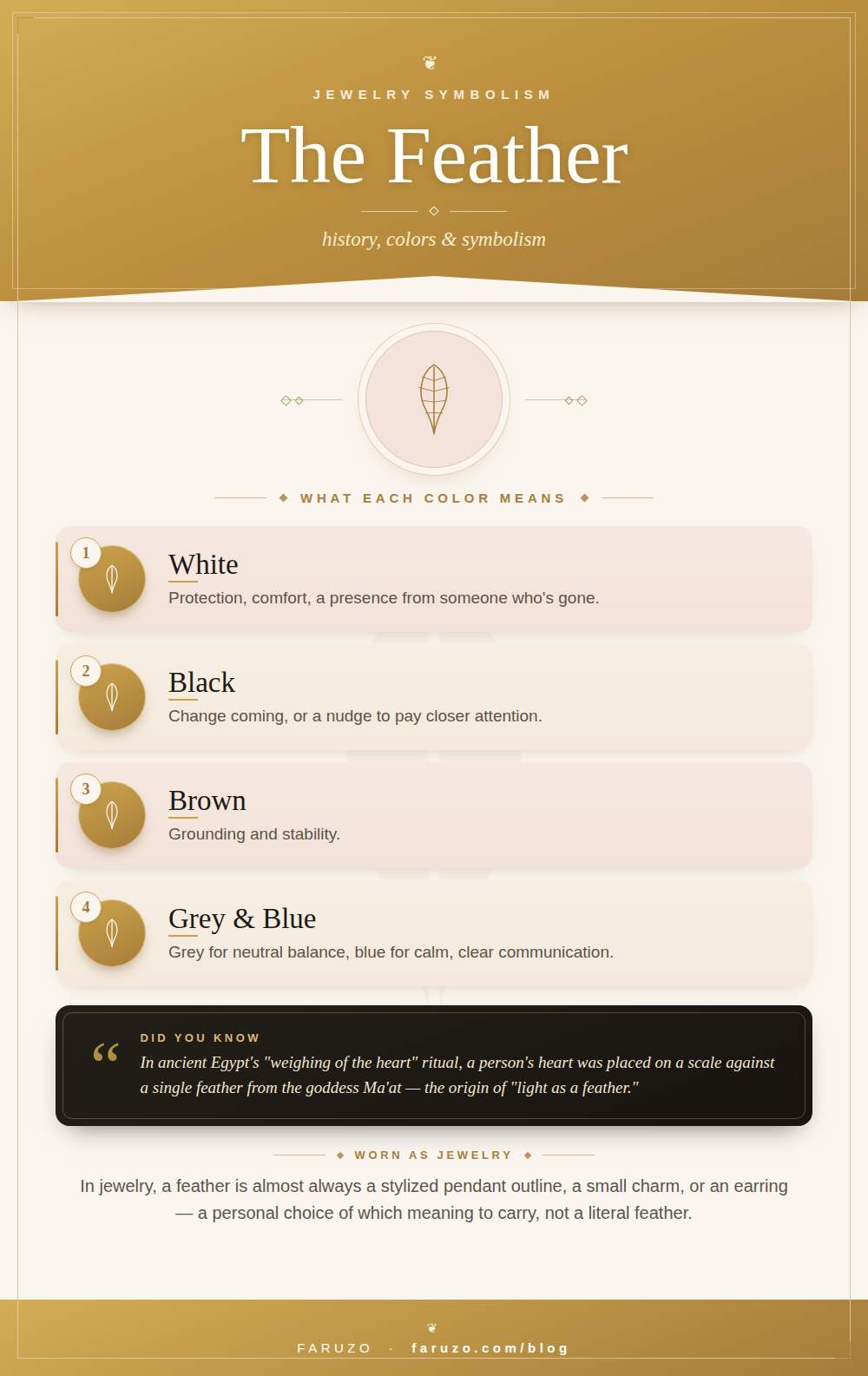
In ancient Egyptian religion, a single upright ostrich feather represented Ma'at, the goddess — and abstract principle — of truth, balance, and cosmic order. Ma'at was consistently depicted wearing that one feather in her headdress, and it became her defining emblem. Its most famous role was in the “weighing of the heart,” a judgment ritual described in the Egyptian Book of the Dead: after death, a person's heart was placed on one side of a scale and Ma'at's feather on the other. A heart no heavier than the feather — read as a life lived truthfully — was judged worthy of the afterlife. A heart weighed down by wrongdoing was said to tip the scale and be devoured by Ammit, a composite creature part crocodile, lion, and hippopotamus, ending any chance at an afterlife entirely.
That single image — truth measured against a feather's near weightlessness — is very likely the root of “light as a feather” meaning an unburdened conscience, an association that predates the English idiom by thousands of years. It's also the reason the feather, more than almost any other object in Egyptian iconography, became shorthand for honesty and moral order specifically, rather than a general-purpose symbol of the divine.
Eagle Feathers in Native American Culture
Feathers carry deep, tribe-specific meaning across Native American nations, and the eagle feather in particular is treated as one of the most sacred objects a person can receive. Eagles are widely regarded as the bird that flies closest to the Creator, and their feathers are considered to carry that same power. An eagle feather is traditionally earned, not bought — awarded for a genuine achievement or milestone: military service, a graduation, a period of sobriety, or another significant life event. It functions less like a decorative accessory and more like a medal, and it's treated accordingly: handled with great care, displayed with pride, and, if dropped during a dance or ceremony, retrieved only through a specific ritual rather than simply picked back up.
That significance is recognized under U.S. federal law, which otherwise protects bald and golden eagles strictly — it's generally illegal to possess eagle feathers — but carves out specific exceptions allowing enrolled Native Americans to possess, gift, and pass eagle feathers down. Because that legal protection and cultural weight are specific to Native communities, real eagle feathers worn or sold outside that context sit very differently from most jewelry symbolism, and are worth approaching with real care rather than as a generic style choice — see our dream catcher guide for the same consideration applied to another Native American symbol widely sold outside its original tradition.
The White Feather: Comfort, Angels, and a Newer Kind of Meaning
Separately from either of those traditions, a white feather has become one of the most common “signs from above” in contemporary folklore — the belief that finding one unexpectedly is a message of comfort or presence from an angel, or from a loved one who has died. There's no single documented origin for this belief; it draws loosely on older Christian and folk associations between feathers, wings, and angels, and has spread mainly through word of mouth and social media rather than any one text or tradition.
It's worth being upfront that this is a distinct, modern reading — separate from the Egyptian and Native American meanings above, and not a claim either of those traditions makes itself. It sits closer to the same folklore space as our guide to angel wings necklace meaning, another symbol people wear specifically to hold onto the idea of a continuing connection with someone no longer here.
What Different Feather Colors Are Said to Represent
Color meanings for feathers come mostly from that same modern folklore tradition rather than from Egyptian or Native sources, and they vary by source — treat them as a loose, popular reading rather than settled fact. White is the most commonly cited color and is generally tied to protection, comfort, and spiritual presence. Black feathers are often read as a sign of change or a nudge to pay closer attention, though in a plainly practical sense black is also simply the most common feather color among crows, ravens, and blackbirds. Brown is usually linked to grounding and stability, grey to neutrality or a need for balance, and blue to calm or clear communication.
If you're drawn to symbolism organized by color, our gemstone color meanings guide covers the same idea for stones — these popular feather associations are the closest equivalent, though, unlike gemstone color, which traces back to a specific mineral cause, feather color meaning is folklore from start to finish, with no comparable physical explanation behind it.
Feathers in Jewelry Today
Feather jewelry meaning today usually comes down to which piece you're wearing. A feather necklace or feather pendant is almost always a stylized metal outline rather than a real feather, feather earrings follow the same rule, and a feather charm on a bracelet or chain reads the same way — all clearly separate from the sacred, tribe-specific eagle feather described above. The meaning usually tracks one of the readings covered here rather than being purely decorative: a single feather charm as a nod to freedom or a received sign, a cluster of feathers on a longer chain leaning into a bohemian, nature-inspired look, or a small feather added to a memorial piece alongside a birthstone or an engraved name.
Because the symbol carries so much unrelated meaning depending on which tradition it's drawn from, a feather piece is one of the rare jewelry symbols worth choosing deliberately — picking the reading (truth, honor, remembrance, or simple style) you actually want it to carry, rather than assuming a single universal meaning applies.
Frequently Asked Questions
What does a feather symbolize?
Depending on the tradition, a feather has stood for truth and moral balance (ancient Egypt's Feather of Ma'at), honor and a connection to the divine (the Native American eagle feather), or, in modern folklore, a comforting sign from an angel or someone who has died.
What does it mean when you find a white feather?
In popular modern folklore, an unexpectedly found white feather is usually read as a sign of comfort, protection, or presence from an angel or a loved one who has passed away. It's a widely shared belief rather than a documented tradition with a single origin.
Why is a feather associated with truth in Egyptian mythology?
Because of the “weighing of the heart” ritual described in the Egyptian Book of the Dead, in which a person's heart was weighed against the feather of the goddess Ma'at. A heart no heavier than the feather — meaning a life lived truthfully — was judged worthy of the afterlife.
Is it disrespectful to wear an eagle feather if you're not Native American?
Real eagle feathers specifically are protected by U.S. federal law, with exceptions carved out only for enrolled Native Americans, so possessing or wearing an actual eagle feather outside that context can be both legally and culturally fraught. Stylized feather jewelry that doesn't depict or use a real eagle feather is a separate, much more common category.
Do different feather colors mean different things?
In popular folklore, yes — white is generally tied to comfort and protection, black to change or a signal to pay attention, brown to grounding, grey to balance, and blue to calm. These associations come from modern folk tradition rather than the Egyptian or Native American meanings, and they vary by source.