Above an Ojibwe cradleboard, generations before the souvenir shops, hung a small hoop of bent willow strung with a web of plant-fiber cord. It was not decoration. It was a mother's answer to the oldest problem of parenthood: how do you protect a child from what arrives in the dark? The dream catcher began there — as a piece of practical love — long before it became one of the most recognized, and most argued-about, symbols in North America.
The legend of Asibikaashi, the Spider Woman
In Ojibwe tradition, the story begins with Asibikaashi — Spider Woman — a caretaker spirit who watched over the people and especially their children. As the Ojibwe nation spread across North America, the story goes, Asibikaashi could no longer reach every cradle by herself. So mothers and grandmothers took over her work by hand: they bent small hoops of willow, wove webs of nettle or sinew inside them, and hung them where children slept. The word itself in Ojibwe, asabikeshiinh, refers to the spider — the web was always the point.
How a dream catcher is meant to work
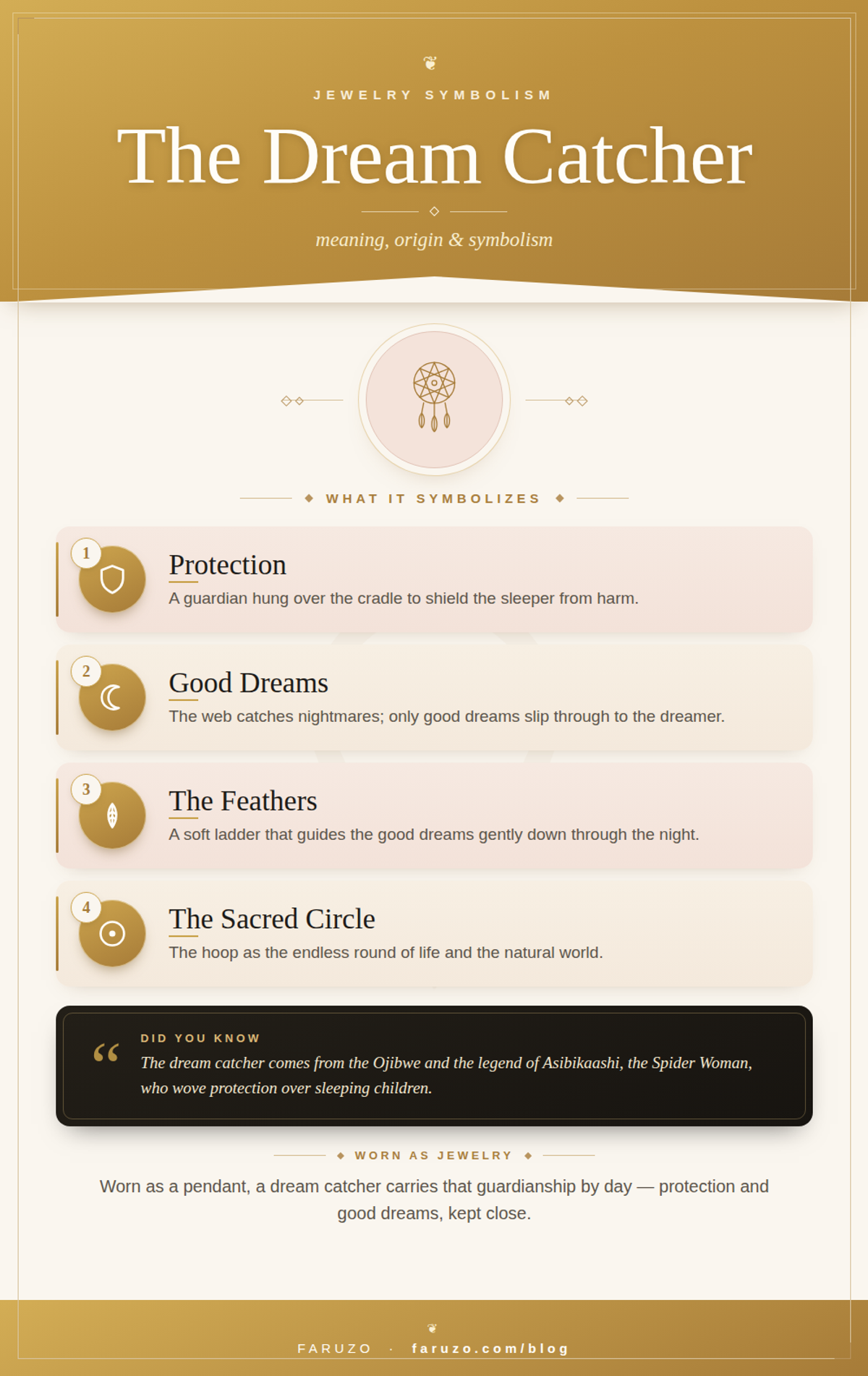
The mechanics of the charm are precise and rather beautiful. At night, dreams drift through the air toward the sleeper. Bad dreams, clumsy and heavy, tangle in the web — where they are held until first light, and the morning sun destroys them. Good dreams know the way: they slip through the small hole at the web's center, glide down the feathers, and settle gently on the person sleeping below. By morning the web is clean, the harm burned away, and only the good has reached you. In some tellings — notably Lakota versions, which carry their own distinct story — the logic runs in reverse, with the web holding the good and letting the bad pass on. Both traditions agree on the essential job: filtering the night.
What each part of a dream catcher means
Every element carries its share of the story. The hoop's circle mirrors giizis — the sun — and its daily journey across the sky, along with the larger circle of life. The web does the catching, woven traditionally with a small opening at the center for good dreams to pass. Feathers act as a soft ladder, sliding good dreams down to the sleeper; a bead woven into the web often stands for the spider herself, keeper of the design. Traditional Ojibwe dream catchers were small — a few inches across — and made of willow and natural cord that would eventually dry, tighten and break: a built-in reminder that childhood's protections are meant to be temporary.
Colors, patterns and modern variations
Color symbolism in dream catchers is largely a modern layer, but a consistent one: white and cream for purity and peace, blue for calm and truth, red for vitality and courage, black for strength and mystery, turquoise — echoing the stone — for protection and healing. Patterns vary from the classic radial web to flower-like weaves and doubled hoops. None of these variations change the core grammar of the object: circle, web, opening, feather. If a design keeps those four, it keeps the story.
From Ojibwe cradles to the wider world
For most of its history the dream catcher belonged to the Ojibwe and neighboring nations. That changed in the 1960s and 70s, when the Pan-Indian movement — a period of renewed solidarity and cultural exchange among Native American nations — carried the dream catcher far beyond its origin. Within a generation it became a shared Native American emblem, and then a global one: hung from rearview mirrors, inked as tattoos, woven into festival fashion. Somewhere along that journey it also became one of the clearest test cases for a modern question — where is the line between honoring a culture and borrowing from it?
Wearing it respectfully: honoring the origin
There is no single Native American position on who may hang or wear a dream catcher — opinions differ between nations, elders and individuals. But a few principles are widely shared. Know the story: a dream catcher worn knowingly honors Asibikaashi and the mothers who wove for their children; worn blindly, it is merely a shape. Name the source: the dream catcher is Ojibwe, not a generic 'tribal' motif. And when you buy a traditional, handmade dream catcher, buying from Native artists supports the culture that created it. Worn this way — with its story intact — the dream catcher joins the long family of protective charms we explore in our jewelry symbolism guide, alongside the hamsa and the evil eye — each a different culture's answer to the same wish for safe passage through the night.
The dream catcher in jewelry
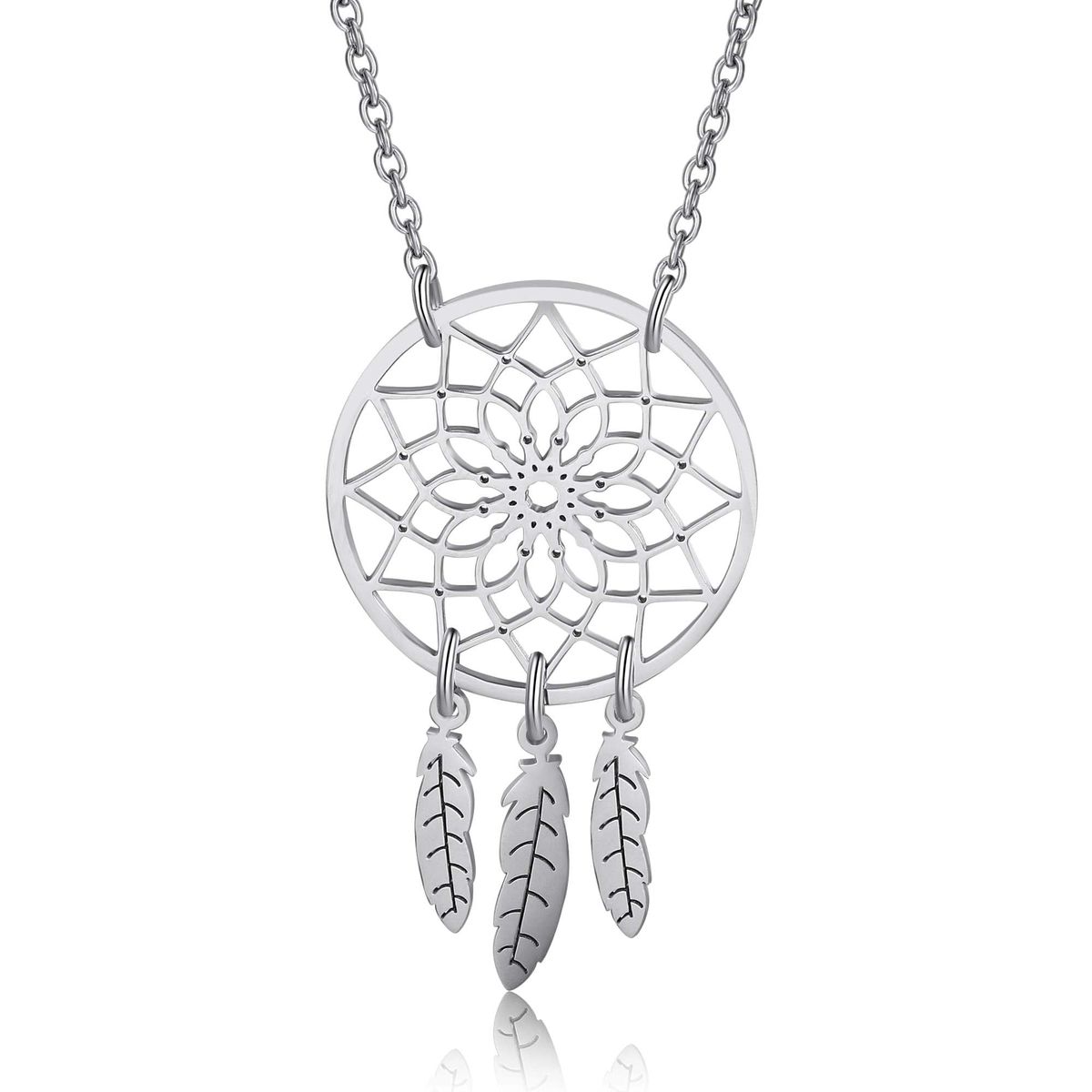
Shrunk to pendant size, the dream catcher keeps its promise portable: a circle, a web, a feather at the collarbone — protection you don't leave at home. It has become a favorite gift for new mothers, for children leaving home, and for anyone walking through an anxious season. Our dream catcher necklace renders the full design — web, beads and feathers — in gold or sterling silver, made to order and finished by hand.
Frequently Asked Questions
What does a dream catcher symbolize?
A dream catcher symbolizes protection during sleep — a woven filter that catches bad dreams in its web and lets good dreams through the center opening, down the feathers, to the sleeper. More broadly it carries the care of Asibikaashi, the Ojibwe Spider Woman, and the mothers who wove hoops to guard their children.
Where should you hang a dream catcher?
Tradition places it above the bed — especially a child's — or near a window where morning light can reach it, since sunrise is what destroys the bad dreams caught overnight. Many people also hang them in cars or doorways as general protective charms, a modern extension of the original bedroom use.
Is it disrespectful to wear a dream catcher if I'm not Native American?
Views differ, and no one answer speaks for all Native people. What is widely agreed: know that the dream catcher is Ojibwe, understand what it means, and avoid treating it as a costume. Buying traditional handmade pieces from Native artists is the most direct way to honor the source; wearing the symbol thoughtfully, with its story intact, is generally received very differently from wearing it blindly.
What do the feathers on a dream catcher mean?
The feathers act as a pathway: good dreams that pass through the web's center opening slide softly down the feathers to reach the person sleeping below. In many traditions the feather also carries a breath-of-air, freedom association of its own.
Does a dream catcher have to be a gift?
A popular belief holds that a dream catcher should be given rather than bought for yourself, echoing its origin as something woven by mothers and grandmothers for children. It is custom rather than rule — but it is part of why dream catcher jewelry is so often chosen as a protective gift for someone entering a new chapter.
A hoop, a web, a feather: the dream catcher has traveled from Ojibwe cradleboards to the world's jewelry boxes without changing its job description. It stands watch over sleep. Learn its story, credit its makers, and it remains what Asibikaashi meant it to be — care, made visible.