A mood ring is one of the few pieces of jewelry that claims to do something measurable: change color as your mood changes. The claim is only half true. The stone really does change color — that part is real physics, not a gimmick — but what it is measuring is your skin temperature, not your emotional state. Temperature and mood are loosely related (stress and anxiety often do cool the fingers, since blood moves toward your core), which is enough overlap to keep the mood-reading premise believable, but not enough to make the ring an accurate mood detector.
What a Mood Ring Actually Is
Underneath the setting, a mood ring's "stone" is a hollow quartz or glass shell, or a flat disc, coated or filled with a thermochromic liquid crystal — a substance whose molecules shift their physical arrangement as temperature changes. That shifting arrangement changes which wavelengths of light the crystal reflects, which reads to the eye as a change in color. It is the same class of material used in strip thermometers and some LCD displays, repurposed into a piece of jewelry.
Cheaper modern versions sold as "mood rings" sometimes skip the thermochromic crystal entirely and use a fixed-color glass or resin cabochon instead — fashion-only, with no temperature response at all. If a ring marketed as a mood ring never changes color regardless of how long you wear it, that is usually why.
The idea traces to 1974, when American jeweler Marvin Wernick read about thermosensitive liquid crystals being used in medical thermometers and adapted the concept into a ring. His compound shifted from black through green and blue within the 32–38°C range, and sales began in February 1975. Marketers Joshua Reynolds and Maris Ambats pushed the rings hard that year — Reynolds called it "a real biofeedback tool" — and by December 1975 the fad had generated roughly $15 million in sales before oversaturation collapsed the market almost as quickly as it had grown, per the ring's documented history.
How the Color Change Actually Works
The liquid crystals used in the original 1970s mood rings were calibrated to shift through visible colors across a specific temperature band.
- Response range: roughly 90–100°F (32–38°C) for the original formulation — within the range of skin temperature at the fingertip
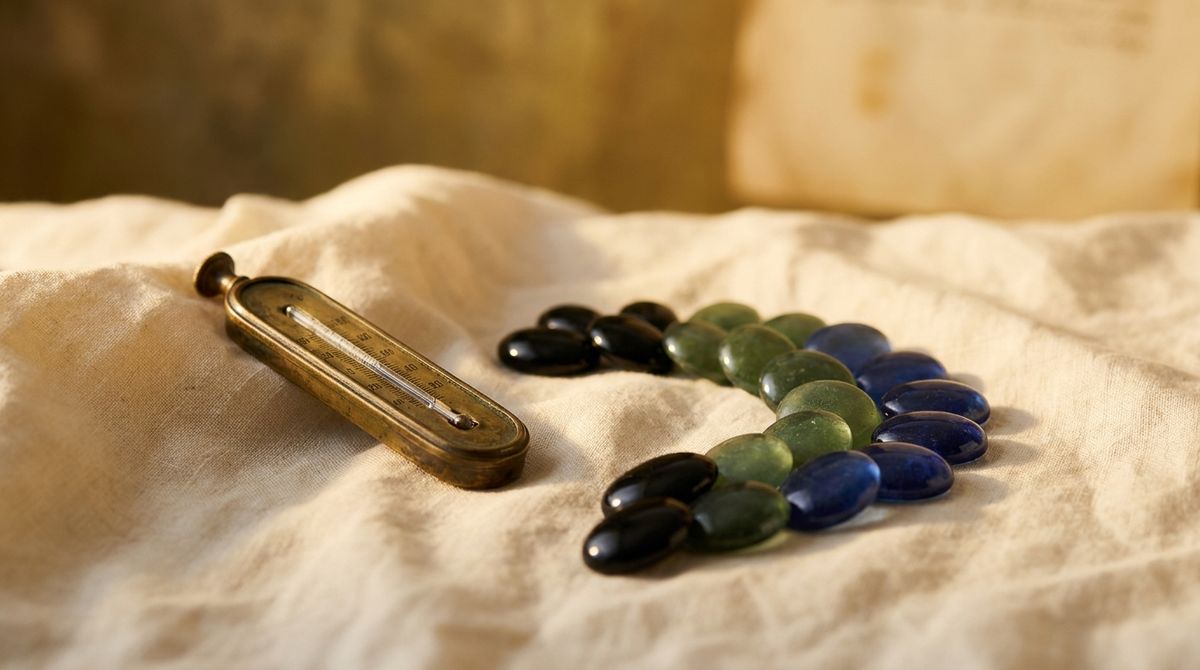
- Color progression: black at the cool end, moving through green and blue to deep blue as temperature rises
- Source: the compound behind the original mood ring, documented in its patent history, per Wikipedia's account of the 1975 invention
Finger temperature itself is driven mainly by peripheral blood flow, which narrows under stress, cold, or anxiety and widens when you are relaxed or warm — which is the real mechanism connecting the ring's color to anything resembling a "mood." It is a genuine physiological signal, just a blunter and less specific one than the marketing implies.
Mood Ring Color Meanings
The color chart popularized alongside mood rings in the 1970s is the version most people still reference today, even though — as the next section covers — it was never an industry standard:
- Black — stressed, tense, or anxious (sometimes listed as "amber" on some charts instead)
- Gray — nervous or overworked
- Brown / Amber — unsettled or mixed emotions
- Yellow — tense but active; a mind that is alert
- Green — calm and balanced — usually listed as the "neutral" resting color
- Blue — relaxed and at ease
- Dark blue / Violet — happy, passionate, or romantic
- Black-to-clear extremes — either very cold hands or, at the opposite end, overheated — read as stress regardless of the actual cause
Are Mood Ring Colors Actually Standardized?
No. This is the part most color charts leave out. Because manufacturers used different liquid-crystal formulations with different calibration points, two mood rings from two different brands can land on different colors at the exact same finger temperature. There has never been one universal color-to-emotion standard — the chart that circulates online is a popular convention, repeated because it is the version that shipped with the most mood rings historically, not because a lab verified it.
That does not make the ring meaningless as an object — it just means the "chart" is closer to a shared cultural reference (like what colors traditionally mean in flowers) than a calibrated instrument reading.
How to Tell If Your Mood Ring Is Real
Since fixed-color novelty rings are often sold under the same name, here is a quick way to check what you actually have:
- Cup the stone in your closed palm for 30–60 seconds — a real thermochromic stone will visibly shift color as your hand warms it
- Hold an ice cube near it (not touching) for a few seconds — a genuine stone should darken toward black or brown as it cools
- Check the underside of the stone for a slightly domed, glassy shell rather than a solid-colored cabochon — the liquid crystal needs a thin, light-permeable layer to work
- If the color never moves after both tests, it is a fixed-color fashion piece, not a functioning thermochromic mood ring
- Extreme heat (hot water, direct sun on metal) can permanently damage the crystal layer, so warm it with body heat only, never a heat source
Mood Rings in Jewelry Today
The mood ring's core idea — a piece of jewelry that visibly reflects something personal — is part of why color-coded jewelry has stayed popular well past the 1970s trend cycle. It shows up in the color logic behind gemstone color meanings and in newer pieces like friendship bracelets, where the colors carry their own coded meanings. A mood ring sits closer to novelty science than to symbolic jewelry like a pinky ring, but the appeal is related: jewelry that seems to say something about the person wearing it. For anyone drawn to that idea but wanting something with a fixed, chosen meaning instead of a temperature-dependent one, a personalized ring carries a meaning that does not change with the weather or your circulation — a name, a date, or a symbol you actually picked.
Frequently Asked Questions
Do mood rings actually detect emotions?
Not directly. They detect skin temperature, which is influenced by blood flow and can shift with stress, cold, or relaxation — factors that are related to mood but not the same as measuring it. Room temperature, recent exercise, or simply cold hands will change the color just as much as an emotional state will.
What does it mean when a mood ring turns black?
On most color charts, black is read as stress, tension, or anxiety, and on some charts it can also indicate the coldest end of the temperature range rather than a specific emotion. Since colors are not standardized across brands, check the chart that came with your specific ring if it included one.
Why did my mood ring stop changing color?
The liquid crystal layer degrades with age, and especially with exposure to heat above its calibrated range (hot water, direct sunlight on metal, a hot car). Once degraded, the crystal can lose its ability to shift color and settle permanently into one shade.
Is a mood ring the same as a birthstone?
No. A birthstone is a specific, fixed gemstone tied to a birth month by long-standing tradition. A mood ring uses a synthetic thermochromic material chosen for its temperature response, not a natural gemstone, and its color changes constantly rather than staying fixed.
What color is a mood ring supposed to be normally?
Green is the color most commonly listed as the "neutral" or baseline reading, corresponding to an average resting hand temperature, though the exact shade depends on the specific ring's calibration.