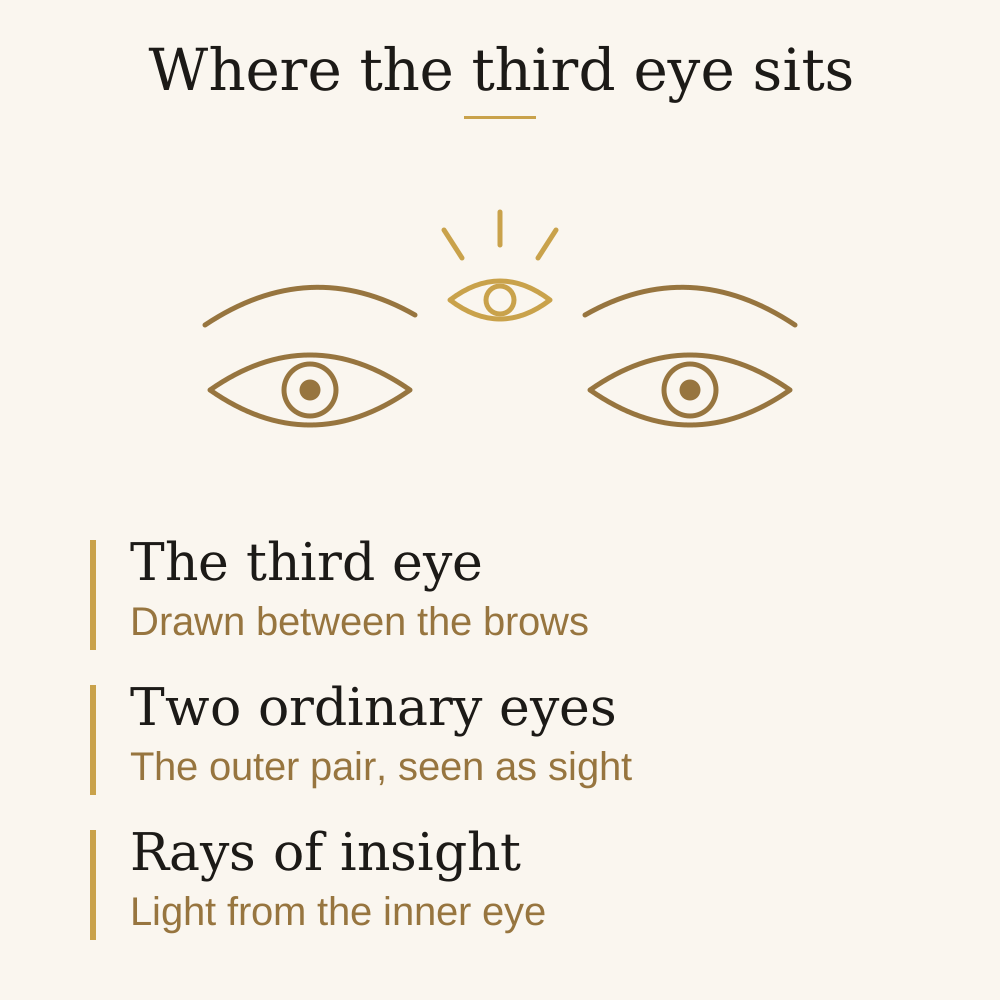
The third eye is an inner eye: a symbol of insight, intuition and spiritual perception, traditionally placed in the middle of the forehead, between the eyebrows. It comes mainly from Hindu and Buddhist traditions, where it appears as the ajna chakra and as the third eye of the god Shiva, and it is now widely used in modern spiritual language.
Below: what it means, where it comes from, how it is shown, a timeline of approximate dates, the link with the bindi, and how it differs from the evil eye and the Eye of Horus.
At a glance
- The third eye is traditionally a symbol of inner sight, intuition and wisdom, placed between the eyebrows.
- In Hindu and tantric tradition it is the ajna chakra, the sixth of the seven main energy centers, often drawn as a two-petaled lotus.
- The god Shiva is shown with a third eye on his forehead, and is called Trilochana, "the three-eyed".
- It is not the evil eye (a belief about envious looks) and not the Eye of Horus (an Egyptian protective amulet).
What does the third eye mean?
In short: seeing beyond the ordinary, with insight rather than with the eyes. In most traditions the third eye is not a physical organ but a symbol. It stands for awareness that goes past appearances, and for a calm, focused kind of attention. In modern usage it is often shorthand for intuition.
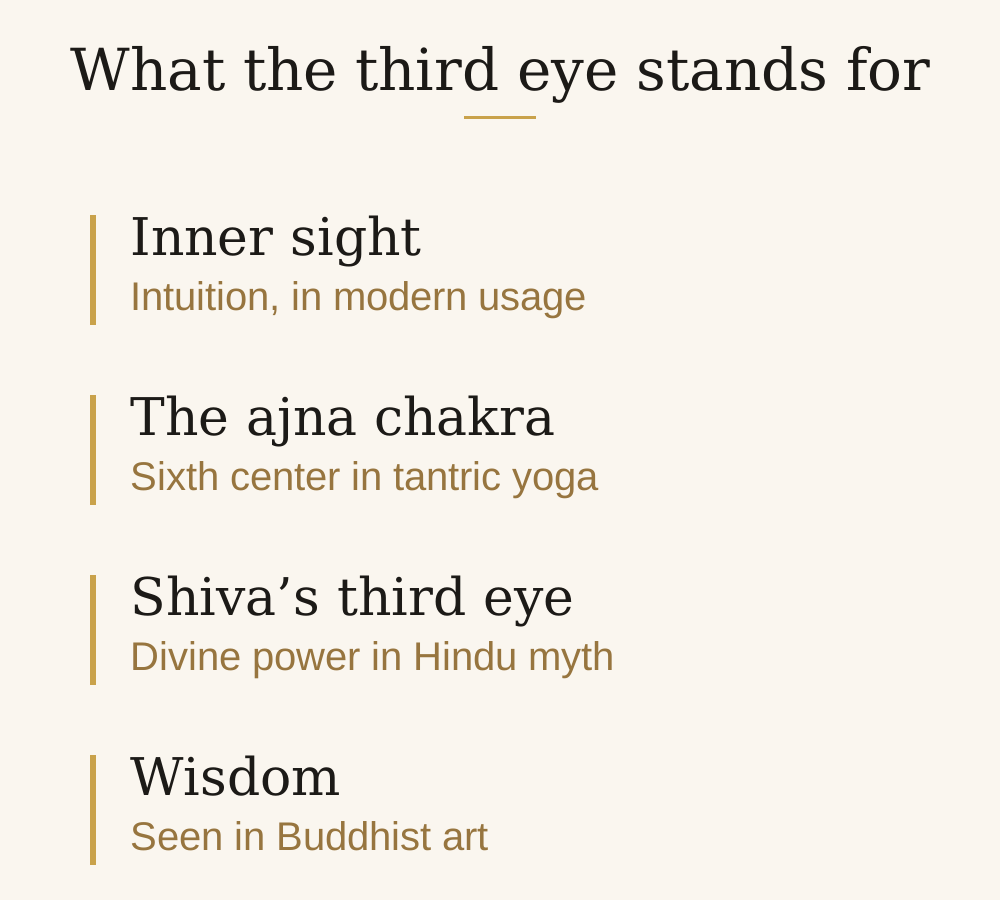
The details change with the tradition. In Hindu and tantric teaching it is tied to a particular point in the body and to a stage of spiritual practice. In stories of Shiva it is a sign of divine power. In Buddhist art it is read as wisdom. This guide presents each as tradition and belief, not as fact, and makes no medical claim of any kind.
The ajna chakra
In several Indian traditions, especially tantric and yogic ones, the body is described as having a series of energy centers called chakras, a Sanskrit word often translated as "wheel". Seven main centers are commonly listed, from the base of the spine to the top of the head. The ajna chakra is the sixth, placed between the eyebrows. The word ajna is often translated as "command" or "authority".
Traditionally, the ajna chakra is shown as a lotus with two petals. Different schools describe its color, its sound and its meaning a little differently. Many teachers link it with the syllable Om, and in many modern charts it is drawn in indigo, though that color is a later convention rather than an ancient rule.
The ajna point is also the place yogic and meditation traditions often name as a focus for attention, which is why the phrase "third eye" is so often paired with meditation. How a practice describes the experience depends on its own teaching, so we leave it there.
Shiva’s third eye
In Hindu tradition, Shiva is shown with a third eye in the middle of his forehead, set vertically above the two ordinary eyes. One of his names is Trilochana, meaning "three-eyed". Artists show it closed, half open or open, and the depiction varies from region to region.
The best-known story concerns Kama, the god of desire. In the retelling, Shiva is deep in meditation when Kama shoots an arrow at him to stir his heart. Shiva opens his third eye and Kama is burned to ashes. Many versions go on to restore Kama in some form, and accounts differ on how and why, so treat any single retelling as one version of a story told for centuries.
In this tradition the third eye is a sign of power, discernment and the ability to see through illusion. It is also associated with the destructive side of the divine, since a glance from it can end an age or reduce a thing to ash. Devotees read it as a reminder that insight can be as forceful as it is calm. Shiva is not the only deity shown this way, but he is the one most people picture.
In tradition, the third eye is a symbol of inner sight, not a part of the body.
The bindi and the tilak
Many people link the third eye with the dot worn between the eyebrows in South Asian cultures. The Sanskrit word bindu means "dot" or "drop", and the modern word bindi comes from it. A related mark, the tilak, is applied to the forehead in devotional settings and is worn by both men and women.
Traditionally, the bindi is worn mainly by Hindu women, historically in red, and it has social and cultural meanings that vary by community, from marking a married woman to simple decoration. Many people describe the spot as the same place as the ajna point, and some explain the dot as a mark of that inner eye. Not everyone who wears one gives it that reading, and it should not be assumed.
Today the bindi is also worn as fashion in many places. Views differ on whether it is respectful for people outside the tradition to wear one as an accessory, so if you are not sure, it helps to learn what it means to the community it comes from.
Buddhist imagery
Buddhism has its own related images. Traditional texts list the urna among the marks of a great being: a curl of white hair between the eyebrows, often shown in sculpture as a small dot or a jewel. It is a mark of the Buddha, and it is described differently from the Hindu third eye.
In some Tibetan and other Buddhist art, deities are painted with a third eye on the forehead, and this is commonly read as wisdom and the ability to perceive things as they are. Some wrathful figures are shown with it as well. Since Buddhist schools differ widely, the reading depends on the figure and the lineage.
The common thread across these images is a mark between the brows that points to a deeper kind of seeing.
Today it most often stands for intuition and a calm, attentive mind.
The third eye today
In modern spiritual language, "opening the third eye" usually means becoming more intuitive, aware or mindful. Western esoteric writers began using the phrase in the late 1800s and early 1900s, and it spread through yoga, meditation and New Age circles in the later 20th century. It has since entered everyday speech, where it is often used loosely and with a light touch.
Some modern writers connect the third eye with the pineal gland, a small gland in the brain. That link is a spiritual idea. It is not an established scientific or medical claim, and we do not treat it as one.
People also use the symbol in art, tattoos and design, where it often appears as an eye with rays, a single eye inside a triangle or lotus, or a simple eye on a forehead. Meanings in these uses are personal, and the wearer's reading matters most.
Third eye, evil eye and Eye of Horus
A few symbols are often mixed up, but they come from different places and do different things.
- Eye of Horus: an Egyptian protective amulet, the eye of the god Horus, tied to wholeness and restoration.
- Evil eye: a belief, found around the Mediterranean and Middle East, that an envious look can bring harm, and the blue eye charm worn against it.
- Hamsa: a hand-shaped protective charm that often has an eye at its center.
- Lotus: the flower pictured on the ajna chakra, with a long and separate history of its own.
The table puts them side by side.
| Symbol | What it shows | Traditionally read as |
|---|---|---|
| Third eye | A third eye between the eyebrows, or the ajna point | Inner sight, intuition and wisdom |
| Eye of Horus | A falcon-styled eye with a curved brow and a marking beneath | Protection and wholeness |
| Evil eye | A round eye, often blue, worn as a charm | Protection against envious looks |
| Hamsa | An open hand, often with an eye at the center | Protection and good fortune |
The simplest way to remember it: the evil eye charm and the Eye of Horus are worn to guard the wearer, while the third eye looks in and stands for awareness.
How people wear it
The third eye appears as a pendant, a ring, a bracelet charm or a tattoo. Many wearers choose it for yoga or meditation practice, as a reminder to stay present, or simply for the design. When choosing jewelry, look for a piece whose metal is described plainly, such as 316L stainless steel with a gold-plated, rose gold-plated or silver-tone plated finish, rather than vague "gold" or "silver" wording. Genuine stainless steel is nickel-safe.
Frequently Asked Questions
What does the third eye symbolize?
Traditionally it stands for inner sight: intuition, wisdom and awareness beyond ordinary seeing. In Hindu and tantric teaching it is the ajna chakra, in stories of Shiva it is a sign of divine power, and in Buddhist art it is commonly read as wisdom. Today it is often used as shorthand for intuition.
What is the third eye chakra?
In Hindu and tantric tradition, the ajna chakra is the sixth of the seven main chakras, placed between the eyebrows and often drawn as a lotus with two petals. Schools describe it a little differently, and it is presented here as tradition, not as a medical or scientific claim.
Why does Shiva have a third eye?
In Hindu tradition the third eye is a sign of Shiva's divine power and discernment. The best-known story tells of Shiva opening it to burn Kama, the god of desire, to ashes. Accounts differ on the details, and he is also called Trilochana, "the three-eyed".
Is the third eye the same as the evil eye?
No. The evil eye is a belief, found in the Mediterranean and Middle East, that an envious glance can cause harm, and the blue eye charm is worn to guard against it. The third eye is an inner eye of insight from Indian traditions. The two are unrelated in origin.
Is the bindi a third eye?
Not always. The bindi is worn at the same place as the ajna point, and many people describe it as marking that inner eye, but it also has social and cultural meanings that vary by community. Not everyone who wears one gives it that reading.
Is the third eye real?
The third eye is a symbolic and spiritual idea, not a physical organ. Some modern writers link it to the pineal gland, but that connection belongs to spiritual teaching and is not an established scientific or medical claim.