The Eye of Ra is the ancient Egyptian idea of the sun god's eye as a living, active force. Unlike a simple charm, it was imagined as a fierce goddess who could guard the sun god and punish his enemies, and who could also be calmed and brought home. Traditionally it stands for solar power, protection and royal authority.
Below: what the symbol means, the myth behind it, the cobra called the uraeus, a timeline of dated records, and how it differs from the Eye of Horus and the evil eye.
At a glance
- The Eye of Ra is the Egyptian sun god's eye, often personified as a goddess such as Hathor, Sekhmet or Tefnut.
- Its best-known myth has the eye turn destructive, then be calmed, so it stands for both fierce protection and return.
- The uraeus, the rearing cobra on royal crowns, is traditionally linked to it.
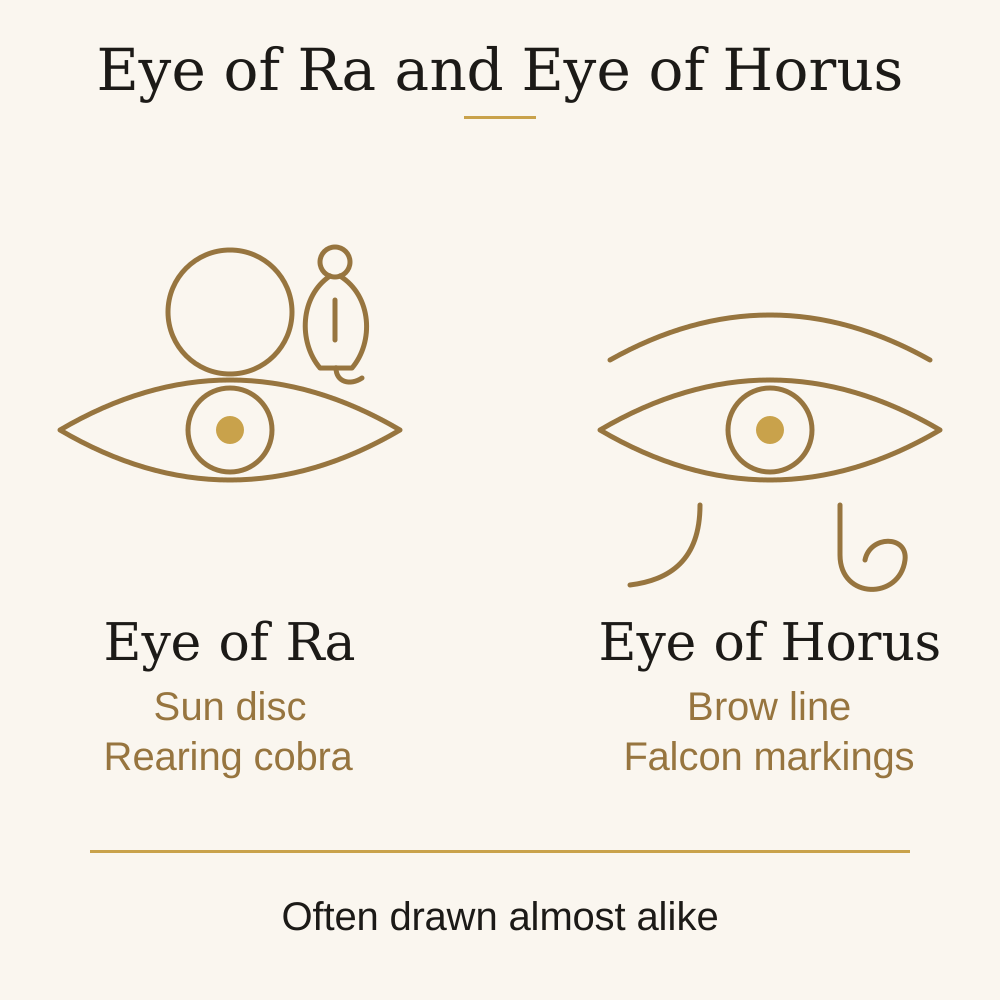
- It is separate from the Eye of Horus, though the two overlap and are often drawn alike.
What does the Eye of Ra mean?
In short: the sun's protective power. In Egyptian thought the sun god Ra had an "eye" that acted on his behalf. It could be sent out to guard him and subdue rebels, and it was often described with the heat and danger of the sun itself. Because it was personified as a goddess, the eye was not only a symbol but a character in stories.
This is ancient religious belief. We present it only as tradition, not as a promise of any effect.
The myth: the eye that left and came back
There is no single story. Several related tales are told, and some rest on scattered references. Two are best known.
The Destruction of Mankind. In this story, usually dated to the New Kingdom, humans rebel against Ra. He sends his eye, in the form of the goddess Hathor, who becomes Sekhmet (a lioness), to punish them. The slaughter goes too far, and Ra tricks the goddess by flooding the land with beer dyed red. She drinks it, becomes drunk and stops. Retellings vary on the details, so treat any one as a version.
The Distant Goddess. In another group of stories the eye becomes angry with Ra and runs away, leaving him weakened. She wanders in a far land, often named as Nubia, Libya or Punt, sometimes as a wild lioness. Gods such as Thoth, Shu or Anhur are said to coax her back with persuasion, music or celebration, depending on the version. The tale is sometimes linked to the Nile's yearly flood or to eclipses. Those are proposals, not settled conclusions.
How old is the symbol?
Egyptian texts name the Eye of Ra from early on, though the full myths are recorded later. The funerary texts of the Old Kingdom (c. 2686–2181 BCE) mention both the Eye of Horus and the Eye of Ra. Allusions to a myth about the eye appear in the coffin inscriptions of the Middle Kingdom (c. 2055–1650 BCE), and a religious text telling the Destruction of Mankind belongs to the New Kingdom (c. 1550–1070 BCE). A fuller account is found in a papyrus from around the 4th century BCE, and temple rituals celebrating the goddess's return were common in the Ptolemaic and Roman periods (c. 305 BCE–390 CE).
Which goddess is the Eye of Ra?
The Eye of Ra is a role, not one fixed goddess. Different temples and periods gave it to different deities, including Hathor, Sekhmet, Tefnut, Bastet and Mut, and also cobra goddesses such as Wadjet. That is why accounts differ about who "the" Eye is: several answers are correct for different places and times.
The uraeus: the cobra on the crown
The uraeus is the rearing cobra shown on the foreheads of pharaohs and gods. Traditionally it is the Eye of Ra in a protective, fire-spitting form, often drawn coiled around a sun disc. In one version of the myth the angry eye is calmed by being placed on Ra's forehead as a cobra. That link helps explain why the uraeus became a sign of royal authority and protection. Sekhmet is often shown with a sun disc and a uraeus on her head.
What the symbol stood for
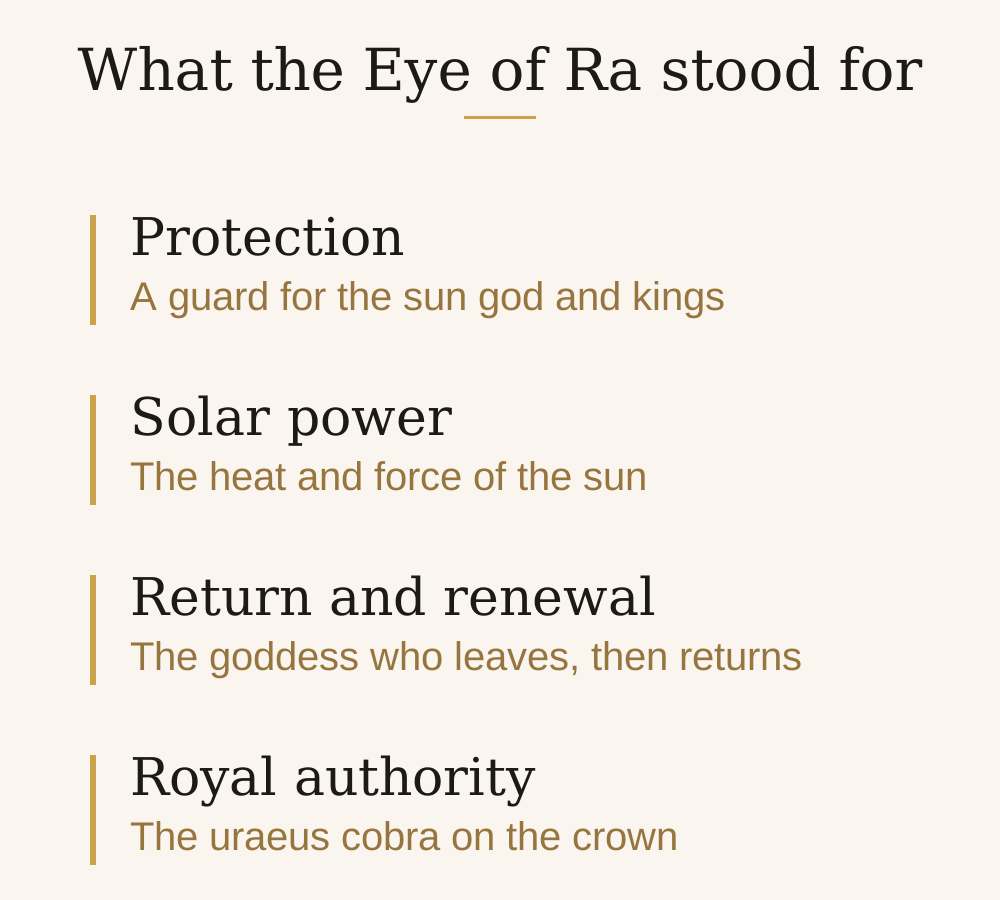
No single text lists every meaning, but across Egyptian religion the Eye of Ra points the same way:
- Protection — the eye as a guard of the sun god, and by extension of kings.
- Solar power — heat, light and the force of the sun.
- Return and renewal — the story of the goddess who leaves and is brought home.
- Royal authority — through the uraeus worn on the crown.
Eye of Ra vs. Eye of Horus vs. evil eye
These three share one word, "eye", but come from different ideas.
- Eye of Ra: the sun god's eye, a fierce goddess and protector, tied to the sun and the uraeus.
- Eye of Horus: the restored eye of the god Horus, tied to wholeness and healing in myth, and in some accounts to the moon.
- Evil eye: a Mediterranean and Middle Eastern belief in harm caused by envy, answered by a blue-and-white eye charm. It is not Egyptian.
The first two are closely related, and it is not fully agreed how. The Egyptians sometimes called the moon eye the Eye of Horus and the sun eye the Eye of Ra. One view sees the two gradually becoming distinct, while another holds that no text ties the Horus eyes to the sun and moon until late. Both are described as wedjat-type eyes, and the same motif of a lost and restored eye runs through both stories.
| Eye of Ra | Eye of Horus | Evil eye | |
|---|---|---|---|
| Origin | Ancient Egypt | Ancient Egypt | Mediterranean, Middle East |
| Belongs to | The sun god Ra | The god Horus | Folk belief, no god |
| Linked to | Sun, uraeus, goddesses | Moon (in some accounts) | Envy |
| Stands for | Solar power, protection | Wholeness, protection | Warding off harm |
| Usual look | Eye, sun disc, cobra | Eye with brow and falcon marks | Blue-and-white eye |
Because Egyptian artists often drew the two Egyptian eyes in almost the same way, context and added details, such as a sun disc or a cobra, are what usually tell them apart. For a related sun symbol from the same world, see the scarab, and for a protective symbol of life, the ankh. The pairing of sun and moon more broadly is covered in sun and moon meaning.
How people wear it today
The Eye of Ra is worn as a pendant, ring or tattoo, usually for protection, an interest in Egyptian history, or the look of the design. Some modern pieces sell a plain Eye of Horus under the name "Eye of Ra", and some designs combine the eye with a sun disc or cobra, so it is worth knowing the difference. Some wearers choose it as a quiet sign of strength and watchfulness. When choosing jewelry, look for a piece whose metal is described plainly, such as 316L stainless steel with a gold-plated, rose gold-plated or silver-tone plated finish, rather than vague "gold" or "silver" wording. Genuine stainless steel is nickel-safe.
Frequently Asked Questions
What does the Eye of Ra symbolize?
Traditionally, the sun god's protective power, along with solar force and royal authority. In myth it is a fierce goddess who can also be calmed and brought home.
What is the difference between the Eye of Ra and the Eye of Horus?
The Eye of Ra belongs to the sun god Ra and is tied to the sun and the uraeus cobra. The Eye of Horus is the restored eye of Horus, tied to wholeness and, in some accounts, the moon. They overlap, and it is debated how they separated.
Which goddess is the Eye of Ra?
No single one. Hathor, Sekhmet, Tefnut, Bastet, Mut and others each took the role in different temples and periods.
What is the uraeus?
The rearing cobra worn on the brow of pharaohs and gods. Traditionally it is the Eye of Ra in a protective, fire-spitting form, and it became a sign of royal authority.
Is the Eye of Ra the same as the evil eye?
No. The evil eye is a Mediterranean and Middle Eastern belief about harm caused by envy, and has no link to Ra. The Eye of Ra is an Egyptian religious idea.