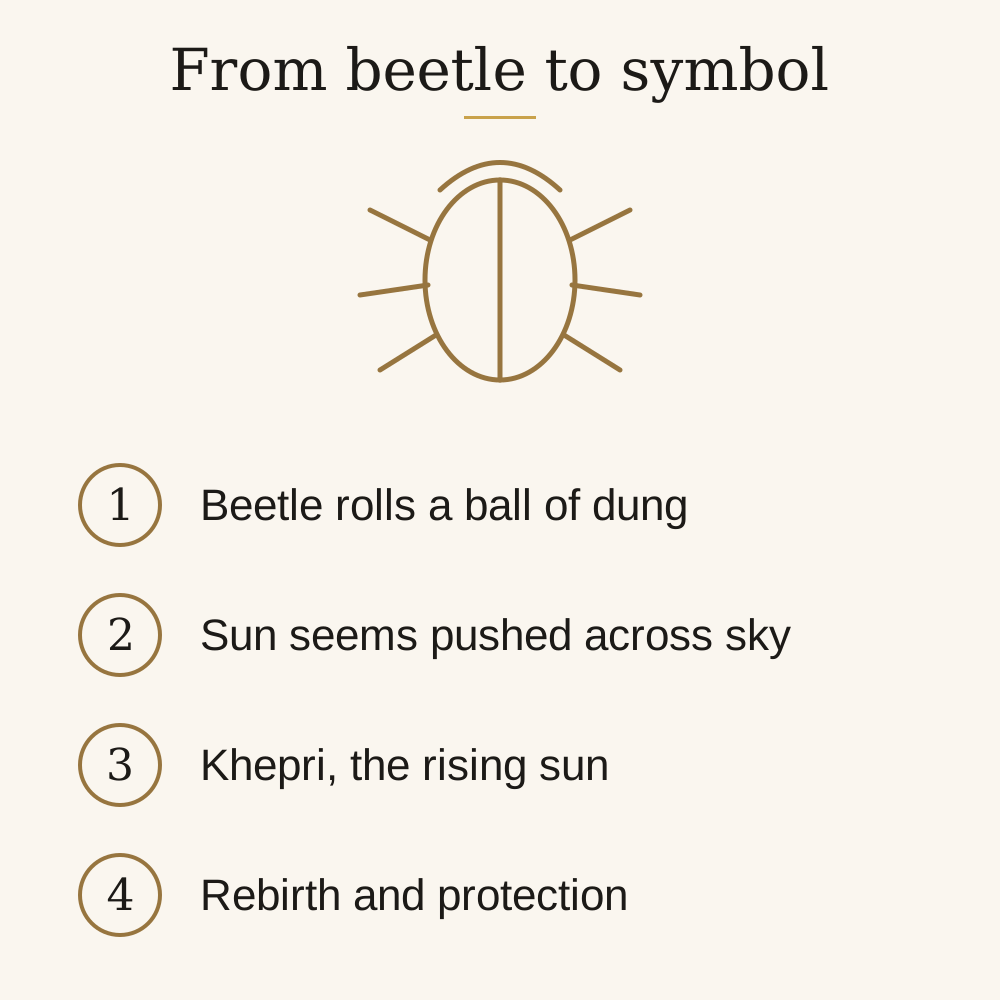
The scarab is the dung beetle that ancient Egyptians turned into one of their most lasting symbols. Because the beetle rolls a ball of dung across the ground, Egyptians connected it with the sun being pushed across the sky, and so with rebirth, renewal and protection. The scarab was carved as an amulet, a seal and a funeral charm for thousands of years.
Below: what the scarab means, the god Khepri, heart scarabs, a timeline of dated examples, and how it differs from other Egyptian symbols.
At a glance
- The scarab is an Egyptian symbol of rebirth, renewal and protection, based on the dung beetle.
- It is tied to Khepri, the god of the rising sun, whose name is linked to the word for "come into being".
- Heart scarabs were placed on mummies with a spell asking the heart not to speak against the dead.
- Scarab amulets and seals are known across roughly two thousand years or more.
What does the scarab beetle mean?
In short: rebirth, transformation and the renewal of the sun. Egyptians watched the beetle roll its ball of dung and, in some traditions, believed new beetles appeared from it. That seemed to echo the sun's daily return at dawn. For that reason the scarab came to stand for new life, and it was worn or buried as a protective charm.
This is ancient belief. We present it only as tradition, not as a promise of any effect.
Khepri, the scarab and the rising sun
The scarab is closely tied to Khepri, an Egyptian god of the rising sun, usually shown as a man with a beetle for a head, or simply as a beetle. His name is connected to a verb meaning "to come into being" or "to become," which fits the idea of morning renewal.
In sun imagery, Khepri is the sun at dawn, while the sun at midday and evening are linked with other forms of the sun god. Some texts show him pushing the sun disk into the sky like a giant beetle. Details differ between periods and texts, so treat any one telling as one version.
Heart scarabs and the afterlife
One of the best-known uses of the scarab is the heart scarab: a large scarab, often of green stone, placed on the chest of a mummy. In Egyptian belief, the heart was weighed in the afterlife, and the scarab was inscribed with a spell from the Book of the Dead (usually called Spell 30B) asking the heart not to testify against its owner.
Heart scarabs are described as a funerary amulet meant to protect and help the deceased be reborn through the sun's cycle. They are known from the Second Intermediate Period onward, though dates for the very earliest examples vary.
How old are scarab amulets?
Scarabs were used in more than one way. They were seals pressed into clay, amulets worn on the body, and funeral objects. Scarab seals are placed widely in the Middle Kingdom, and heart scarabs from roughly 1750 to 500 BCE.
What the scarab stood for
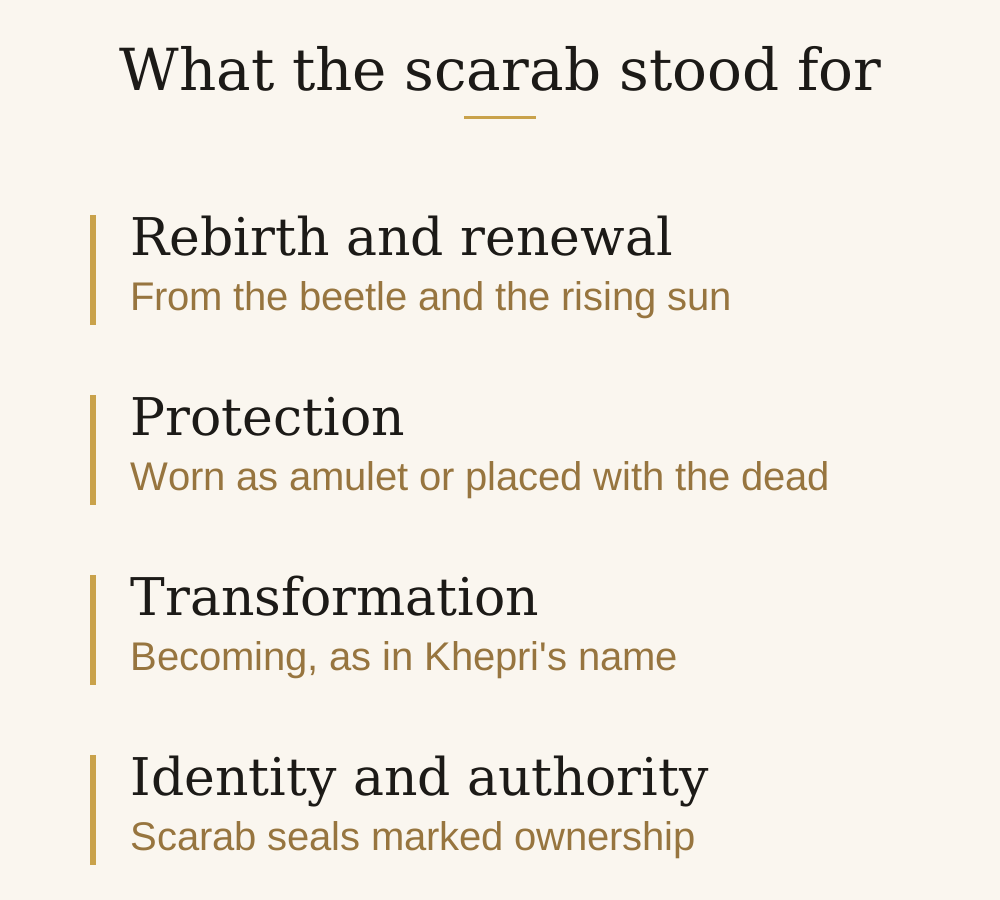
No single text lists every meaning, but across Egyptian art the scarab points the same way:
- Rebirth and renewal — from the beetle and the rising sun.
- Protection — worn as an amulet or placed with the dead.
- Transformation — the idea of "becoming," as in Khepri's name.
- Identity and authority — scarab seals were used to mark ownership.
Beyond Egypt
Scarab designs spread around the Mediterranean through trade. Phoenician and Greek craftsmen made scarab-shaped gems, and the beetle shape reached the wider ancient world. In the 19th and 20th centuries, the scarab returned as a fashionable motif in Egyptian Revival jewelry, and it is still used that way today.
Often confused with
These symbols all come from Egypt or a similar world, but each stands for something different.
- Ankh: a loop-topped cross meaning "life".
- Eye of Horus: a protective eye from the myth of Horus and Set.
- Ouroboros: a snake eating its tail, a separate symbol of cycles, from a different tradition.
- Other beetles. Ordinary jewelry beetles, such as a ladybug, are not Egyptian and carry different, folk-luck meanings.
The table puts the scarab beside the symbols it is most often grouped with.
| Symbol | Shape | Stands for |
|---|---|---|
| Scarab | Dung beetle | Rebirth, renewal and protection |
| Ankh | Loop-topped cross | Life |
| Eye of Horus | Protective eye | Protection, from the myth of Horus and Set |
| Ouroboros | Snake eating its tail | Cycles, from a different tradition |
How people wear it today
The scarab is worn as a pendant, ring, bracelet charm or tattoo, for rebirth after change, protection, or an interest in Egyptian history and design. Some wearers like it as a quiet sign of a fresh start. When choosing jewelry, look for a piece whose metal is described plainly, such as 316L stainless steel with a gold-plated, rose gold-plated or silver-tone plated finish, rather than vague "gold" or "silver" wording. Genuine stainless steel is nickel-safe, which is what helps with sensitive skin.
Frequently Asked Questions
What does a scarab beetle symbolize?
Traditionally, rebirth, renewal and protection. In ancient Egypt it was linked to the rising sun and the god Khepri.
What is a heart scarab?
A large scarab amulet, often green stone, placed on a mummy's chest. It carried a spell from the Book of the Dead asking the heart not to speak against its owner in the afterlife.
Who is Khepri?
Khepri is the Egyptian god of the rising sun, shown as a beetle or a man with a beetle's head. His name is connected to the idea of "coming into being."
Is the scarab a symbol of good luck?
In ancient Egypt it was mainly a symbol of rebirth and protection. In modern jewelry it is often called a luck charm, but that is a later, popular meaning.
How old are scarab amulets?
Scarab amulets and heart scarabs from roughly 1750 BCE through the Late Period, around 500 BCE, and scarab seals appear earlier still. Exact dates vary.
Is it disrespectful to wear a scarab?
Ancient Egyptian religion is no longer practiced in its original form, and wearing a scarab is generally seen as an appreciation of the history. It is worth knowing what it meant.