A black ring doesn't have one meaning — it has several, and they don't agree with each other. Search for "black ring meaning" and you'll find it described as a mourning symbol, a quiet signal of asexual identity, a mark of rebellion, and simply a minimalist style choice, sometimes all on the same page.
None of that makes the question unanswerable — it just means the honest answer depends on which finger, which hand, and which community is doing the reading. Here's what's actually documented, what's internet folklore repeated until it sounds official, and how to tell the difference.
At a glance:
- Only one meaning is actually documented — a black ring on the right hand's middle finger as an asexual-identity convention from AVEN forums.
- Everything else — power, rebellion, "unavailable," mourning's modern echo — is folklore or retail copy, not an agreed code.
- Victorian mourning jewelry is the oldest documented use of black in rings, centuries before any finger-specific claim.
- Material matters more than symbolism for daily wear — black ceramic and black-plated 316L stainless steel hold color far longer than thin base-metal plating.
What a Black Ring Is Said to Symbolize, Generally
Strip away finger- and hand-specific claims and a few broad themes show up again and again in both jewelry retail copy and folklore sites. Power, mystery, and independence are the most common — the logic is almost always about the color itself: black reads as bold, authoritative, and deliberately unconventional next to the gold and silver most rings come in.
A second theme is rebellion or nonconformity, often aimed at the idea of wearing a ring with no romantic or marital meaning attached to it at all. That's itself a kind of statement in a culture where ring-wearing defaults to signaling a relationship status.
A third, quieter theme is simply minimalism. Black-finished rings — black-plated metal, black ceramic, matte black tungsten — have become a mainstream menswear and unisex staple over the last decade purely because black is easy to match with anything else someone wears, no symbolism required.
Treat all three of these as plausible readings in circulation, not a settled code. Unlike, say, a wedding band's placement, there's no single authority that assigned the color black this meaning.
The Asexual Pride Meaning
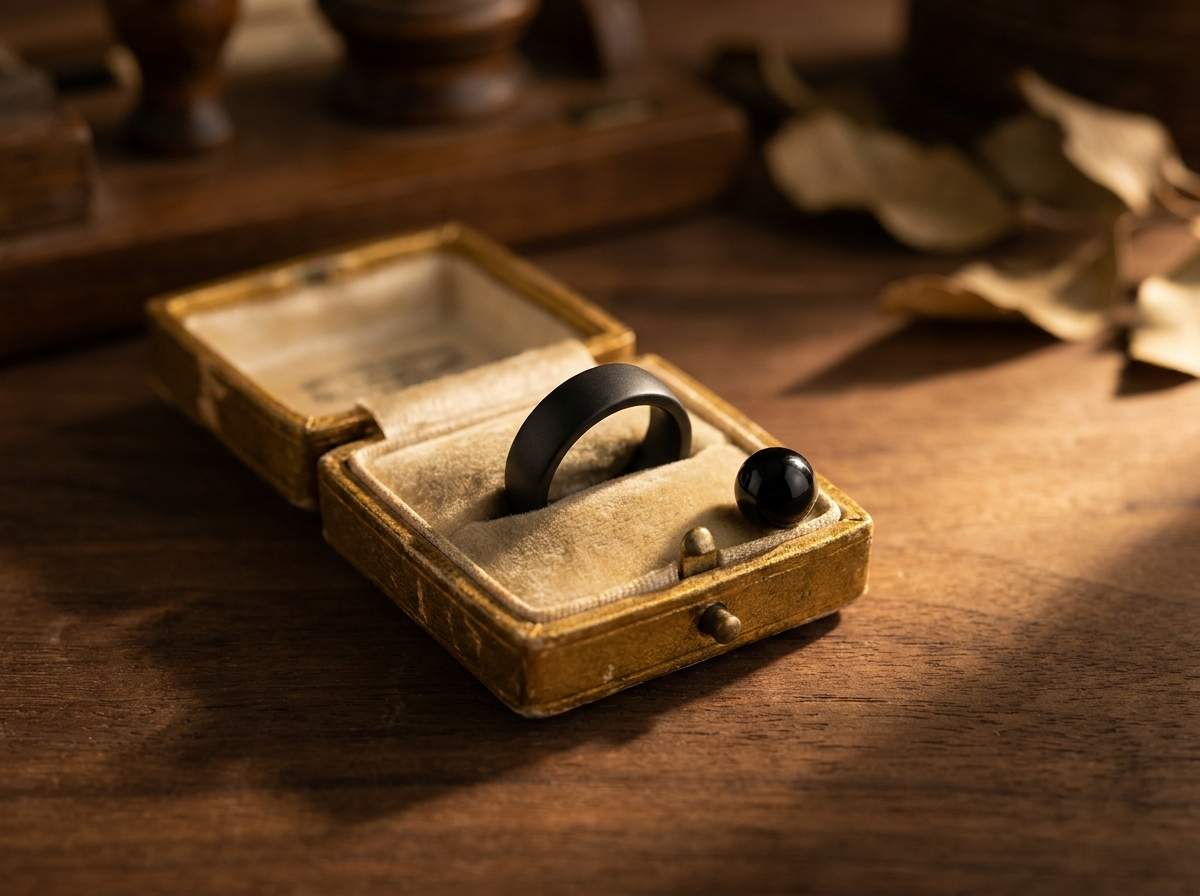
One use of the black ring has a documented origin. A black ring worn on the middle finger of the right hand has been used since the early-to-mid 2010s as a low-key identifier within the asexual community.
It's a way for people on the asexual spectrum to recognize each other without announcing anything to people outside the community. The convention traces to discussion on the Asexual Visibility and Education Network (AVEN) forums.
Members there looked for something unobtrusive enough to wear anywhere, and a plain black ring suited that need: it doesn't look symbolic to anyone who doesn't already know what to look for.
What it isn't is a universal rule everyone in the community follows, or something you can read off a stranger's hand with confidence. It's an informal, grassroots convention rather than an officially codified symbol.
Plenty of asexual people don't wear one at all, and plenty of people wearing a black ring on their right middle finger have never heard of the association. It's real, it's documented, and also quieter and less fixed than secondhand summaries tend to suggest.
By Finger and Hand: How the Reading Changes
Search demand for this topic is dominated by finger- and hand-specific questions — "black ring on right hand meaning," "black ring on middle finger," "black ring on index finger meaning." That tells you most people asking aren't curious about black rings in the abstract — they're trying to decode a specific one.
None of the claims below come from one agreed-upon source — read them as readings in circulation, not fact:
- Right hand, middle finger: the asexual-identity convention above — the most consistently documented placement-specific meaning on this list.
- Right hand, general: folk readings lean toward outward confidence, assertiveness, or "doing" energy, mirroring the general right-hand-as-active-hand convention used for a lot of ring symbolism.
- Left hand, general: more often tied to introspection, emotional protection, or — when worn on the ring finger specifically — sometimes read online as signaling "unavailable" or "not interested," a claim that is popular but has no fixed cultural authority behind it.
- Index finger: commonly framed in style and folklore sources as leadership or authority, continuing a much older association between the index finger and signet-ring status symbolism.
- Thumb: gets folded into the same independence-and-nonconformity reading as thumb rings generally, with the black color read as intensifying that statement rather than adding a new one.
- Pinky: inherits the pinky's own long status history — see our pinky ring meaning guide — with black specifically sometimes read as a more serious, less flashy alternative to a gold pinky signet.
Mourning, Military, and Other Older Uses
Before any of the modern readings above, black jewelry had a well-documented, centuries-old job: mourning. Victorian-era mourning jewelry used jet, onyx, black enamel, and vulcanite specifically because black was the prescribed color of grief under the era's strict mourning etiquette.
A black ring was one of the plainer, more wearable ways to observe it. That tradition has mostly faded as formal mourning dress codes relaxed, but it's the deepest-rooted documented meaning a black ring carries — older than any of the finger-specific folk claims above.

A looser, much less standardized claim shows up around military and veteran contexts, where some wearers describe a black ring as a personal marker of service or remembrance.
Unlike the mourning tradition, this isn't tied to one specific documented convention. It reads more as individuals adopting the color's existing "serious, solemn" association for their own purpose than a recognized symbol with rules.
Is There a Universal Meaning?
No — and that's the most honest answer this topic has. A black ring's meaning depends on finger, hand, material, and who's doing the interpreting, with exactly one of the common claims — the asexual middle-finger convention — tracing to a documented community origin.
Everything else — power, rebellion, mourning's modern echo, "unavailable" on the left ring finger — is a mix of older tradition, retail-copy convergence, and internet folklore repeated confidently enough to sound settled.
If someone asks what your black ring means, the only fully accurate answer is: whatever you intend it to.
Choosing a Black Ring
Symbolism aside, a few practical things matter more once you're actually buying one:
- Material and how "black" is achieved: black-plated stainless steel and black ceramic both hold color far better than black-plated base metals, which can wear to a different color at the edges with daily friction. A genuine black gemstone — black onyx, black diamond, black spinel — is a different look entirely, with its own cost and durability profile.
- Durability for daily wear: a ring worn every day takes constant contact from hands, keys, and fabric. FARUZO's personalized rings plate over 316L stainless steel rather than a thin base-metal coating — nickel-safe and more resistant to the chipping that can turn a black-plated ring patchy within a year.
- Sizing: finger size varies more than people expect by hand, time of day, and temperature. If sizing is the main uncertainty, the ring size calculator — a print-at-home sizing strip — works the same way for any finger you're planning to wear it on.
- Engraving contrast: a dark band makes light-colored engraving fill or a polished engraved line stand out more than it would on a gold or silver base, which is worth factoring in if the ring is also meant to carry a name or date.
For a different finger with its own distinct history and symbolism, see our signet ring meaning guide.
Frequently Asked Questions
What does a black ring mean?
It depends entirely on finger, hand, and context. The most documented single meaning is a black ring worn on the right middle finger as an asexual-identity convention; beyond that, common readings include mystery, independence, a modern echo of mourning tradition, or simply a style choice with no symbolism attached.
Is a black ring an asexual symbol?
Yes, specifically on the right hand's middle finger — a grassroots convention that traces to discussion on AVEN (the Asexual Visibility and Education Network) forums in the early-to-mid 2010s. It's a real, documented community practice, but an informal one: not everyone who's asexual wears one, and not everyone wearing a black ring there knows the association.
Does the hand matter for a black ring's meaning?
Only for specific claims, not as a fixed rule. The right hand is more often read as active or assertive, the left as introspective or protective, but neither reading comes from a single agreed source the way the asexual middle-finger convention does.
Is wearing a black ring on the right hand a sign of being single?
That's a popular online claim, usually about the ring finger specifically, but it has no documented cultural authority behind it — treat it as internet folklore in circulation rather than an established code anyone is expected to know.
What's the most durable material for an everyday black ring?
Black-plated 316L stainless steel or black ceramic typically outlasts thinner black-plated base metals, which can wear unevenly at points of contact. A genuine black gemstone like black onyx or black spinel is a different, usually pricier, option with its own care needs.