Two Lights, One Sky
One rises as the other slips away. The sun burns gold at noon; the moon glows silver at midnight. They are never fully together, and never truly separate — two lights taking turns to keep the same sky. For as long as people have looked up, we have read that rhythm as a story about ourselves: about opposites that need each other, about two very different things that somehow make one whole.
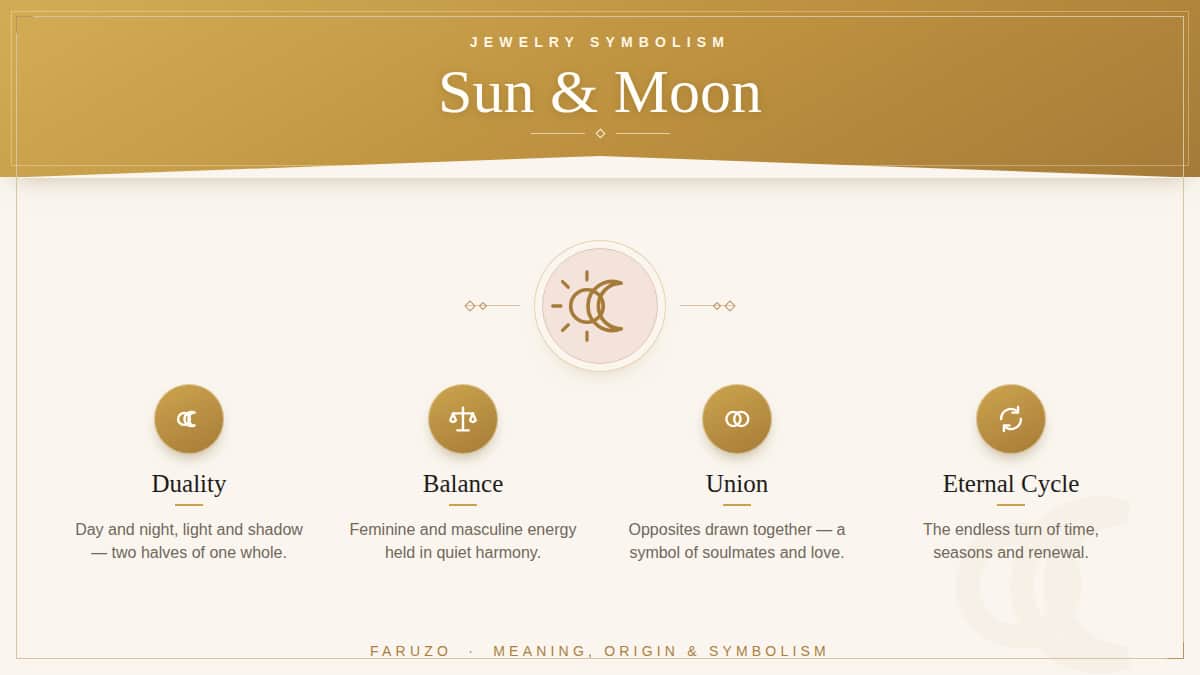
That is why the sun and moon, paired, has become one of the most beloved symbols in jewelry. Worn together it speaks of balance and unity. Worn apart, by two people, it says something quieter and more tender — that you can be different, even distant, and still belong to the same story.
The Oldest Pair: Day and Night
Before myth, before metaphor, the sun and moon were simply the two great clocks of human life. The sun governed the day, the harvest, the working hours; the moon governed the tides, the months, the dark. Our word month descends from the same ancient root as moon — the moon was humanity's first calendar, waxing and waning in a cycle we could count on. The sun gave us the day and the year.
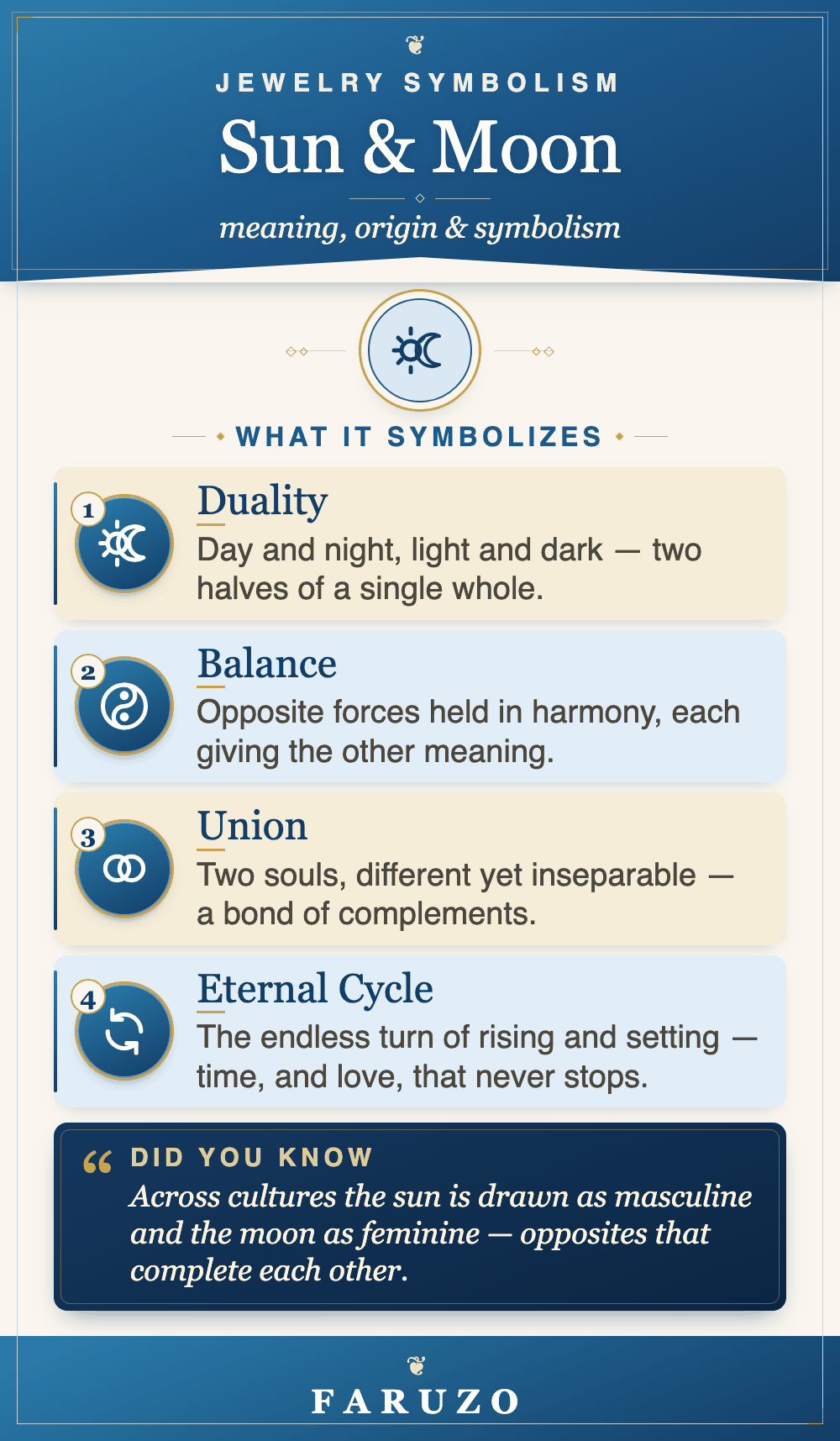
So the pair carries the whole span of experience: warmth and cool, waking and dreaming, effort and rest, the seen and the hidden. Neither is the whole picture. Day without night would scorch; night without day would freeze. The symbol holds both at once, insisting that light and shadow are not enemies but partners — each defining the other, each necessary.
Gods of the Sun and Moon
Nearly every culture gave the two lights faces. In Greek myth the sun was Helios and the moon Selene, radiant siblings who crossed the sky in turn — Selene famous for loving the mortal shepherd Endymion, watching over him as he slept. Later Greeks and Romans folded these roles into the twins Apollo and Artemis, born together yet forever linked to opposite lights: the golden archer of the sun, the silver huntress of the moon. Egypt honored the sun god Ra; Norse myth sent Sól and Máni fleeing across the heavens; Japan told of the sun goddess Amaterasu and her brother, the moon god Tsukuyomi, who parted ways in anger — which is why, the story goes, day and night are never seen together.
What recurs across all these traditions is kinship: sun and moon are almost always drawn as a pair — siblings, twins, lovers, rivals who cannot quit each other. Different temperaments, opposite hours, one bond. The mythologies disagree on the details, but they agree on the shape of the feeling.
Masculine, Feminine, and Everything Between
In the Greco-Roman tradition the sun reads masculine and the moon feminine, and much later symbolism inherited that pairing — the fiery, outward, active sun beside the cool, receptive, intuitive moon. Chinese thought frames the same balance as yang and yin: two complementary forces, light and dark, that are not opposites so much as halves of a single turning whole, each carrying a seed of the other.
But it is worth being honest that the gendering isn't fixed. In Germanic and Norse cultures the sun, Sól, is female and the moon, Máni, is male — the reverse of the classical scheme. That flexibility is part of the symbol's quiet wisdom. It was never really about men and women. It is about difference itself: two natures, warm and cool, bold and gentle, that fit precisely because they are not the same.
"To the Moon and Back"
The moon has always been love's favorite distance. It is the farthest bright thing we can see, and so it became our unit of measure for feeling too large for words. The phrase we all know — "I love you to the moon and back" — was popularized by Sam McBratney's 1994 children's book Guess How Much I Love You, where a little hare reaches for the biggest love he can imagine. What began as a bedtime line has become shorthand for devotion that goes the whole impossible distance and returns.
That is what makes the sun-and-moon pairing so fitting for long-distance love and for friendship stretched across miles. The two are rarely in the same sky at the same moment, yet they orbit the same earth, keep the same watch, belong to the same night and day. To carry the sun while someone you love carries the moon is to say: we may be apart, on different schedules, in different time zones — and we are still one system, still circling each other.
Balance and the Spiritual Meaning
Beyond romance, the sun and moon together is one of the clearest emblems of inner balance. The sun is the part of us that acts, speaks, and shines outward; the moon is the part that reflects, feels, and turns inward. A life tilted entirely toward one becomes exhausting or unmoored. Wearing both is a small daily reminder to honor the whole of yourself — the doing and the being, the giving and the receiving.
This is why the motif appears so often as a talisman of harmony and, for many, of good fortune. It doesn't promise that the hard days vanish. It promises something steadier: that shadow and light take turns, that after every night a morning is owed, and that wholeness comes not from choosing a side but from holding both.
Worn Apart, Belonging Together
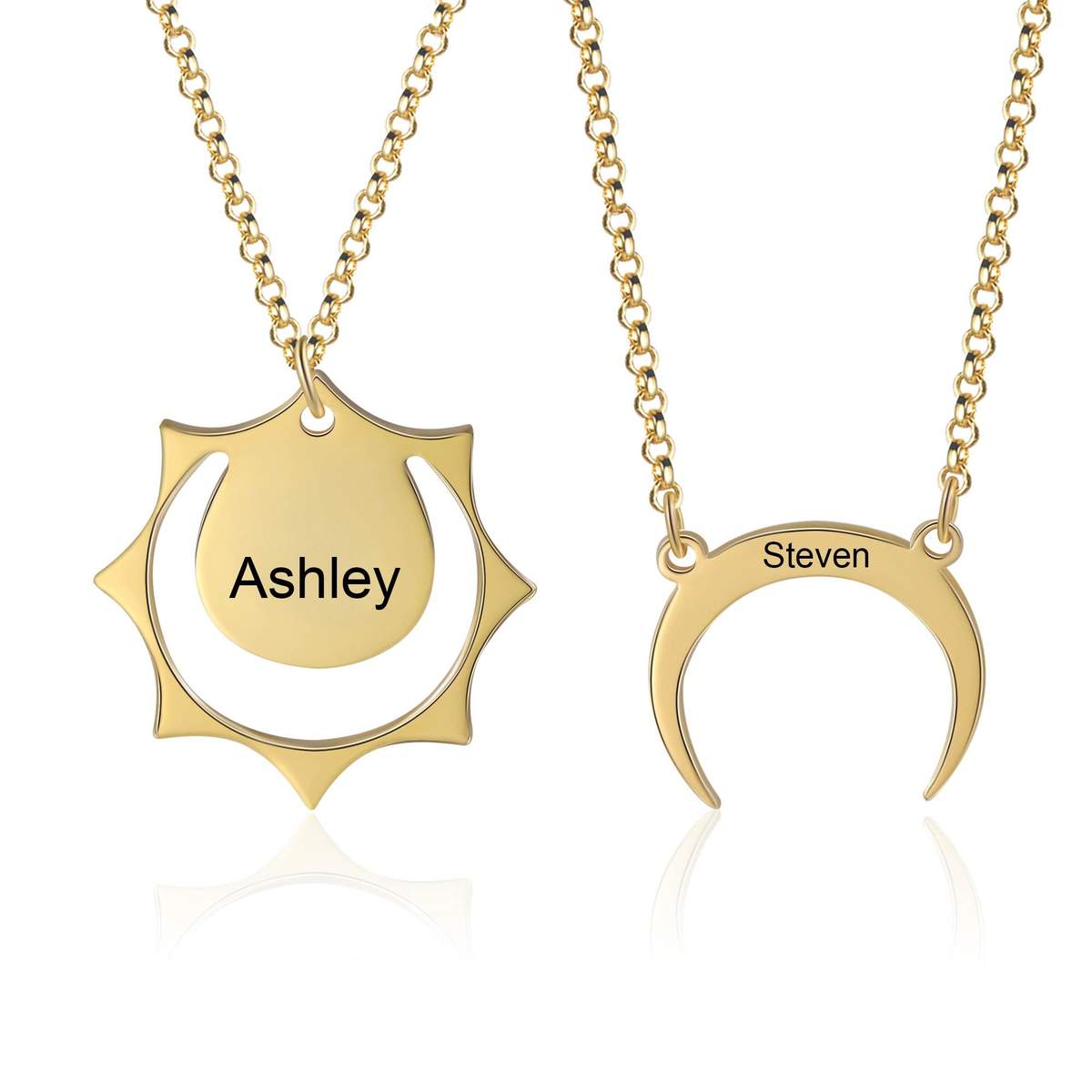
A symbol this much about pairs almost asks to be shared. That is the idea behind matching Sun and Moon Friendship Necklaces — one pendant is the sun, the other the moon, and the set is meant to be divided between two people. One wears the sun; the other wears the moon. Sisters, best friends, a couple keeping love across a distance, a mother and daughter — each carries half of the same sky.
There is something disarming about splitting a symbol on purpose. Apart, each necklace is complete and lovely on its own. Together, they finish a picture. It is a way of saying you are my other light without saying anything at all — a private constant you can wear under a collar on an ordinary Tuesday and feel the pull of, wherever the other person happens to be standing.
A Pact You Can Wear
To give someone the moon while you keep the sun — or the other way around — is to make a small, wearable promise. Not a loud one. Just the daily, unglamorous fact of it: that you are thinking of each other, that difference is the point rather than the problem, that you are counting on the sky to bring you back around. It is a good gift precisely because it needs two people to mean what it means.
The sun and the moon never share the horizon for long, and they have never once lost each other. Maybe that is the whole quiet lesson of the symbol. Belonging has never required being in the same place. It only asks that, night after night and day after day, you keep faithfully rising — each of you a light the other can find.
Frequently Asked Questions
What does a sun and moon necklace symbolize?
A sun and moon necklace symbolizes duality and balance — the union of opposites like day and night, light and shadow, action and reflection. Shared between two people, it represents two different souls who belong together despite being apart, which is why it is popular for couples, friends, and long-distance relationships.
Is the sun and moon a good luck symbol?
Many cultures view the sun and moon together as a talisman of harmony and good fortune. Rather than promising that troubles disappear, it symbolizes the reassuring cycle that light always follows dark. That sense of restored balance is why people often wear it as a positive, protective emblem.
What does it mean when couples or friends wear matching sun and moon necklaces?
When two people split a sun and moon set — one wearing the sun, one the moon — it signifies that they are two halves of one whole. It says they can be different in nature, or physically apart, and still belong to the same story. It is a favorite for couples in long-distance relationships and for close friends and sisters.
What do the sun and moon mean in mythology?
Across mythologies the sun and moon are almost always a pair. Greek myth gave us Helios and Selene, and later the twins Apollo and Artemis; Japan told of the sun goddess Amaterasu and moon god Tsukuyomi. They are usually cast as siblings, twins, or lovers — different in temperament but eternally bound to each other.
Do the sun and moon represent masculine and feminine?
In Greek and Roman tradition the sun is masculine and the moon feminine, an association many later symbols inherited, echoed in the yang and yin balance of Chinese thought. But it isn't fixed — in Norse myth the sun is female and the moon male. At its heart the symbol is about complementary difference more than gender specifically.