Matching necklaces have a reputation problem: done badly, they read as a costume rather than a keepsake. Done well, they're one of the few gift categories that actually solves the hardest part of shopping for a couple — finding something that belongs to both people, not just one of them. Here's how to choose a set that reads as considered rather than matchy-matchy, what to actually engrave, and what to know before ordering for an anniversary or a long-distance reunion.
Why 'Matching' Doesn't Have to Mean Identical
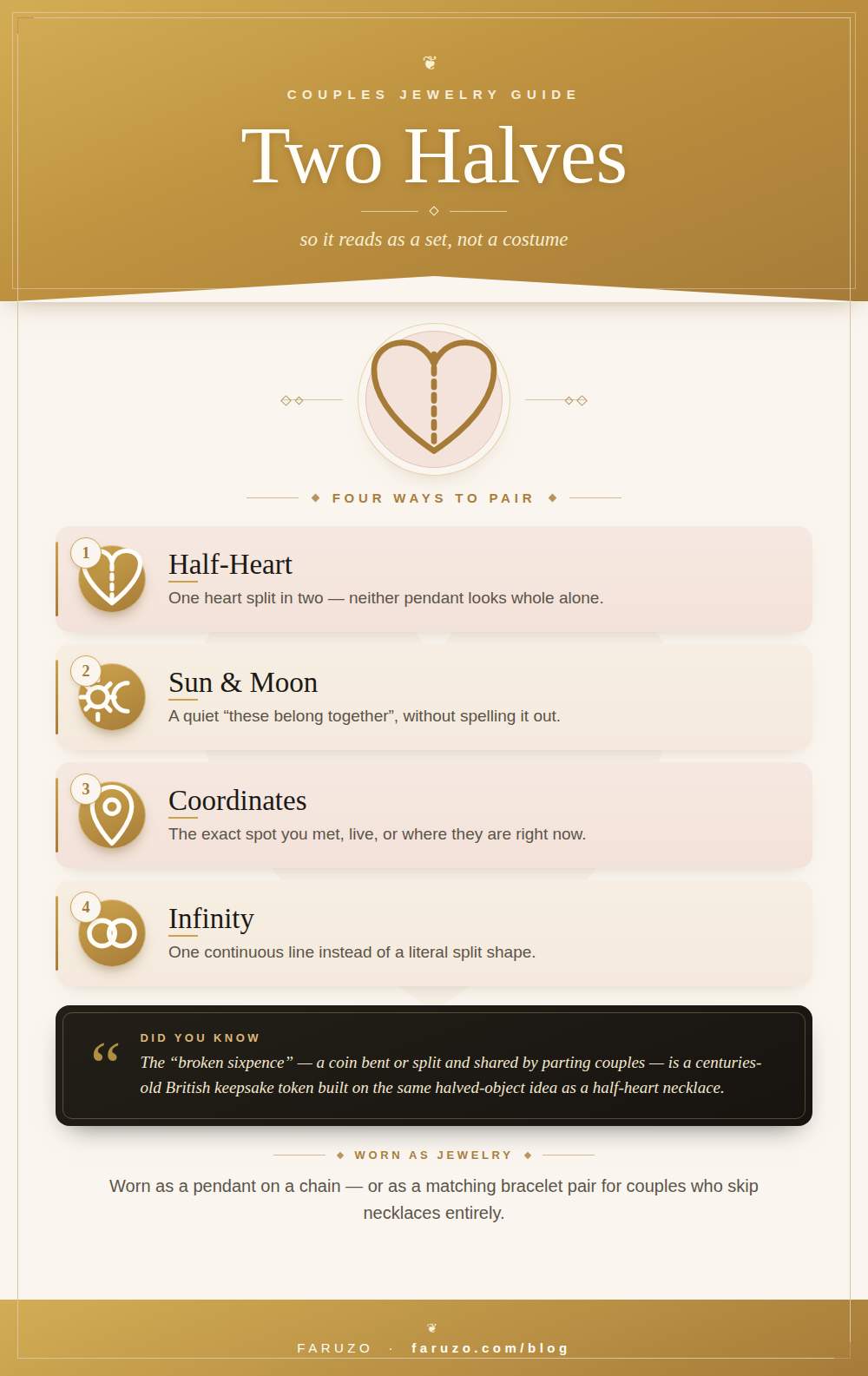
The sets that avoid looking try-hard are almost never two identical pendants — they're two halves of one idea. A half-heart necklace splits a single shape between two people, so neither pendant looks complete on its own; a sun-and-moon pair hints at 'these clearly belong together' without spelling it out; an infinity necklace made for couples leans on a symbol instead of a literal split shape. All three read as a considered pair rather than a uniform, because the two pieces are different objects that only make sense next to each other — not two copies of the same one.
Mixing Metals on Purpose
One of the simplest ways to keep a matching set from looking like a costume is to stop matching the metal, too. A gold half-heart pairs cleanly with a silver-tone one, or a rose gold pendant with a plain silver-tone chain — the shapes still read as one design even when the finishes don't match, the same logic covered in our guide to mixing metals. It also solves a real, common problem: most couples don't actually wear the same metal day to day, and forcing a match usually means one person wears their half less.
Built for Long-Distance More Than Anyone Else
Matching sets are ordered by long-distance couples more than almost any other jewelry category, and the logistics tend to work in their favor rather than against them — free shipping means a partner in one country and one in another pay nothing extra to have it delivered. Each piece is typically made to order, so it's worth building in a couple of weeks of lead time before a reunion, a deployment date, or a specific airport pickup rather than ordering the week of.
Some couples skip the shared-symbol approach entirely and engrave each other's coordinates instead — the latitude and longitude of wherever the other person actually is, rather than where they met. It turns the necklace into less of a couple's symbol and more of a two-way check-in: a glance down is a reminder of exactly where the other half of the set is standing.
What People Actually Engrave
Coordinate necklaces are the quiet favorite specifically because the options are personal rather than generic: the coordinates of where you met, where you got married, or your first home together, often paired with a name or date on the back. Half-heart and sun-and-moon styles more often carry initials or a single shared date. None of it needs to be elaborate — the smallest, most specific detail usually reads as more considered than a long inscription.
Timing an Anniversary Gift
A matching set works particularly well as an anniversary gift because it sidesteps the usual problem of picking 'his' gift and 'her' gift separately. Since each piece is generally made to order rather than pulled off a shelf, ordering with real lead time matters more here than with most jewelry — a rough two-week buffer before the date itself leaves comfortable room even with customization and shipping. For a broader look at what's traditionally given each year, our anniversary jewelry by year guide covers the milestones beyond just matching sets. If the ten-year mark is the one you're planning around, our 10th anniversary gift guide covers the tin-and-diamond tradition specifically.
If Neither of You Wears Necklaces
A pendant isn't the only way to do this. Couples who don't typically wear anything around the neck — or who want something less visible under a work shirt — tend toward a magnetic bracelet made for couples instead: the same paired-not-identical logic, just worn on the wrist. It solves the same problem (one gift for two people) without asking either person to change how they usually accessorize.
The half-heart logic itself also isn't limited to hearts. A half-heart necklace built specifically for couples and a butterfly-themed split pendant both use the identical idea — one shape, cut in two, each half meaningless without the other — just with a different motif for people who'd rather not wear a literal heart.
What Actually Makes a Set Feel Personal, Not Generic
The design choice (half-heart vs. sun-and-moon vs. coordinates) matters less than most people assume — what actually separates a considered gift from a generic one is almost always the engraving, not the shape. A coordinate necklace with the exact latitude and longitude of a specific bar, rather than just 'our city,' reads as personal; the same pendant with a vague, could-apply-to-anyone phrase doesn't. The shape is the vehicle; the specific detail engraved on it is what makes it about these two people and nobody else.
This is also where mixing metals earns its keep beyond aesthetics: a couple who splits a set into gold-for-him, rose-gold-for-her (or any other combination) is making a small, specific decision about how they each actually want to look, rather than defaulting to whatever the set ships in. Small, specific decisions are what read as thought-out — identical-and-generic is what reads as an afterthought.
Browsing Styles
The full range — half-heart, sun-and-moon, coordinate, and infinity styles, across gold, rose gold, gold plate, and silver tone — is easiest to compare directly in the couples necklace collection. For a pair that isn't a couple in the romantic sense — best friends or sisters splitting a shape the same way — the friendship necklace collection uses the same half-and-half logic without the romantic framing. For more pairing ideas beyond necklaces, browse our style & trends guides.
Frequently Asked Questions
Do matching necklaces have to be the exact same design?
No — the pairs that read best are usually two different but related pieces (a split half-heart, a sun paired with a moon) rather than two identical pendants. Identical tends to read more like a uniform; complementary reads like a pair.
Can each necklace in a set be a different metal?
Yes, and it's a common choice rather than a compromise — gold for one person and silver tone or rose gold for the other is a normal way couples split a set, and the shapes still visually pair up regardless of finish.
What should we actually engrave?
Something specific rather than generic tends to hold up better over time: coordinates of a real place, a date, or initials. Long-distance couples sometimes engrave each other's current city or coordinates instead of a shared one.
How far ahead should we order for an anniversary?
Because pieces are typically made to order rather than shipped from stock, building in roughly two weeks before the date gives comfortable room for crafting and delivery, including for international shipping.
Is a matching necklace only for romantic couples?
No — the same half-and-half design logic (a half-heart, a shared symbol split two ways) is just as commonly chosen by best friends or siblings, usually browsed under a separate friendship-necklace line rather than the couples one.