Walk past any jewelry counter this year and you'll see the same thing: necklaces that aren't a single pendant anymore, but a small cluster of charms — a star, a shell, an initial, a tiny lock — hung along one chain or stacked across a few. The charm necklace never fully went away, but it's back in a looser, more personal form than the matched "charm sets" of a decade ago. The problem most people run into isn't finding charms, it's that the necklace ends up looking like a junk drawer instead of a considered piece. There's a real difference between the two, and it comes down to a few decisions made before you add a single charm.
What Counts as a Charm Necklace (and What Doesn't)
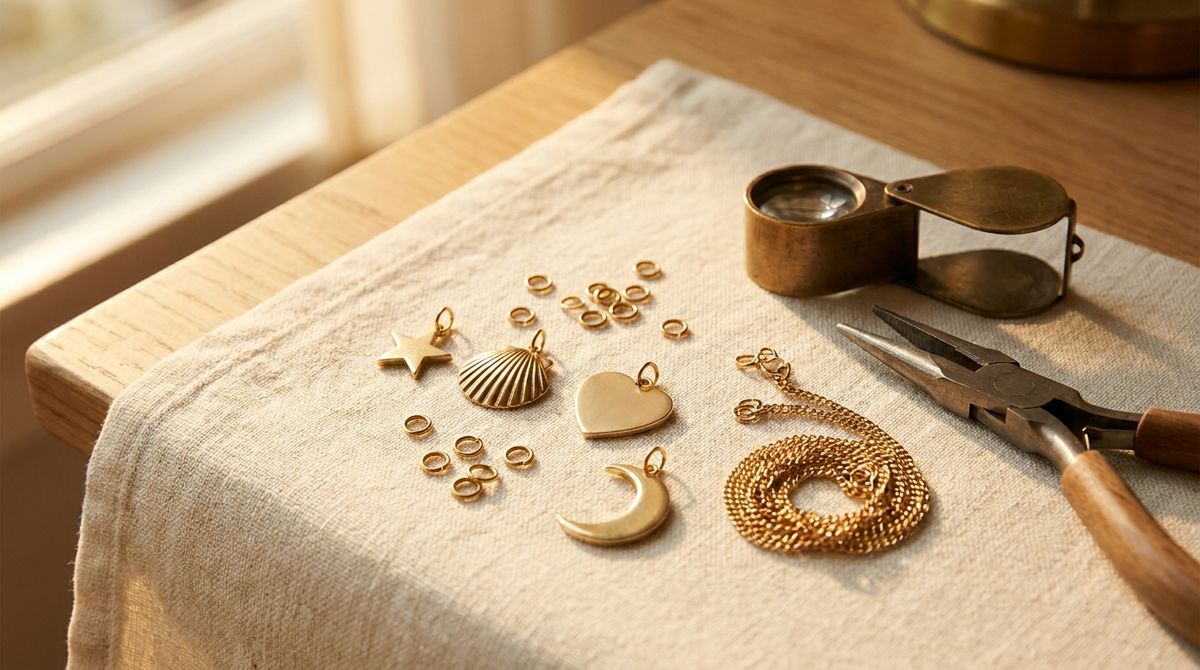
A charm necklace is any chain built to carry more than one small, meaningful object — as opposed to a single pendant necklace, which is designed around one fixed centerpiece. The charms themselves are usually attached with jump rings, either fixed in place or left to move and jingle slightly as the chain settles. That movement is part of the appeal: a charm necklace reads as collected over time, not manufactured as one finished object. A locket, by contrast, is a single enclosed charm that opens, and a medallion or coin necklace hangs one flat disc-shaped pendant rather than a cluster — related ideas, but each its own category of jewelry.
Why the Charm Necklace Is Having a Moment
Stylists and jewelry editors covering the trend tend to point to the same draw: a charm necklace lets someone build a piece that tells a specific story — a birth flower, a star sign, an initial, a souvenir from a trip — instead of buying something generic off a shelf. It also pairs naturally with the layered-necklace look that's been building for a few years, since a charm-heavy chain gives a layered stack texture and visual weight that a single thin chain can't. None of that is a measurable statistic worth citing as data — it's a styling trend, read off what's actually selling and what stylists are recommending, not a tracked market figure.
Charm Necklace vs. Charm Bracelet vs. Single Pendant Necklace
These three get confused constantly, mostly because all three can carry a "charm." The difference is where it sits and how many it's built to hold:
- Charm necklace — worn at the neckline, usually holds 2-6 charms along one chain or across 2-3 layered chains; charms are chosen to be seen together, as a set that reads from a short distance.
- Charm bracelet — worn at the wrist, traditionally holds more charms (5-15+) added one at a time over years, often as a milestone-gift tradition (a charm for each grandchild, each anniversary); seen close-up far more than a necklace is.
- Single pendant necklace — one fixed centerpiece, no jump-ring cluster, built around a single symbol, initial, or birthstone rather than a collected group.
How to Build a Charm Necklace That Doesn't Look Cluttered
The difference between "curated" and "cluttered" comes down to a handful of concrete choices, in roughly this order:
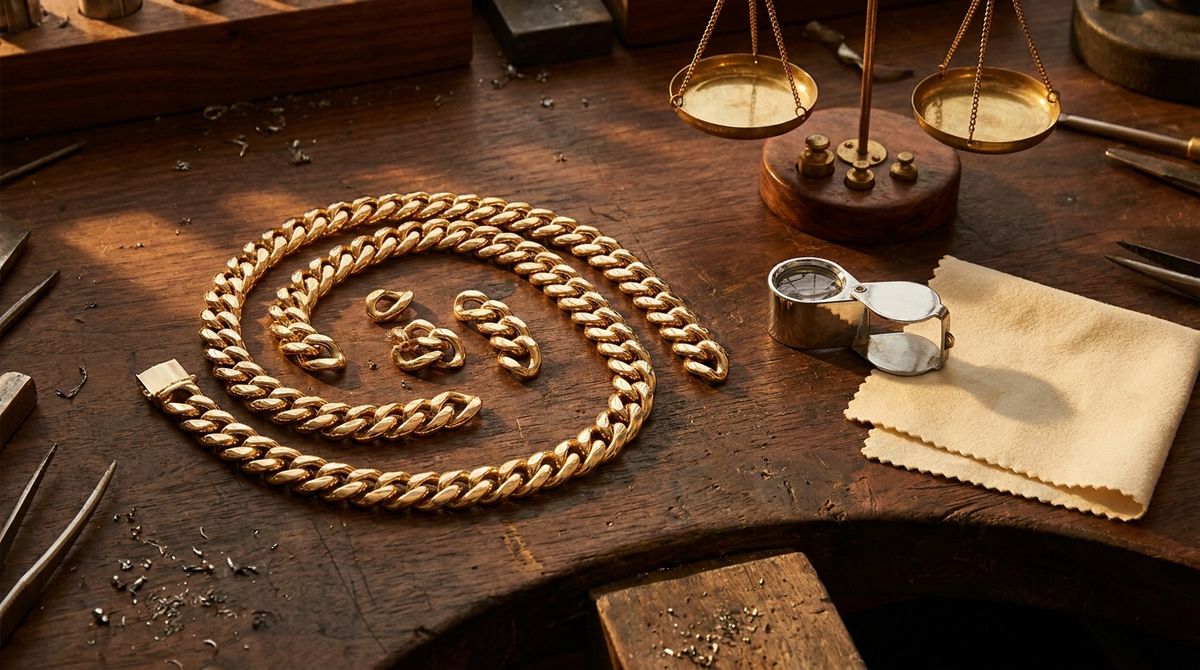
- Start with the base chain. Pick the chain first, before any charms — a slightly sturdier chain (a cable or curb link, not the finest hair-thin chain) holds the weight of multiple charms without twisting or sagging.
- Choose an odd number of charms. Three or five charms sit better visually than an even number — it avoids the symmetrical, "matched set" look and reads as more deliberately collected.
- Vary the charm size, not just the shape. One slightly larger "anchor" charm (an initial or a birthstone) plus two or three smaller ones creates a visual hierarchy, instead of every charm competing for the same attention.
- Space them with intent. Cluster charms toward the center-front of the chain rather than spreading them evenly end to end — evenly spaced charms read as a pre-made kit; clustered charms read as chosen.
- Decide on metal tone before you add anything else. Pick one dominant tone (gold or silver) for most of the charms, and treat a second tone as a deliberate accent on just one piece, not a 50/50 mix.
- Leave room to add later. A charm necklace is meant to grow — leaving one or two open jump rings, or picking a chain style that's easy to add a charm to later, keeps the piece from feeling "finished and static."
Chain Length and Charm Count by Neckline
Charm necklaces with a cluster of pieces tend to sit best slightly shorter than a plain pendant chain, because the visual weight of several charms reads as "longer" than the chain length alone suggests. A 16-18 inch chain keeps a 3-5 charm cluster at or just below the collarbone, which is where most of the styling guides covering this trend recommend it land — low enough to be read as deliberate, high enough to stay visible under a crew-neck top. A longer chain, 20-24 inches, works better for a sparser cluster of 2-3 charms, where the extra length gives each piece room to be seen on its own rather than overlapping.
If you're starting from scratch, the easiest route is to build on a personalized nameplate or bar necklace as the base chain, then add charms to it over time rather than buying a necklace that's already fully charm-covered — it keeps the "collected over time" feel honest instead of staged.
Mixing Metals and Caring for Your Charms
Mixed-metal charm necklaces have become more accepted than they were a decade ago, but the rule that still holds is to keep one tone dominant and treat the other as the exception, not a true 50/50 split. FARUZO pieces are plated over 316L stainless steel rather than solid precious metal, which matters for a charm necklace specifically: plating holds up well to daily wear but, like any plated jewelry, is better kept away from chlorine, saltwater, and perfume applied directly onto the chain. Taking the necklace off before swimming or showering, and giving it a wipe with a soft cloth after wear, is the simplest way to keep a multi-charm piece looking new — there's more surface area across several small charms for a plated finish to show wear than on one simple pendant.
A charm necklace is also a natural fit for layering with other necklaces — the cluster of charms gives a stack texture and a focal point, while a plainer chain underneath keeps the overall look from competing with itself. And because every charm on the chain tends to carry its own small story, it's worth reading up on the symbolism behind individual charms before picking which ones to add — a star, a shell, and a crescent moon each carry a different association, and most people building a charm necklace want that meaning, not just the shape.
The milestone-gift version of this trend also shows up at mother and grandmother necklaces, where a charm (or a birthstone) is added for each child or grandchild over the years — the same "built to grow" logic as a charm necklace, just with a specific gifting occasion attached to each addition.
Frequently Asked Questions
How many charms should a charm necklace have?
Three to five is the range most styling guides land on. An odd number avoids the overly matched, symmetrical look of an even-numbered set, and keeping the count under six leaves the necklace readable from a short distance rather than turning into visual noise.
Can you wear a charm necklace every day?
Yes, as long as the base chain is sturdy enough to carry the weight — a fine, hair-thin chain can twist or strain under several charms worn daily. A cable or curb-link chain holds up better for everyday wear. Taking it off before swimming, showering, or applying perfume directly to the chain helps any plated finish last longer.
What's the difference between a charm necklace and a charm bracelet?
Placement and scale. A charm bracelet sits at the wrist, is seen up close, and traditionally grows to hold many charms (often one added per milestone over years). A charm necklace sits at the neckline, is seen from a short distance, and usually works best with a smaller, more curated cluster of 2-6 charms rather than a dense collection.
Should charm necklace charms match in metal tone?
Mostly, yes. Keeping one metal tone dominant across most of the charms, with at most one piece in a contrasting tone, reads as intentional. An even mix of gold-tone and silver-tone charms tends to read as mismatched rather than deliberately styled.
What chain length works best for a charm necklace?
16-18 inches for a cluster of 3-5 charms, since the visual weight of the charms sits the piece slightly higher than the chain length alone suggests. For a sparser cluster of 2-3 charms, 20-24 inches gives each piece more room to be seen individually.