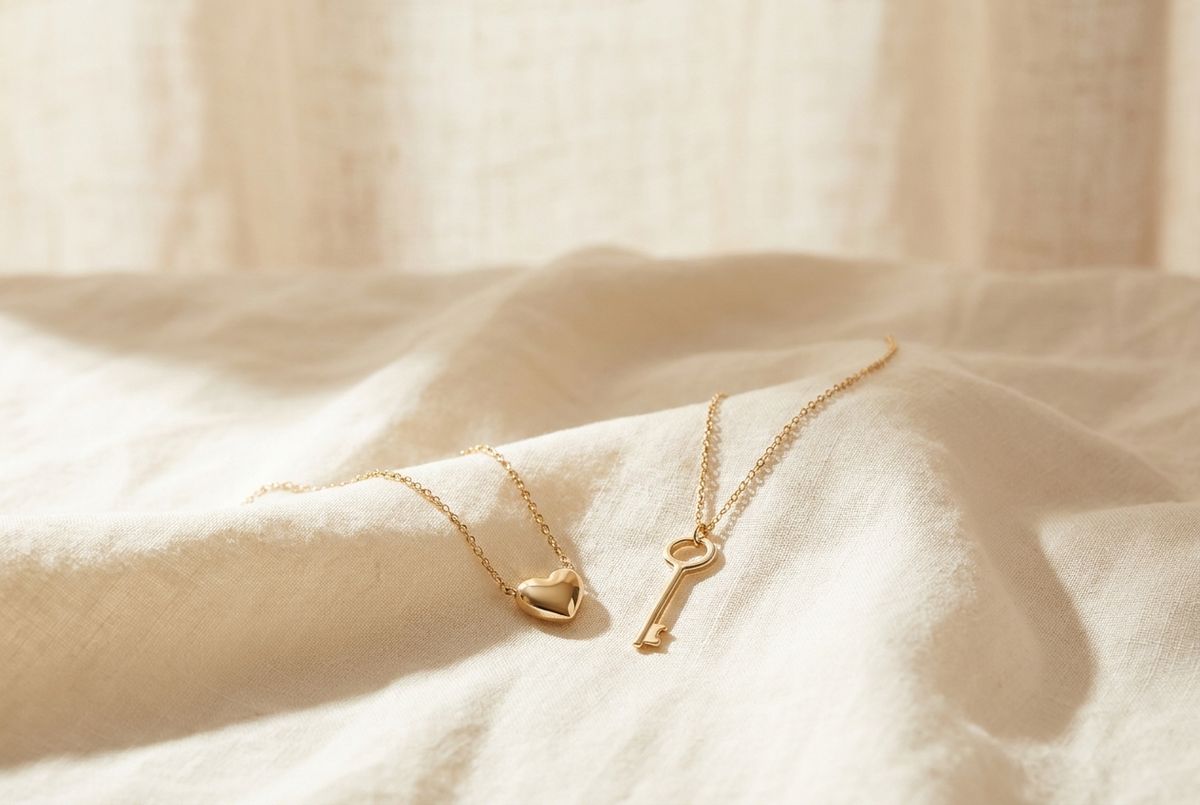
A key on a chain is a strange thing to give someone. It opens nothing. That is the point of it, and it is why the gesture has lasted.
What the key actually says
A lock is a decision to keep something closed. Handing over the key does not undo the lock, it just names the one person allowed through it. That is a narrower promise than a heart on its own, and a more deliberate one. The heart says I love you. The key says I chose you, and I am telling you where the boundary is.
It is also a promise that can be taken back, which most love symbols quietly avoid admitting. A key can be returned. Everyone who wears one knows that, and the piece is better for the honesty.
The meaning only completes across two people
This is what separates a key pendant from most symbolic jewelry. A tree of life means the same thing on one neck as on fifty. A key does not. Worn alone it is decorative. Worn opposite the lock or the heart it belongs to, it becomes a sentence with two halves, and neither half reads properly by itself.
That is why key jewelry is almost always sold in pairs, and why the pairing is not limited to couples. Mothers and daughters wear the set as often as partners do. The grammar is the same either way: one person holds the thing that is guarded, the other holds the permission.
Who wears the key and who wears the heart
There is no rule, and anyone who tells you otherwise invented it. But there is a convention worth knowing, because most people land on it anyway once they think about it for a minute.
The person doing the giving usually keeps the heart and hands over the key. Read it aloud and it makes sense: this is mine, and you may come in. Reversing it is not wrong, it just says something different. Wearing the key yourself means you are the one who was let in, and some people prefer to carry that.
If you are buying the set for someone else entirely, a mother and daughter for instance, give the heart to the person the relationship is anchored on and the key to the one who will grow up and move away. That is usually the child.
What people actually engrave
An engraving on a two-part set works differently from a single pendant, because you have two surfaces and they are read together. The strongest ones use that. A phrase split across the pair, half on the heart and half on the key, only resolves when the two people are in the same room. Our own set is built that way, with the line carried from one pendant to the other.
A date works well on the key and badly on the heart, for the same reason a key is specific and a heart is not. Initials work on either. Full sentences rarely survive the size of a key pendant, so count the characters before you fall in love with a phrase.
Before you buy one
Three things decide whether this piece is still around in five years.
Metal first. Sterling silver is silver all the way through and can be polished when it tarnishes. Gold plated and rose gold plated are a layer of gold over a base metal, and that layer wears at the points where the pendant rubs, which on a key means the bow at the top. Neither is worse, they age differently, and a key that is handled often will show it sooner. If that matters to you, read the difference properly before choosing.
Then chain length, because the two halves are usually worn by two people of different heights and a shared length flatters neither. Order them separately if the set allows it.
Then the engraving, last, once you have held the piece and seen how much room a key bow really gives you.
If the symbol is the part you care about
The key is one of a small family of symbols that mean something about a relationship rather than about the wearer. If it is not quite right, the heart on its own is the older and broader statement, and a promise ring says something closer to a commitment with a date on it.
What none of them do is what the key does. A key is the only one that admits there was a door.


