Chrysanthemum stone looks like a flower was pressed into dark rock and left there forever — and unlike most stones in a gemstone guide, there's no single mineral recipe behind it. What's sold under this name is a rock bearing radiating, petal-like mineral clusters, and what those "petals" are actually made of depends entirely on where the stone came from. Here's what's really going on geologically, where the two best-known sources are, and how to avoid the dyed fakes that are common in the trade.
What Chrysanthemum Stone Actually Is
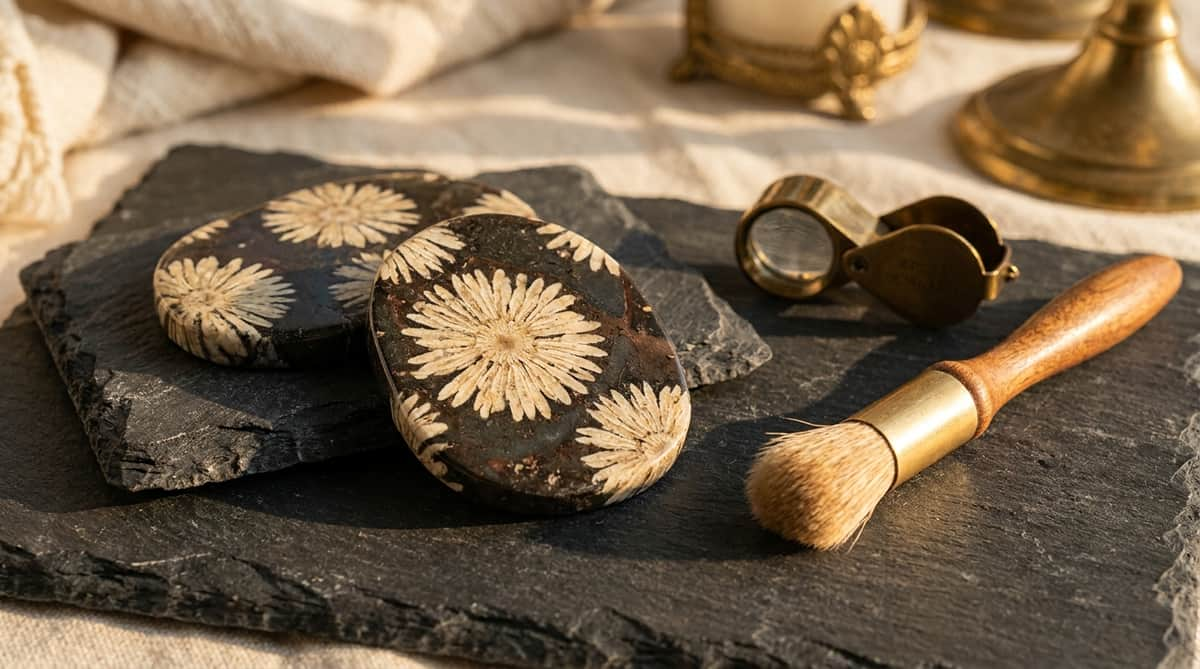
Chrysanthemum stone isn't a mineral species the way quartz or calcite is — it's a trade name for rock that shows flower-shaped clusters of radiating crystals set in a darker matrix. Gemological sources are explicit that there's no single scientific definition covering every stone sold under this name, because the "petals" themselves are made of different minerals depending on the deposit.
The best-documented source is the classic locality at Yonghe, in Liuyang County, Hunan Province, China. A 1988 geological study of that site describes the "petal" formations as made of celestite (a strontium sulfate mineral), with the center of each flower formed from colloidal quartz. At other outcrops of the same rock layer nearby, the original celestite has often been chemically altered and replaced over time by calcite and chalcedony instead — so even within the same general region, two pieces of "chrysanthemum stone" can have meaningfully different mineral makeups.
The Japanese material, from the Neo Valley in Gifu Prefecture, is generally identified by mineralogical sources as aragonite, or calcite that has pseudomorphed (replaced the original crystal shape of) aragonite, set within a matrix called schalstein — an altered, weathered basaltic rock. Some commercial sellers describe the Japanese stones as andalusite instead, but that identification isn't well supported outside of sales listings.
Because the composition varies this much by source, treat any single hardness number or mineral claim you see attached to "chrysanthemum stone" generally as applying to one specific deposit, not the category as a whole.
Physical, Mental, and Metaphysical Properties
Physical
The hardness of a chrysanthemum stone piece depends on which minerals actually formed it: celestite and calcite are both soft, in the 3 to 3.5 range on the Mohs scale, while a quartz- or chalcedony-replaced specimen can be notably harder, closer to 7. That range means some pieces scratch easily with normal wear and others hold up much better — there's no one hardness figure that's accurate for the category as a whole, which is also why it's worth asking a seller what the specific piece you're buying is actually made of.
Mental
In crystal-healing circles, chrysanthemum stone is associated with new beginnings and personal growth — an association that leans heavily on the literal flower imagery in the stone itself rather than on any older documented tradition. Treat this as a modern belief association, not a historical one.
Metaphysical
Unlike stones such as carnelian or lapis lazuli, chrysanthemum stone doesn't carry a long, well-documented history of ritual or symbolic use going back centuries — most of its popularity as a collected and lapidary stone is comparatively recent. What does have real documentation is its formal recognition as a natural landmark in Japan, covered below.
Where It Comes From
China (Hunan Province). The Yonghe locality near Liuyang is the classic Chinese source, where the stone formed in calcium-magnesium shale, marl, and nodular or cherty limestone, in what the 1988 geological study describes as a closed or semi-closed bay environment during early diagenesis — the process by which loose sediment compacts and chemically transforms into solid rock. Commercial sources commonly cite a Permian-period age for this material, roughly 250 to 290 million years old.
Japan (Gifu Prefecture). The Japanese material comes from the Neo Valley, where it's known locally as kikka-seki or kikuka-seki — "chrysanthemum stone." This site has a notable legal history: the area was designated a Natural Monument of Japan in 1941 and upgraded to Special Natural Monument status in 1952, and collecting new material from the original locality has been prohibited since. Most Japanese-style chrysanthemum stone in the market today is therefore older material already in circulation rather than freshly quarried.
China vs. Japan: How the Two Main Sources Compare
- Matrix color and texture — Chinese (Hunan) material typically sits in a dark grey-to-black limestone or marl base; Japanese (Gifu) material sits in schalstein, an altered basaltic rock with its own distinct dark, sometimes greenish-grey tone
- "Petal" mineral — Chinese petals are most often celestite (classic Yonghe material) or calcite/chalcedony where celestite has altered; Japanese petals are generally identified as aragonite or calcite pseudomorphing aragonite
- Legal status of new material — Chinese material is still actively quarried and sold; Japanese material from the original Gifu locality has been protected and off-limits to new collection since 1952
- Typical hardness — Both sources skew soft (roughly 3–3.5) where celestite, calcite, or aragonite dominates, though silica-replaced Chinese specimens can be considerably harder
How to Spot a Dyed Fake
Mineral databases note that chrysanthemum stone specimens sold commercially are sometimes enhanced by selectively dyeing the dark matrix to make the pale "petals" stand out more dramatically than they do naturally. A few things worth checking before buying:
- Even, flat-black background color with no natural tonal variation is a sign of a dyed or stained matrix rather than untreated stone
- Petals with unnaturally crisp, uniform edges across every flower on a piece suggest carving or enhancement rather than natural crystal growth, which tends to be slightly irregular
- Ask the seller which locality the piece is from — a seller who can't say whether a piece is Chinese or Japanese material, or what mineral the petals actually are, likely hasn't verified it themselves
Is Chrysanthemum Stone a Fossil?
No — despite the name and the flower-like appearance, chrysanthemum stone isn't a fossilized plant. The "petals" are mineral crystal clusters that grew within the rock before it fully hardened, not organic material that was preserved and replaced the way an actual plant or shell fossil forms. The resemblance to a flower is a coincidence of crystal growth pattern, not a botanical one.
Caring for Chrysanthemum Stone
Because hardness varies so much by piece, treat any chrysanthemum stone as a soft-to-moderate gem unless you know for certain it's a silica-replaced, harder specimen. Avoid ultrasonic and steam cleaners, which can stress softer celestite- or calcite-based material, and clean with a soft, dry cloth instead. If you're setting a piece into a personalized ring, a pendant or earrings worn occasionally is a safer bet than a ring worn through daily tasks, the same caution that applies to other soft collector stones. For the fuller rundown on what each stone in a gemstone collection actually is, see our guide to gemstone meanings, and gemstone color meanings for how mineral impurities produce the colors seen across this whole stone family. Our general gemstone ring cleaning guide covers the cloths and solutions to use or avoid.
Frequently Asked Questions
What is chrysanthemum stone made of?
It depends on where it's from. Classic Chinese (Hunan) material is typically celestite petals with a colloidal quartz center, sometimes later altered to calcite and chalcedony; Japanese (Gifu) material is generally aragonite or calcite that has pseudomorphed aragonite. There's no single fixed mineral recipe for the category as a whole.
Is chrysanthemum stone rare?
Chinese material is still actively mined and reasonably available. Japanese material from the original Gifu locality is effectively rare today because new collection there has been prohibited since 1952 — what's in circulation is older material, not freshly quarried stone.
How is chrysanthemum stone formed?
The radiating "petal" crystals grew within soft sediment — shale, marl, or limestone in the Chinese case — before the surrounding material fully hardened into rock, during a slow geological process called diagenesis. The exact mineral that crystallized into petal shapes differs by deposit.
Is chrysanthemum stone natural?
The flower pattern itself is a genuine natural crystal formation, not a carving. However, commercial specimens are sometimes enhanced with dye on the dark matrix to make the pattern stand out more sharply, so "natural" doesn't always mean "untreated" — ask about treatment before buying a piece marketed as premium.
What's the difference between Chinese and Japanese chrysanthemum stone?
Chinese material (from Hunan Province) typically has celestite or calcite/chalcedony petals in a limestone matrix and is still being mined today. Japanese material (from Gifu Prefecture) is generally aragonite or calcite-after-aragonite in a basaltic schalstein matrix, and new collection has been banned at its original site since 1952, making genuine Japanese pieces harder to source than Chinese ones.