Chalcedony is the gemstone world's quiet umbrella term — the single mineral family that quietly produces agate, onyx, carnelian, jasper, and chrysoprase, yet rarely gets named on its own. Most people who own a piece of banded agate jewelry or a black onyx ring are, technically, already wearing chalcedony; they just know it by one of its more famous family names. Here's what chalcedony actually is, where its name comes from, the meaning people attach to it, and how it differs from the varieties sold under their own names.
What Chalcedony Actually Is
Chalcedony is a microcrystalline form of silica (SiO2) — meaning it's built from quartz crystals so fine they can't be seen or separated under an ordinary magnifier, unlike a large, clearly faceted quartz crystal such as amethyst or citrine. Mineralogists describe it more precisely as an intergrowth of two silica minerals, quartz and moganite, fused together at a microscopic scale. That fine, dense structure is what gives chalcedony its signature waxy, slightly greasy luster rather than the sharp glassy sparkle of a large single quartz crystal, and what makes it tough enough to carve into fine detail without splintering. On the Mohs hardness scale it typically measures 6.5 to 7 — hard enough to resist everyday scratching from dust and grit, but soft enough that jewelers could hand-carve it with simple tools for thousands of years before modern equipment existed.
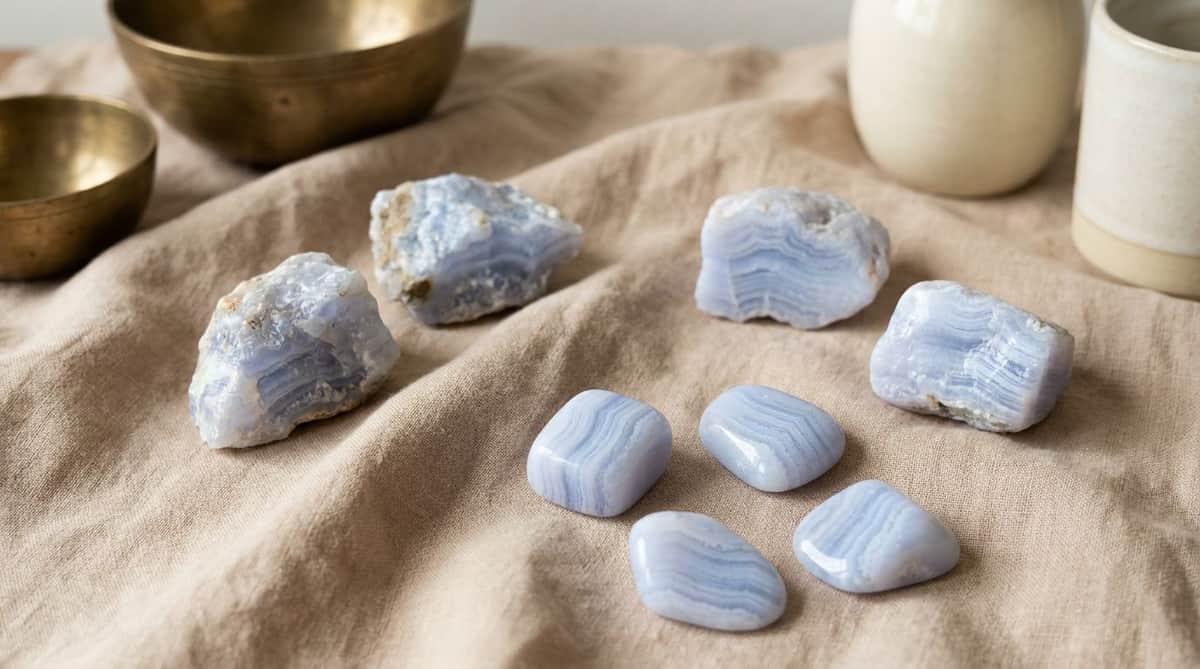
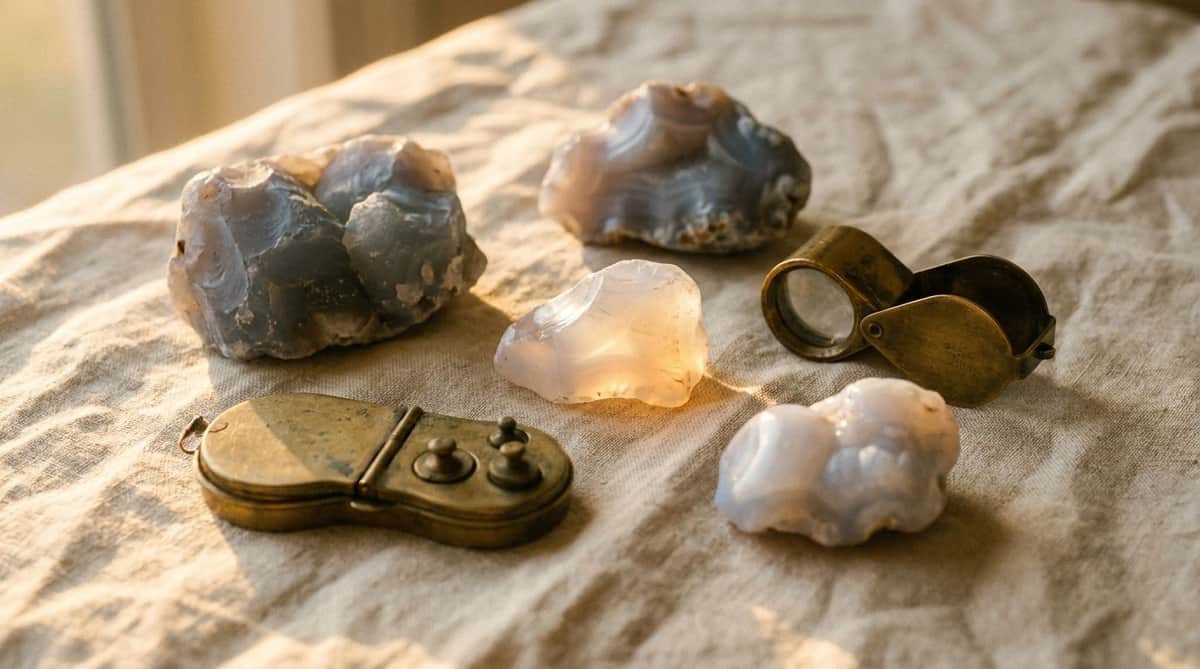
In its purest, most classic jewelry-trade sense, "chalcedony" refers specifically to the translucent, evenly colored material — most often a soft blue-grey, white, or milky tone — rather than to every stone in its own mineral family. Blue chalcedony in particular has become a modern jewelry staple precisely because that plain, cloud-like color reads as calm and minimal next to a busier banded agate or a saturated carnelian.
Where the Name Comes From
Chalcedony's name has a genuinely disputed origin, which is unusual for a stone this old. The most commonly repeated story, recorded by the Roman naturalist Pliny the Elder, traces it to Chalcedon, an ancient Greek city on the Asian side of the Bosphorus (in what is now Kadıköy, a district of Istanbul, Turkey). The trouble is that no significant chalcedony deposit has ever been confirmed near the ancient city, which has led some etymologists to treat the Chalcedon connection as folk etymology rather than settled fact — a few scholars instead suggest a link to the Greek word for copper or bronze, "chalkos," since the trade routes through the region carried both materials. Either way, the name was fixed in Western mineralogy by Pliny's first-century writing and has stuck for roughly two thousand years regardless of which origin story is correct.
Chalcedony also has a documented appearance in religious text: it's named as the third of twelve foundation stones of the New Jerusalem in the Book of Revelation (21:19), alongside stones that include jasper and sardonyx — two of its own chalcedony-family relatives. For more on how this stone's family members get their own separate names, see our onyx meaning guide, since onyx is simply a black-and-white banded variety of chalcedony sold under its own identity.
Chalcedony vs. Its Own Family: How the Varieties Differ
This is where chalcedony gets genuinely confusing for shoppers: agate, onyx, carnelian, jasper, and chrysoprase are not separate minerals competing with chalcedony — they're all chalcedony, distinguished from each other by color, pattern, and opacity rather than by chemistry. Here's how to tell them apart at a glance:
- Chalcedony (plain) — translucent, evenly colored, usually blue-grey, white, or milky, with no visible banding. The "default" form the family name describes.
- Agate — chalcedony with visible, often colorful banding or patterning, formed in layers as mineral-rich water filled a cavity in rock over time.
- Onyx — a specific banded variety of agate, almost always black-and-white or black-and-brown parallel bands; most "black onyx" jewelry on the market today is agate dyed to a uniform black rather than naturally solid-colored stone.
- Carnelian — an orange-to-reddish-brown variety colored by trace iron oxide, prized since antiquity in Egyptian and Roman jewelry and seal carving.
- Jasper — any opaque variety of chalcedony, as opposed to the translucent types above; jasper's opacity comes from a higher concentration of mineral and organic impurities mixed into the silica.
- Chrysoprase — an apple-green variety colored by trace nickel, among the rarer and more valuable chalcedony varieties.
If you've already read our guides to agate or carnelian, you've effectively already read about chalcedony under a different name — the mineral science is identical, and only the color and pattern labels change.
The Meaning People Give Chalcedony
Because plain chalcedony's defining trait is its calm, even, cloud-like color — no dramatic banding, no bold color saturation — the meaning attached to it leans gentle compared to showier family members like carnelian. Crystal-healing sources commonly describe chalcedony as a stone of goodwill, calm communication, and emotional balance, sometimes associated with the throat chakra on the theory that its soft, even tone promotes measured speech over conflict. It's also occasionally called a "nurturing" stone in wellness circles, a reputation that likely owes more to its gentle, unthreatening appearance than to any property of the mineral itself. As with any gemstone's metaphysical claims, these are folk beliefs and marketing language passed down through crystal-shop and jewelry-trade writing, not measured properties of the stone — worth knowing the history of, not worth treating as established fact.
Chalcedony in Jewelry: What to Look For
Blue chalcedony is the variety most commonly set in fine jewelry today, usually cut as a smooth cabochon rather than faceted, since its translucent-but-not-transparent structure doesn't throw light the way a clear faceted gem does — cabochon cutting instead shows off its even color and subtle glow. Because the stone takes dye well (the same property that turns pale agate into "black onyx"), ask whether a deeply saturated or unusually uniform piece of chalcedony has been color-treated; a reputable seller will say so without hesitation. For a ring built around a single colored stone, FARUZO's personalized rings collection is a reasonable starting point if you'd rather build a custom piece than shop a fixed design.
Frequently Asked Questions
Is chalcedony the same as agate?
Not exactly, but they're closely related: agate is a banded variety of chalcedony, while "chalcedony" on its own usually refers to the plain, unbanded, evenly colored form. Both are the same underlying mineral — microcrystalline quartz — distinguished only by whether banding is present.
What color is real chalcedony?
Plain chalcedony is most often blue-grey, white, or milky. Its family members cover a much wider range — orange-red in carnelian, black-and-white in onyx, apple-green in chrysoprase — but those are typically sold under their own variety names rather than as "chalcedony."
How hard is chalcedony, and will it scratch easily?
Chalcedony measures about 6.5 to 7 on the Mohs hardness scale, similar to most quartz varieties. That's hard enough for everyday jewelry wear and resistant to scratching from dust or sand, though it's softer than sapphire or diamond and can still be scratched by harder materials.
Why is chalcedony named after a city no one can confirm it came from?
The name traces to the Roman writer Pliny the Elder, who linked the stone to the ancient city of Chalcedon. No chalcedony deposit has ever been confirmed near that site, so some etymologists treat the connection as a historical mix-up rather than a literal mining origin — but the name was already fixed in Western mineralogy by the time anyone questioned it.
Is dyed chalcedony less valuable than natural-colored chalcedony?
Typically, yes. Chalcedony and its varieties take dye easily, which is how pale agate becomes uniformly "black onyx" on the mass market. A natural, untreated color is usually priced higher than a dyed stone, and a reputable seller should disclose any color treatment.