Most jewelry labeled "onyx" has never seen the inside of an onyx deposit. It's dyed black chalcedony or agate — which isn't a scam exactly, since the base mineral is a close cousin, but it does mean the deep, uniform black most people picture when they hear "onyx" is usually manufactured, not mined that way. Here's what onyx actually is, what the color tradition is built on, and how to tell a dyed stand-in from the real thing.
What Onyx Actually Is
Onyx is a variety of chalcedony — a microcrystalline form of quartz (silicon dioxide) — defined by straight, parallel banding rather than the curved bands typical of agate. Its natural colors run from black and white to brown and red; fine carbon or iron-oxide impurities account for darker bands. True solid-black onyx does occur naturally, but it's uncommon enough that the jewelry trade has dyed lighter chalcedony and agate to a deep, uniform black for well over a century to meet demand for it.
At Mohs 6.5–7, onyx is hard enough for daily wear and resists scratching from most everyday contact, which is part of why it has stayed a jewelry and carving staple for thousands of years despite being, mineralogically, a fairly ordinary form of quartz.
How Onyx Forms
Like agate, onyx forms when silica-rich groundwater fills gas cavities in cooling volcanic rock, depositing quartz in thin layers over long stretches of time. The flat, parallel bands that distinguish onyx from agate's wavy ones come from steady, undisturbed deposition conditions. Commercial deposits come mainly from Brazil, Uruguay, India, and Madagascar, with Brazilian and Uruguayan material supplying most of what reaches the dye tanks before it reaches a jewelry bench.
Physical
Opaque to translucent, with flat parallel banding in black, white, brown, or red in its natural state. Mohs 6.5–7. Takes a high polish, which is why it has been a carving and cameo material since antiquity.
Mental
In crystal-healing tradition, onyx is associated with focus and self-discipline — a stone people reach for when they want to hold a boundary or follow through on something that requires sustained willpower rather than a burst of motivation.
Metaphysical
Onyx's dominant association is protection — absorbing or deflecting negative energy rather than amplifying anything, which is a quieter role than stones associated with manifestation or abundance. It's also tied to grounding and emotional endurance, themes that show up repeatedly in how it was used historically (below) long before "crystal healing" was a phrase.
Onyx vs. Two Other Black Stones
Black jewelry stones get confused constantly, usually because sellers use "onyx" loosely as a catch-all for "shiny and black." Three real distinctions:
- Onyx: quartz-family chalcedony, Mohs 6.5–7, opaque with a glassy polish; almost always dyed when sold as a uniform deep black.
- Black tourmaline: a different mineral family entirely (a borosilicate), usually sold raw or semi-polished with a duller, more matte surface and visible striations — see our full Black Tourmaline Meaning guide for how it forms.
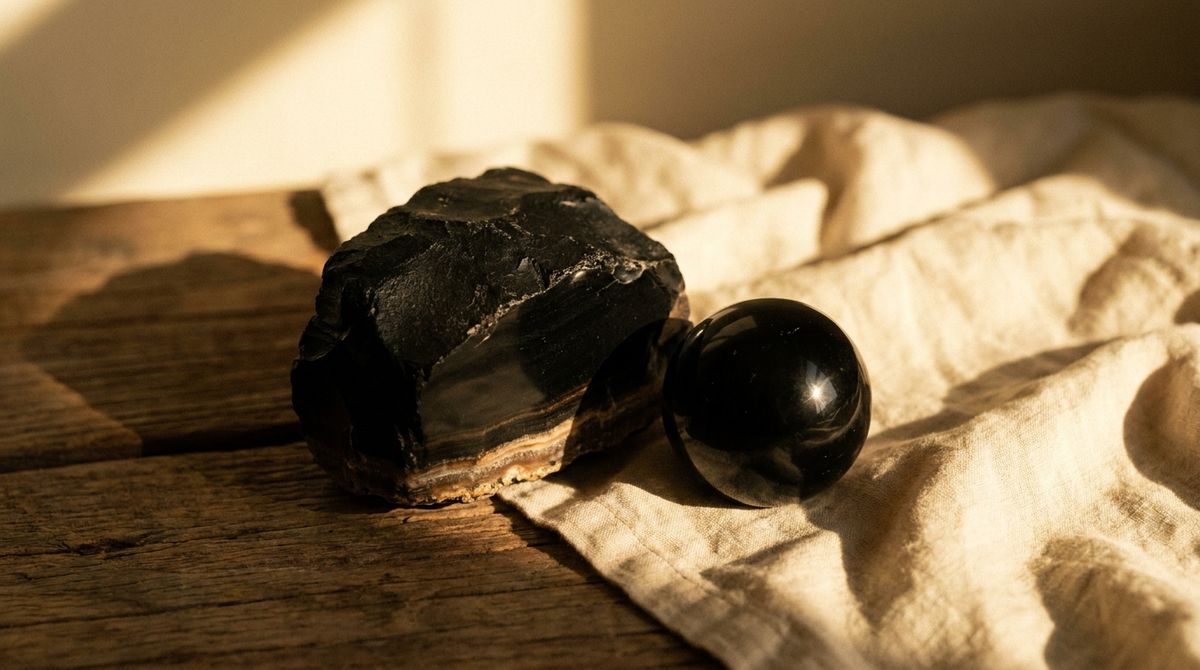
- Black obsidian: volcanic glass, not a mineral at all — lighter than onyx for its size, with a distinctive conchoidal (shell-like) fracture instead of onyx's flat cleavage planes, and noticeably softer at Mohs 5–5.5.
How to Tell Real Onyx From Dyed Agate
Because so much "onyx" on the market is color-treated, a few checks are worth knowing before paying a premium for it:
- Hold it to strong light. Dyed agate sold as onyx will often show faint color banding or a slightly translucent brownish edge where the dye didn't fully penetrate; genuine solid-black onyx stays uniformly opaque.
- Check the price against the size. Dyed chalcedony is inexpensive regardless of piece size, since the base material is common; a large bead or cabochon priced like a rare stone is a red flag, not a reassurance.
- Look for unnaturally flawless color. Natural banding, even in black material, rarely produces a perfectly even, saturated black across an entire piece — that kind of uniformity is usually the dye talking.
None of this makes dyed onyx a bad purchase — it's been standard jewelry-trade practice for well over a century and is typically disclosed by reputable sellers. It just means the all-black look is closer to a finishing technique than a rare natural color.
Onyx in History
Ancient Egyptians carved onyx into amulets and vessels and associated it with protection; Roman soldiers and officials used it for engraved signet rings and cameos because its flat banding let carvers cut a lighter layer into a dark background for contrast — a technique that produced the raised-relief cameo look still associated with the stone today. That same banding made onyx a favorite material for intaglio seals used to stamp wax, since a carved design in hard, fine-grained quartz held crisp detail far longer than softer alternatives.
That same carving tradition carried into Victorian mourning jewelry, where solid black onyx became a standard material for rings and brooches worn during periods of formal mourning, often set in gold with a loved one's initials or a lock of hair sealed behind glass. That 19th-century association is a large part of why black onyx still reads as somber or protective rather than celebratory in Western jewelry tradition today, even outside any mourning context.
Wearing Onyx Jewelry
Onyx's hardness makes it reasonably low-maintenance: wipe with a soft, slightly damp cloth, avoid ultrasonic cleaners if the piece has been dyed (prolonged heat and vibration can affect the color over many years), and store it away from harder stones that could scratch its polish. For the general rules that apply across gemstone jewelry, see our guide on how to clean a gemstone ring.
If you want onyx's dark, protective look in something personal, a custom engraved black onyx bracelet pairs the stone with a name, date, or short inscription on the clasp or bar — a way to wear the meaning rather than just the color.
Frequently Asked Questions
Is onyx a birthstone?
Onyx isn't one of the twelve modern birthstones, though it has appeared on some older, regional birthstone lists as an alternate stone for August and other months. It's not part of the standardized list most US jewelers use today.
Is all black onyx dyed?
No, but most of it is. Naturally solid-black onyx exists but is uncommon enough that dyeing lighter chalcedony and agate has been standard trade practice since at least the 19th century to meet demand for a consistent, deep black.
Can onyx get wet?
Brief contact with water won't damage onyx itself, but repeated soaking isn't recommended for dyed pieces, since prolonged moisture can very gradually affect the color treatment over years. Treat it like you would any dyed gemstone: fine for everyday wear, but not something to leave in water.
What's the difference between onyx and black tourmaline?
They're different minerals entirely — onyx is a banded quartz variety, usually polished glossy and often dyed; black tourmaline is a borosilicate mineral typically sold with a more matte, striated surface and is rarely color-treated.
Does onyx have healing properties?
That depends on what's meant by "healing." There's no scientific evidence that any gemstone affects physical health. In crystal-healing tradition, though, onyx is consistently associated with grounding, protection, and emotional endurance — themes that trace back to its long documented history in protective amulets and mourning jewelry.