Apatite is a mineral with an unusual distinction: it was named after a Greek word for deception, because for centuries gem buyers and even mineralogists kept mistaking it for other stones entirely. It's also, in a different form, quietly load-bearing inside your own body — the same mineral family makes up the hard part of tooth enamel and bone. Here's what apatite actually is, why jewelers rarely set it in rings, and what the metaphysical claims around it actually mean.
What Is Apatite, Really?
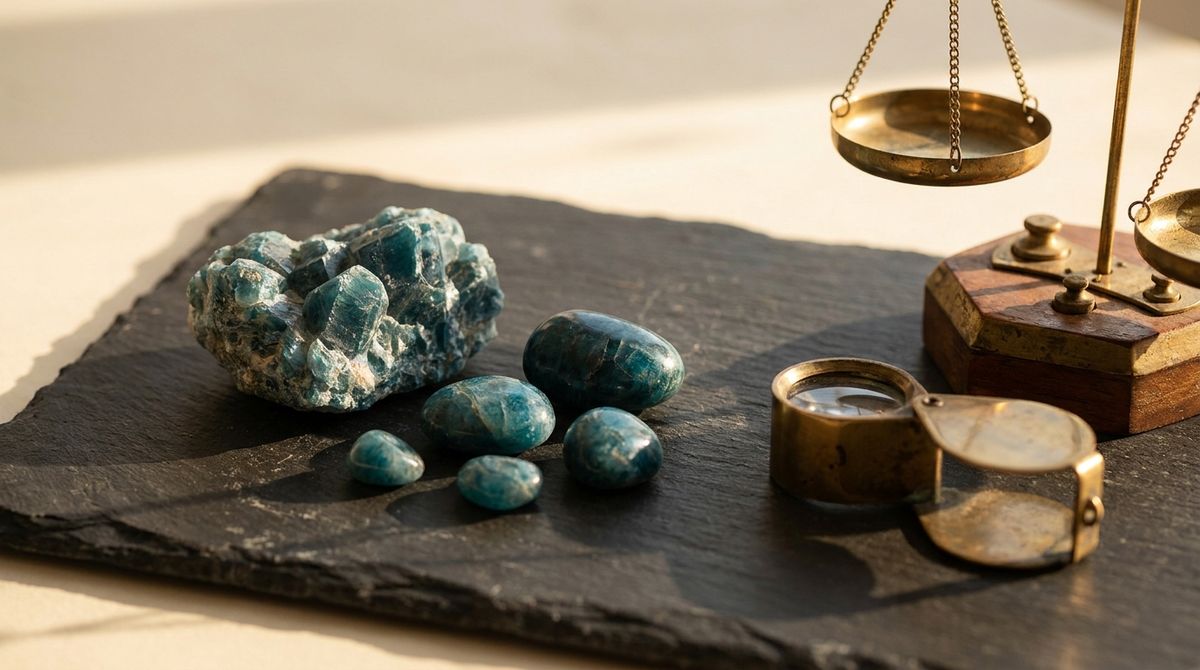
Apatite isn't a single mineral but a group of closely related calcium phosphate minerals — mainly fluorapatite, chlorapatite, and hydroxylapatite, which differ by which extra element (fluorine, chlorine, or a hydroxyl group) fills the same slot in the crystal structure. Gem-quality crystals form in a wide color range: the most prized is a strong neon blue-green from Madagascar that's often compared to Paraiba tourmaline, alongside yellow, purple, pink, and colorless material found in deposits from Brazil to Myanmar.
The “Deceiver Stone”: Where the Name Comes From
German geologist Abraham Gottlob Werner named the mineral in 1786, drawing on the Greek word apate, meaning deceit. The reason was practical rather than poetic: apatite crystals had spent decades being misidentified in mineral collections as beryl, olivine (peridot's mineral family), tourmaline, and even amethyst, because its color range and crystal habit overlap with all of them. Werner's name was essentially a warning label — double-check before you file this one under something else.
Apatite vs. Similar-Looking Stones
That history of misidentification still matters for buyers today, since the stones apatite resembles are still sold side by side with it:
- Apatite vs. aquamarine. Both come in pale-to-vivid blue, but apatite's neon blue-green tone (strongest in Madagascar material) tends to be more saturated than aquamarine's cooler, paler blue; apatite is also noticeably softer at Mohs 5 versus aquamarine's 7.5–8.
- Apatite vs. peridot. Yellow-green apatite can be confused with peridot at a glance, but peridot runs a consistent olive-green regardless of lighting, while apatite's green often shifts toward blue under different light sources.
- Apatite vs. Paraiba tourmaline. The resemblance is closest here — both can show an intense neon blue-green — but Paraiba tourmaline is dramatically more durable (Mohs 7–7.5) and far more expensive; a loupe and a hardness test are the practical ways a jeweler tells them apart.
- Apatite vs. fluorite. Fluorite shares apatite's reputation as an easily-confused, relatively soft gem (Mohs 4), and both can fluoresce under UV light, but fluorite typically shows more visible color zoning and cleaves more easily.
Several of these lookalikes get their own side-by-side breakdown elsewhere on the blog — see our fluorite meaning guide for a closer look at the stone apatite is most often confused with at a casual glance.
The Reference Point for the Mohs Hardness Scale
Apatite has one job in mineralogy that has nothing to do with jewelry: it's the mineral that defines hardness 5 on the Mohs scale, the 1812 ten-point scratch-hardness system still used to describe every gemstone today. A fingernail (about 2.5) won't scratch it, but a steel blade (around 5.5) will — which is the practical test jewelers use to identify a suspected apatite in the field.
That mid-scale hardness is also why apatite rarely ends up in engagement rings or other pieces meant for daily wear: a ring sits against doorframes, countertops, and car doors all day, and most of the material those surfaces are made from is hard enough to leave a mark on a Mohs-5 stone over time.
The Same Mineral in Your Teeth and Bones
Hydroxylapatite — one of the three apatite minerals — is the dominant mineral component of tooth enamel and the mineral portion of bone in humans and most vertebrates. It's the reason enamel is hard enough to chew with for decades: the same calcium-phosphate crystal structure that forms gem-quality apatite also forms in a microscopic, densely packed arrangement inside a tooth.
Apatite also has a much larger, far less glamorous role in the economy: phosphate rock, which is mostly apatite, is the world's primary mineral source of phosphorus, the element behind most agricultural fertilizer. The handful of gem-quality crystals that make it into jewelry are a tiny fraction of a mineral that is mined, globally, by the ton.
Gem-quality deposits are scattered and often small. The neon blue-green material most prized by collectors comes mainly from a handful of pegmatite deposits in Madagascar, with additional sources in Myanmar, Brazil, and Mexico producing yellow, purple, and colorless material. By contrast, the phosphate-rock apatite mined for fertilizer comes from enormous sedimentary deposits — Morocco alone holds the majority of the world's known phosphate rock reserves — and almost none of that industrial-grade material is gem quality.
Apatite in Crystal Healing Lore
In crystal-healing traditions, apatite is commonly described as a “stone of manifestation” — associated with mental clarity, motivation, and communication, and linked to the throat and third-eye chakras depending on its color. These are beliefs passed down through metaphysical practice, not claims with scientific backing, and we're not going to pretend otherwise — but they're a real part of why the stone is popular in crystal shops regardless of its mineralogy.
Is Apatite a Birthstone?
No — apatite doesn't appear on the modern or traditional birthstone lists for any month, unlike stones such as peridot or aquamarine that share its color range. If you're shopping for a birth-month gift rather than a standalone gem, our birthstone-by-month guide covers the official stone for each month, including the alternates.
How to Wear and Care for Apatite Jewelry
Because of its Mohs-5 hardness, apatite holds up better in earrings or pendants, which take far less daily impact than a ring, than in anything worn on the hand every day. Clean it gently — a soft cloth with mild soap and lukewarm water, dried right away — and skip ultrasonic and steam cleaners, since the vibration and heat are exactly the conditions that can damage a softer stone.
If you love the color but want something built for daily wear, FARUZO's birthstone rings collection uses more durable stones in similar blue, green, and purple tones, set in a 316L stainless steel band that won't take the same wear a Mohs-5 gem would.
Frequently Asked Questions
Is apatite a diamond simulant?
No. Apatite's color, softness, and lack of fire make it visually and physically distinct from diamond; it's never used as a diamond substitute the way moissanite or cubic zirconia are.
Can apatite jewelry get wet?
Brief contact with water is fine, but avoid prolonged soaking, swimming, or showering with it — not because the mineral dissolves, but because repeated wet-dry cycles and incidental knocks against hard surfaces add up faster on a softer stone.
Is apatite expensive?
Most commercial-grade apatite is inexpensive relative to harder colored gemstones, since its softness limits how it can be cut and worn. The rare, highly saturated neon-blue Madagascar material in larger sizes is the exception and commands a real premium.
Is apatite the same thing as Paraiba tourmaline?
No, even though the two can look nearly identical in photos. They're chemically and structurally different minerals; Paraiba tourmaline is significantly harder, rarer, and more valuable, and the two are distinguished with a refractometer or hardness test rather than by eye.
Does apatite glow under UV light?
Many apatite specimens do fluoresce under ultraviolet light, typically in yellow or blue-green tones, though the effect varies by locality and which apatite mineral (fluorapatite, chlorapatite, or hydroxylapatite) is present.