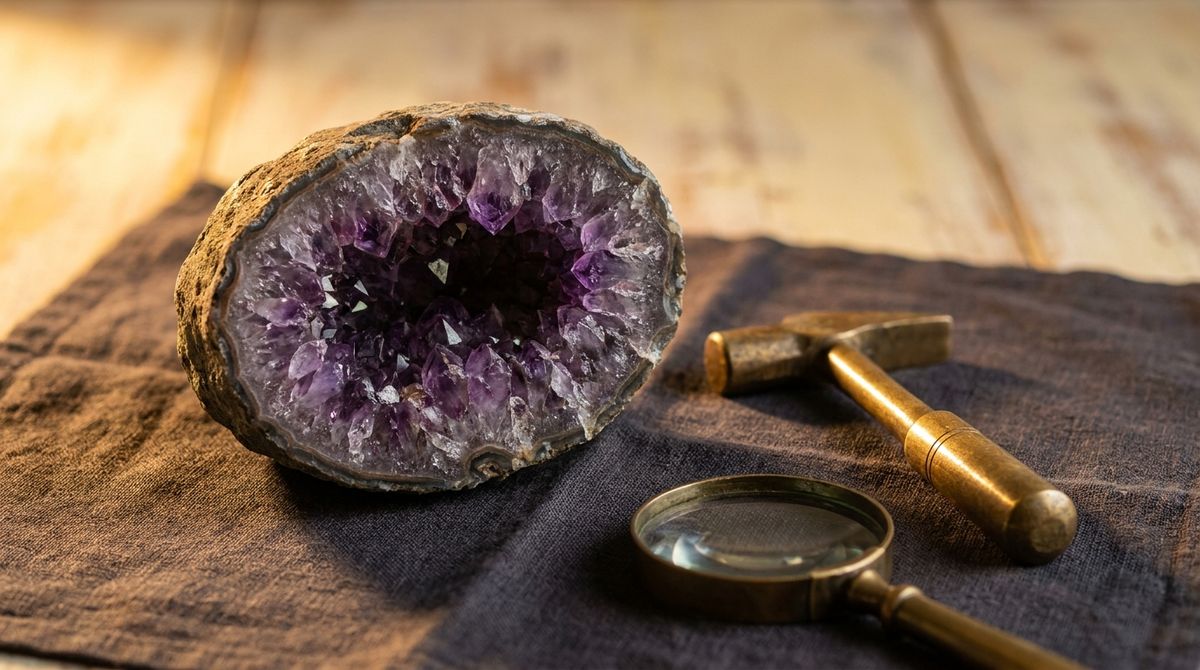
Nearly every crystal shop has one: a fist-sized (or door-sized) rock, split open like a geode-shaped Easter egg, its dull gray exterior hiding a hollow lined with hundreds of glittering purple points. That's an amethyst geode, and almost everything interesting about it happens before it ever reaches a shop shelf — a process that started roughly 134 million years ago, long before anyone was around to call it beautiful.
What a Geode Actually Is (and Isn't)
The word "geode" comes from the Greek geōdēs, meaning "earth-like," and it refers specifically to a hollow rock with crystals growing inward from its walls toward an open center. That's different from a nodule, which is solid all the way through, and different from a crystal cluster, which is a group of crystals that grew without any surrounding rock shell at all. Geologists sometimes use the broader term "vug" for any open cavity in rock, whether or not it happens to be crystal-lined — a geode is really just a vug that got lucky enough to fill with mineral-rich water over a long enough stretch of time. In the jewelry and decor trade, a large amethyst geode that's been cut and stood upright — tall enough to reach a shopper's waist or higher — is usually sold as a "cathedral," a display term rather than a mineralogical one.
How an Amethyst Geode Forms
The formation story starts with the breakup of the supercontinent Gondwana roughly 134 million years ago, an event that sent enormous lava flows across what is now southern Brazil and northern Uruguay. As that lava cooled into basalt, gas bubbles trapped inside it hardened into round, hollow cavities — empty space waiting to be filled. Over a very long time, silica-rich groundwater moved through the rock and deposited mineral layers inside those cavities: first a lining of chalcedony, then calcite, and finally the amethyst crystals that grew inward from the walls. A 2024 fluid-inclusion study published in the journal Mineralium Deposita found that this final crystallization happened at a surprisingly cool 15 to 60°C — evidence that ordinary groundwater, not leftover volcanic heat, did the real work. The world's two leading sources for these geodes today, Ametista do Sul in Brazil and the Los Catalanes district in Uruguay, are both mining directly into that same ancient lava sequence.
Why It's Purple
Quartz — the mineral family amethyst belongs to — is naturally colorless. Amethyst's violet color comes from trace amounts of iron trapped in the crystal structure, activated by natural background radiation from the surrounding rock, which knocks electrons loose and creates what gemologists call a color center. No iron, or no radiation exposure, and the same cavity produces clear quartz instead. The relationship between amethyst and other quartz colors is closer than most jewelry shoppers realize: heat an amethyst crystal to roughly 470–560°C and the iron shifts into a different oxidation state, turning the stone yellow-orange — which is exactly how most commercial citrine is actually made. Amethyst, citrine, smoky quartz, and clear quartz are, chemically, closer to color variants of the same mineral than they are to separate gemstones.
Properties: Physical, Mental, and Metaphysical
Physical
As a variety of quartz, amethyst measures 7 on the Mohs hardness scale — durable enough for daily wear when it's cut into jewelry, though a full geode is typically left raw and displayed rather than worn. Color intensity varies widely within a single geode, often deepening toward the tips of the crystal points, and larger geodes can weigh anywhere from a few pounds to several hundred.
Mental
In popular crystal literature, amethyst is described as a calming stone associated with clarity of mind and easier sleep — language that traces back to its ancient reputation as a guard against overindulgence, discussed below. As with any stone's mental or emotional associations, this is a belief passed down through tradition and modern wellness marketing, not a measured psychological effect.
Metaphysical
Amethyst's name comes from the Greek amethystos, "not intoxicated" — the Greeks associated the purple stone with protection against drunkenness, sometimes carving wine goblets from it or wearing it as an amulet. That association has carried into modern crystal traditions as a broader symbol of sobriety, spiritual clarity, and calm. A geode specifically is often framed in that same literature as a "cluster" energy — one source rather than a single point — said to fill or calm a room rather than a person directly. These are traditional and commercial claims, not documented properties of the mineral itself; for the general meaning and history behind amethyst as a gemstone, see our amethyst vs. iolite comparison, which covers the stone in more depth.
Buying and Caring for an Amethyst Geode
A few things are worth knowing before buying one: color can be artificially deepened with dye on lower-quality material, so ask specifically whether a geode's color is natural; weight and size vary enormously and drive price more than almost any other factor; and like most quartz, amethyst can fade with long-term direct sunlight exposure, so it's best displayed away from a sun-facing window rather than on one. Clean a geode with a soft, dry brush to remove dust — avoid soaking it, since some geodes are backed or reinforced with materials that don't hold up to water. Large geodes are also frequently sold as matched "split pairs" — the same original cavity, cut in half and separated into two bookend-style halves with mirrored crystal patterns — which is worth knowing if a listing's price seems high for what looks like a single piece; you're often paying for both halves even when only one ships with a display base.
A raw geode is a display piece rather than something you wear, but if you'd rather carry amethyst with you than set it on a shelf, February's birthstone shows up in a more everyday form in FARUZO's birthstone necklaces, and general stone care overlaps closely with what's covered in our gemstone ring cleaning guide.
Frequently Asked Questions
Is an amethyst geode the same thing as a raw amethyst crystal?
Not quite. A raw amethyst crystal is a single point or a small cluster, while a geode is the entire hollow rock — the outer stone shell plus the crystals lining its interior. A geode that's been cut open to display the crystal-lined cavity is what's usually sold in stores.
Why are some amethyst geodes hollow in the middle while others are packed solid?
It comes down to how much time and mineral-rich groundwater the cavity had before the amethyst finished growing. A geode with unfilled open space at the center simply ran out of one or both before the crystals could grow all the way to the middle; a fully packed cavity — more accurately called a nodule at that point — had enough of both.
Does sunlight really fade amethyst?
Yes, with enough prolonged exposure. Amethyst's color comes from a radiation-created color center in the crystal, and strong, continuous light — especially direct sun over months or years — can gradually break that color center down, leaving the stone paler than when it was purchased.
Are Brazil and Uruguay the only sources of amethyst geodes?
They're the leading commercial sources by volume, thanks to the scale of the ancient lava fields both countries share, but amethyst geodes and crystals also occur in smaller deposits elsewhere, including Zambia, Bolivia, and parts of the United States.
What's the difference between an amethyst geode and an amethyst "cathedral"?
They're the same material at different scales. "Cathedral" is a trade term for a tall geode, cut and finished to stand upright on its own, usually large enough to be a floor or shelf display piece rather than something that fits in one hand.