Amethyst and iolite are two different gemstones that both land somewhere in the purple-to-blue range, and both get marketed as an affordable alternative to sapphire — which is exactly why they're easy to mix up. They aren't related minerals, don't form the same way, and don't even always land in the same actual color: amethyst is reliably purple from every angle, while iolite is technically violet-to-blue and, per GIA, never true purple the way amethyst is. Here's how to tell them apart, which wears better day to day, which costs more, and which to choose.
Two Different Minerals That Happen to Share a Color Family
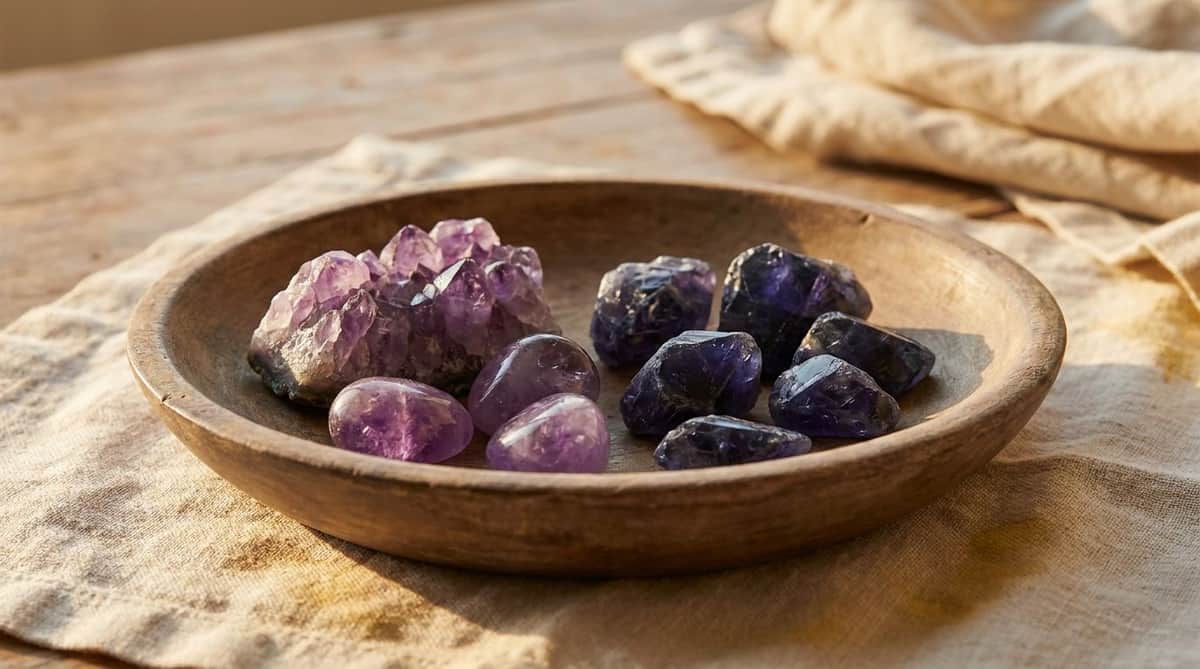
Amethyst is a variety of quartz — silicon dioxide (SiO₂) — the same base mineral as citrine, rose quartz and smoky quartz. Its purple color comes from trace iron built into the crystal, combined with natural background irradiation from the surrounding rock, a process well-documented across independent geology sources: the iron is oxidized by that radiation into a state that absorbs light differently, producing the purple color center. Iolite is the gem-quality form of an entirely different mineral, cordierite (Mg₂Al₄Si₅O₁₈), and per GIA its violet-to-blue color comes from iron built directly into its crystal structure, with no radiation-driven mechanism involved. The two aren't in the same mineral family at all — amethyst is a silicate in the quartz group, iolite a silicate in the cordierite group — they just happen to land in overlapping colors.
Color and Pleochroism: How to Tell Them Apart at a Glance
The clearest tell is the color itself and how stable it looks from different angles. Amethyst holds one consistent purple across the whole stone — GIA describes the finest material as “strong reddish purple to purple with no visible color zoning.” Iolite behaves very differently: GIA notes it's strongly pleochroic, meaning it shows distinctly different colors depending on the direction you view it from — violet-blue from one angle, pale yellow to nearly colorless from another. A jeweler, or a patient shopper with a loupe, can tilt an iolite stone and watch the color shift; amethyst won't do that.
That pleochroism has a practical downstream effect on cutting, too: well-cut iolite is oriented deliberately so its strongest blue-violet face points outward and the paler face is hidden in the setting, which is a consideration that simply doesn't exist for amethyst.
Hardness and Everyday Wear
On the Mohs hardness scale, amethyst measures a flat 7. Iolite measures slightly higher, 7.0 to 7.5 per GIA, so the two are close in scratch resistance and both durable enough for regular jewelry wear. Hardness isn't the full story for iolite, though — gemologists generally note it has only fair toughness, because it carries a distinct cleavage plane in one direction, meaning it can chip or crack along that plane from a sharp knock even though the surface itself resists scratching well. Amethyst has no comparable cleavage weakness. In practice, both work fine for earrings and pendants; for a ring worn daily and knocked against things, amethyst is the slightly more forgiving of the two.
Price and Rarity
Amethyst is one of the most widely available colored gemstones on the market. Large, clean deposits in Brazil, Bolivia and Morocco keep supply high and prices low even at sizable carat weights — notably, amethyst was once treated as precious, on par with ruby and emerald, until 19th-century Brazilian deposits were discovered and supply expanded dramatically, which is what collapsed its price. Iolite is considerably less common at retail, though not scarce in the way fine sapphire is; it typically costs more than amethyst per carat but well below sapphire, which is precisely the price gap that gives it a market as a sapphire substitute in the first place.
Meaning and the "Water Sapphire" Reputation
Amethyst carries centuries of accumulated meaning: calm, clarity, and traditionally protection against overindulgence — its name comes from the Greek amethystos, roughly "not intoxicated" — and it's the modern February birthstone; see our February birthstone guide for more on that tradition specifically. Iolite's best-known nickname is "water sapphire," earned by its strong pleochroic blue-violet flash resembling sapphire despite being an entirely unrelated mineral. Iolite also carries a specific, if debated, historical claim: according to GIA, thin slices of iolite may have been used by Viking navigators as a rough polarizing filter to help locate the sun's position through cloud cover, though GIA itself notes the accuracy of that account isn't fully settled.
Buying Tips for Each Stone
If you're shopping for iolite specifically, ask to see the stone from a couple of different angles before buying, or tilt it yourself under a single light source — that pleochroic shift from blue-violet to pale yellow is the single most reliable way to confirm you're actually looking at iolite rather than a dyed or synthetic imitation. Because of its cleavage plane, iolite also does better in a protective setting — bezel or half-bezel, or prongs that guard the girdle — rather than a fully exposed stone in a style likely to catch on things throughout the day.
Amethyst has no equivalent pleochroism check, so verifying it comes down to more general gemstone red flags: even, glassy color with no visible zoning or banding (zoning can indicate a lower grade or, occasionally, a synthetic), and a price that isn't suspiciously low for the size, since amethyst is already inexpensive at typical jewelry sizes. Because it's a full point softer than sapphire but has no cleavage weakness of its own, amethyst tolerates a wider range of setting styles, including fully exposed prong settings, without the same durability trade-off iolite carries.
Which One Should You Choose?
If you want a reliably rich, consistent purple at an accessible price, amethyst is the straightforward pick — it's the more available stone, holds its color from every angle, and carries centuries of established symbolism. If you're drawn to a stone with more optical personality, a blue-violet flash that shifts as it catches the light, and you don't mind paying somewhat more or handling it a little more carefully, iolite is the more distinctive option. Neither is a compromise pick against sapphire; both are legitimate gemstones in their own right that happen to occupy a similar color-and-price lane.
Frequently Asked Questions
Is iolite the same as amethyst?
No. They're chemically and structurally different minerals — amethyst is a quartz variety (SiO₂), iolite is the gem form of cordierite (Mg₂Al₄Si₅O₁₈) — that happen to overlap in the purple-to-blue color range.
Why is iolite called "water sapphire"?
Because its strong pleochroism gives it a blue-violet flash that resembles sapphire from certain angles, even though iolite isn't related to corundum, the mineral family sapphire and ruby belong to, at all.
Which is more durable, amethyst or iolite?
They're close on the Mohs hardness scale — amethyst at 7, iolite at 7.0 to 7.5 — but iolite has a distinct cleavage plane that gives it only fair toughness, making it somewhat more prone to chipping from a hard knock than amethyst.
Is amethyst or iolite more expensive?
Amethyst is generally the more affordable of the two thanks to large, consistent deposits in Brazil, Bolivia and Morocco. Iolite is less commonly available at retail and typically costs more per carat, though still well under fine sapphire.
Can you tell amethyst and iolite apart just by looking?
Often, yes. Iolite is strongly pleochroic — it shows a different color depending on the viewing angle, shifting between blue-violet and pale yellow-to-colorless — while amethyst holds one consistent purple from every direction.