Sapphire and tanzanite are both sold as deep, often violet-tinged blue gemstones, and shoppers regularly ask which one is the “real” blue stone. They aren't related minerals, they don't form the same way, and they don't wear the same day to day: sapphire is corundum, one of the toughest gems that exists, while tanzanite is a variety of zoisite discovered only in 1967 and mined from a single hillside in Tanzania. Here's how to tell them apart, what drives the price gap between them, and which suits which use.
Two Very Different Minerals
Sapphire is a variety of corundum — aluminum oxide (Al₂O₃) — the same mineral species as ruby, colored blue by trace iron and titanium. Per GIA, sapphire actually occurs in every color but red (red corundum is called ruby, not sapphire); blue is simply its best-known variety. Tanzanite is a variety of zoisite, a calcium aluminum silicate hydroxide (Ca₂Al₃(SiO₄)₃(OH)) colored by trace vanadium. The two aren't in the same mineral family at all — corundum is an oxide, zoisite a silicate — and tanzanite is far younger to the market: it wasn't identified as a gem until a Maasai herder found the first crystals in Tanzania's Merelani Hills in 1967, and Tiffany & Co. named and launched it commercially the following year.
Color and Pleochroism
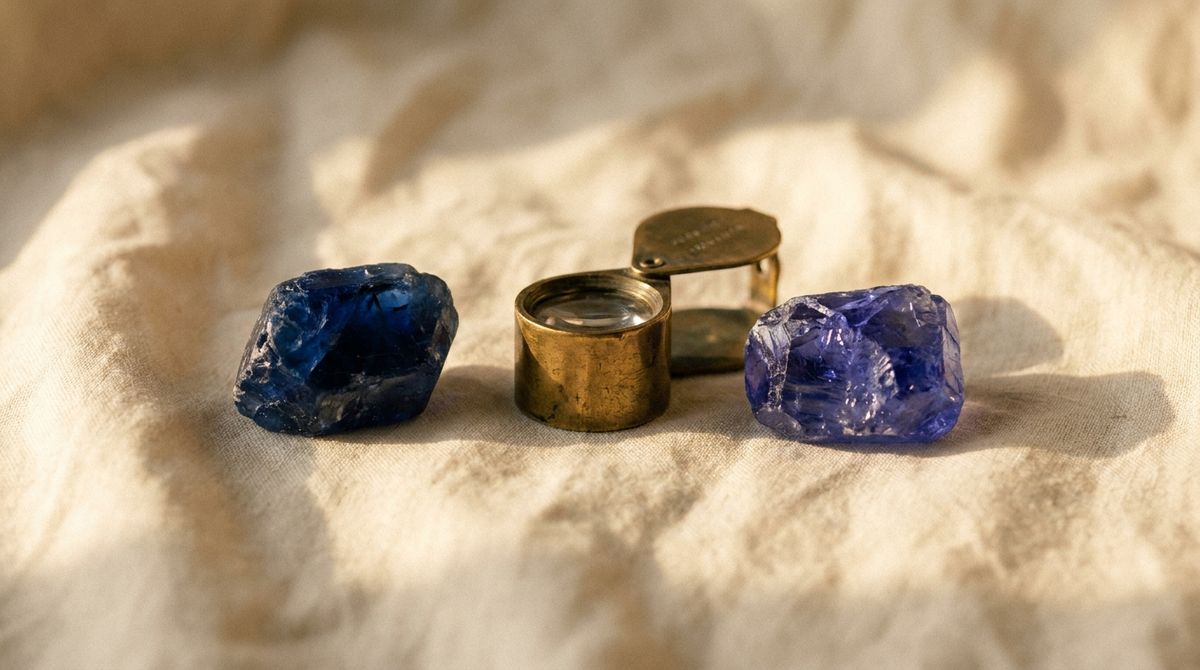
Sapphire's best-known color is a pure, saturated blue, though per GIA it also occurs as pink, yellow, green, orange and violet. Fine sapphire shows dichroism — two different colors from different viewing angles — which cutters orient to show the strongest face. Tanzanite goes further: GIA describes it as trichroic, showing three distinctly different colors — violet-blue, bluish-violet and violet-purple — depending on the direction it's viewed from. Nearly every tanzanite sold at retail has been heat-treated, a standard, disclosed industry practice that removes unwanted brownish tones and intensifies the blue-violet color; untreated material in that brownish state is far less commercially desirable.
Hardness, Cleavage, and Everyday Wear
This is the most practical difference for jewelry. Sapphire measures 9 on the Mohs hardness scale — second only to diamond among natural gems — and has no cleavage, so it resists chipping as well as scratching; it's tough enough that synthetic corundum is used for barcode-scanner windows and watch crystals. Tanzanite measures 6 to 7 per GIA, and on top of being softer, it has perfect cleavage in one direction, meaning a sharp knock at the right angle can split it rather than just scratch it — gemologists generally rate its toughness as fair to poor for that reason. Tanzanite is still wearable in daily jewelry with reasonable care (it's stable under normal heat, light and household chemicals), but it needs a protective setting and a gentler hand than sapphire. For a ring worn every day and knocked against things, sapphire is by far the more forgiving stone.
Rarity and Where Each Is Found
Sapphire is mined across multiple countries, each associated with a different look: Kashmir for velvety cornflower blue (a deposit largely exhausted for roughly a century, part of why record auction prices are Kashmir stones); Sri Lanka, historically Ceylon, with over two thousand years of continuous production; Myanmar's Mogok Valley for deep royal blues; Madagascar, which has grown since the late 1990s into the world's largest sapphire producer by volume; and Montana in the U.S., known for uniform cornflower-blue Yogo Gulch material. Tanzanite is the opposite case: it's commercially mined in exactly one place on Earth, a roughly 14-kilometer zone in the Merelani Hills near Mount Kilimanjaro. Estimates of how long that deposit will keep producing vary by source and assumption — figures commonly cited range from about 20 to 30 years — but there's no comparable second source anywhere, which is unusual for a major colored gemstone.
Price
Because sapphire is sourced from many countries at many quality levels, it spans an enormous price range: commercial-grade blue sapphire is genuinely affordable, while a fine, large, unheated Kashmir or Ceylon stone can be one of the most expensive gems per carat in the world. Tanzanite sits in a narrower, generally more accessible band — it's rarer geologically than ordinary sapphire, but its shorter market history and lack of sapphire's centuries-old premium reputation keep even fine, large stones well under top sapphire prices. Cutting also wastes more tanzanite rough than sapphire, since cutters have to orient each stone around that cleavage plane and its strongest color face, which pushes finished-stone prices up relative to rough.
Birthstone and Meaning
Sapphire is the traditional September birthstone and the gem tied to the 5th and 45th wedding anniversaries. Tanzanite is a newer addition to the birthstone calendar: the American Gem Trade Association added it as a December birthstone in 2002, alongside the older December stones zircon and turquoise, and it also marks the 24th wedding anniversary. Sapphire's symbolism — wisdom, loyalty, royalty — has accumulated over centuries. Tanzanite's is much younger and tied directly to its origin story: one Tanzanian hillside, discovered within living memory, without the older folklore layered onto sapphire.
Buying Tips for Each Stone
For tanzanite, ask specifically whether the stone has been heat-treated — nearly all commercial tanzanite has, and that's normal, but it should be disclosed, not hidden. Have it set in a protective style, such as a bezel or prongs that guard the girdle, rather than a fully exposed setting, given the cleavage risk, and avoid ultrasonic cleaners, which can worsen existing fractures. For sapphire, ask about treatment too: most sapphire on the market is heat-treated to improve color and clarity, which is standard and doesn't hurt value much, but untreated stones — especially from Kashmir or fine Ceylon material — carry a real premium and should come with a lab report if the price reflects that. Because sapphire has no cleavage weakness, it tolerates a much wider range of setting styles safely, including fully exposed prongs for daily wear.
Which One Should You Choose?
If you want a gemstone that can take a hard daily knock without special handling, holds value across a huge range of price points, and carries centuries of established meaning, sapphire is the safer choice — especially for an engagement ring or anything worn constantly. If you're drawn to a color no other gem quite produces, the shifting violet-blue tanzanite is known for, and you're willing to treat the piece a little more carefully and reserve it for occasional wear, tanzanite is a genuinely distinctive alternative, not a downgrade. Neither is a compromise pick against the other; they occupy different parts of the blue-gem market for real geological reasons.
Frequently Asked Questions
Is tanzanite as durable as sapphire?
No. Sapphire measures 9 on the Mohs hardness scale with no cleavage, while tanzanite measures 6 to 7 and has perfect cleavage in one direction, making it more prone to chipping from a hard knock. Both are stable under normal wear with reasonable care.
Why is tanzanite rarer than sapphire if it's usually cheaper?
Rarity and price aren't the same thing. Tanzanite is geologically rarer — it comes from a single deposit in Tanzania rather than multiple countries — but sapphire's much longer market history, wider size range, and top-tier stones from historic sources like Kashmir push its ceiling price far higher than tanzanite's.
Is tanzanite always heat-treated?
Nearly all tanzanite sold commercially has been heat-treated to remove brownish tones and intensify its blue-violet color — a standard, disclosed industry practice, not a defect.
What's the birthstone difference between sapphire and tanzanite?
Sapphire is the traditional September birthstone. Tanzanite is a December birthstone, added to that month's lineup by the American Gem Trade Association in 2002 alongside zircon and turquoise.
Can sapphire and tanzanite look the same color?
They can overlap in the blue-to-violet range, especially with sapphire's violet variety, but tanzanite's strong trichroism gives it a color shift between violet-blue, bluish-violet and violet-purple depending on the angle, which sapphire doesn't show to the same degree.