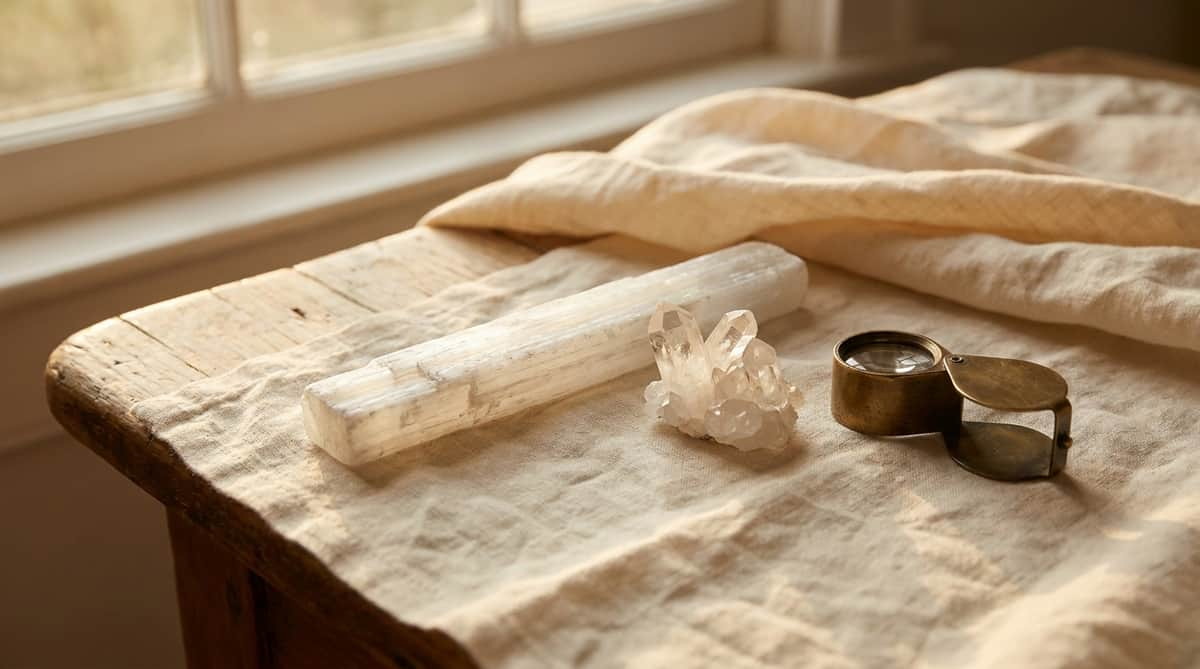
Selenite and clear quartz sit side by side in almost every crystal shop, get sold as a matching "cleanse and amplify" pair, and share almost nothing in common as minerals. One is soft enough to scratch with a fingernail and dissolves if you leave it in the rain; the other is hard enough to scratch glass and has been carved into tools for thousands of years. Here's what each one actually is, the fastest way to tell them apart without a lab, and why mixing them up matters more than it sounds like it should.
Two Different Minerals, One Marketing Pairing
Clear quartz is silicon dioxide (SiO2), the same mineral family behind amethyst, citrine, and smoky quartz — it just happens to be the colorless, high-clarity member of that family. Selenite is a form of gypsum, calcium sulfate dihydrate (CaSO4·2H2O), which puts it in an entirely different mineral class — closer, chemically, to the gypsum used in drywall and plaster than to any variety of quartz. They're shelved together because they're both pale, both popular as "starter" crystals, and both marketed around a cleansing-and-charging ritual — not because they're related.
The Fastest Tell: Hardness
This is the single most reliable way to identify either stone without any equipment. Clear quartz sits at 7 on the Mohs hardness scale — hard enough to scratch glass and resist most everyday scuffs. Selenite sits at about 2 — soft enough that a fingernail (which rates roughly 2.5) can scratch it, and soft enough that it can be damaged just from being tumbled in a pocket against keys or coins. If you have a loose piece and a steel pin or a fingernail you don't mind risking, a light scratch test settles the question in seconds: quartz won't show a mark, selenite will.
Selenite, Satin Spar, and Alabaster Are the Same Mineral
Most of what's sold as "selenite" in home-decor and crystal shops — the translucent wands, towers, and charging plates — is technically satin spar, a fibrous variety of gypsum with a silky sheen running through it in parallel lines. True selenite, in the strict mineralogical sense, refers to the flat, transparent, bladed crystal form of gypsum. Alabaster is the third common form: fine-grained, opaque, and prized for carving. All three are the identical mineral, gypsum, just grown or cut into different shapes — the names describe habit and appearance, not a different chemical makeup. Several gemology sources flag the "satin spar sold as selenite" substitution as one of the more commonly mislabeled pairings in the crystal trade, though it's more a matter of loose, decades-old naming convention than deliberate deception.
Selenite vs. Clear Quartz at a Glance
- Composition — Selenite: gypsum, calcium sulfate dihydrate. Clear quartz: silicon dioxide, the same family as amethyst and citrine.
- Hardness — Selenite: about 2 on the Mohs scale, scratches with a fingernail. Clear quartz: 7, scratches glass.
- Water safety — Selenite: water-soluble over time; a wet cloth or a soak can etch or dull the surface. Clear quartz: fully safe to rinse under running water, one of the few crystals gemologists recommend actually cleaning that way.
- Appearance — Selenite: silky, pearly, or glassy luster depending on the form (satin spar vs. true selenite); almost always white, colorless, or faintly honey-toned. Clear quartz: glassy luster, often grows as a hexagonal, pointed crystal with visible facets.
- Typical form sold — Selenite: flat wands, towers, and charging plates, usually cut or shaped. Clear quartz: natural points and clusters that keep their original crystal faces, alongside tumbled and carved pieces.
- Durability for jewelry — Selenite: too soft for a ring or bracelet in regular contact with hard surfaces. Clear quartz: durable enough for daily-wear settings, which is part of why it shows up in jewelry far more often than selenite does.
Why They Get Marketed as a Pair
In crystal-shop tradition, clear quartz is sold as the "master healer" or amplifier — a stone said to magnify intention or the effect of whatever's placed near it — while selenite is sold as the cleanser, the stone said to clear stagnant energy from a space or reset other crystals. Paired together, the pitch is simple: cleanse with one, amplify with the other. These are traditional and modern wellness framings rather than documented mineral properties, but the pairing is also just a convenient story that happens to cross-sell two inexpensive, visually similar-toned stones that look good displayed together — the metaphysical story and the merchandising story reinforce each other.
A Notable Deposit, for Scale
The largest documented selenite crystals ever found come from the Cueva de los Cristales (Cave of the Crystals) in Naica, Mexico, discovered in 2000 roughly 300 meters underground — some beams there measure over 10 meters long, grown over hundreds of thousands of years in a uniquely stable, mineral-saturated, superheated environment. Clear quartz has no single deposit of comparable fame; it's one of the most common minerals on Earth, found on every continent, with Brazil, Madagascar, and Arkansas's Ouachita Mountains among the best-known commercial sources of large, clear specimens.
Care: The One Rule That Actually Matters
Because selenite is water-soluble, never soak it, run it under a tap, or leave it somewhere damp — a soft, dry cloth is the only safe way to clean it, and direct sun can also fade or cloud some selenite pieces over long exposure. Clear quartz has no such restriction: it can be rinsed with water and even briefly exposed to sunlight without damage, which is part of why gemologists point to it as a genuinely low-maintenance stone rather than one that just has a low-maintenance reputation. If you're buying a piece to actually handle and clean regularly rather than display behind glass, that durability gap is worth weighing more than the color match.
FARUZO doesn't set loose selenite or quartz into jewelry — pieces this soft, in selenite's case, wouldn't hold up to daily wear — but if the shimmer and symbolism of a crystal is what you're after in a piece you can wear every day, our personalized rings are plated over durable 316L stainless steel rather than set with a stone that needs to stay dry.
Meaning and Symbolism
Selenite takes its name from Selene, the Greek goddess of the moon, after its pale, faintly luminous sheen — in crystal lore it's associated with clarity, calm, and clearing out what no longer serves you. Clear quartz carries the broadest set of associations of any crystal in the trade, generally framed as an all-purpose amplifier for intention, focus, and whatever energy is placed near it. As with all crystal-lore associations, these are traditional and modern-wellness framings, not documented properties of either mineral. For the full lore and history behind each stone individually, our selenite meaning guide and clear quartz meaning guide both go deeper on the symbolism side.
Frequently Asked Questions
Is selenite actually a crystal?
Loosely, yes, in the everyday retail sense — it forms crystalline structures. Mineralogically it's a variety of gypsum, not a "crystal" in the quartz-family sense people often mean by the word, which is part of why it behaves so differently (far softer, water-soluble) from quartz-family stones.
Can I clean my clear quartz and selenite the same way?
No. Clear quartz can be rinsed under running water safely. Selenite is water-soluble and should only be wiped with a soft, dry cloth — water can etch, dull, or in extreme cases dissolve its surface over time.
Is "selenite" sold in stores actually selenite?
Often it's satin spar, a fibrous variety of the same mineral, gypsum — not a different stone, just a different habit of the same material. True selenite, in the strict sense, is the flat, transparent, bladed form.
Which one is harder?
Clear quartz, by a wide margin. It rates 7 on the Mohs hardness scale versus roughly 2 for selenite — quartz can scratch glass, while selenite can be scratched with a fingernail.
Why are they sold together so often?
They're marketed as a complementary pair in crystal-healing tradition — selenite as a cleanser, clear quartz as an amplifier — and both are inexpensive, pale-toned stones that display well together, which reinforces the pairing commercially as well as symbolically.
Can either stone be set into a ring or bracelet for daily wear?
Clear quartz can; its hardness holds up to regular contact with other surfaces. Selenite generally can't — at Mohs 2, it's too soft to survive daily-wear jewelry without scratching or chipping.