Chrysoprase is one of the few green gemstones that isn't jade, isn't an emerald substitute, and isn't dyed to get its color — and yet it gets mistaken for all three constantly. Here's what chrysoprase actually is, where its apple-green color comes from, why "Australian jade" is a nickname worth being skeptical of, and how to avoid the two things most often sold under its name that aren't quite what they claim.
What Chrysoprase Actually Is
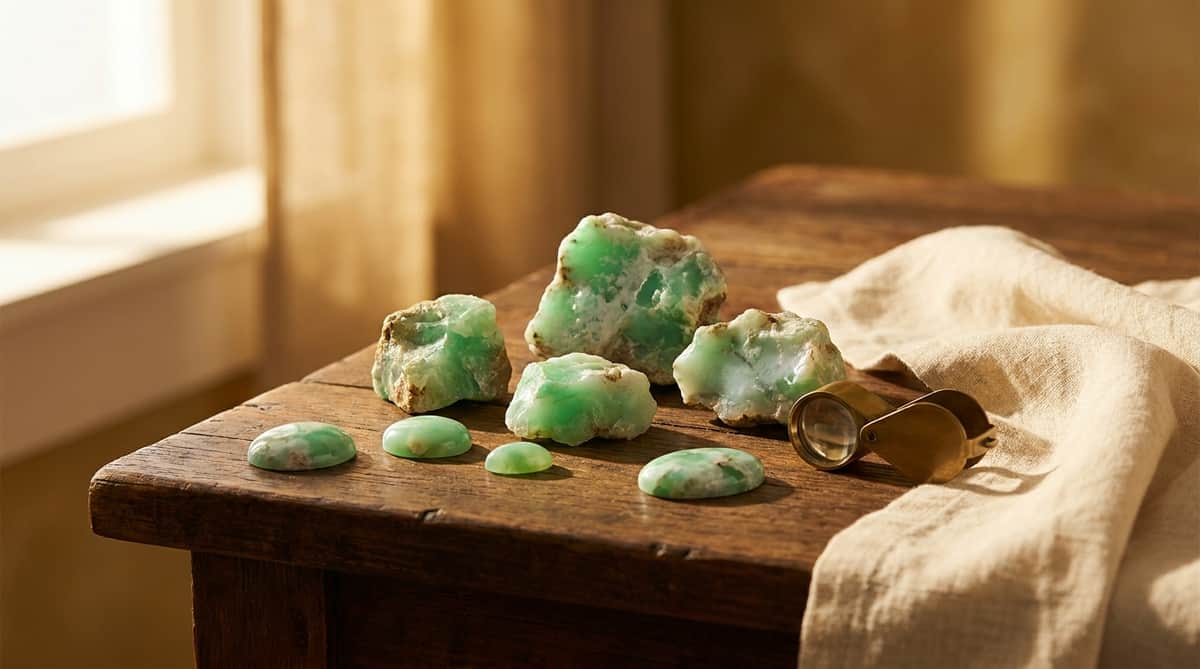
Chrysoprase is a gem-quality variety of chalcedony — the same microcrystalline quartz family behind agate, onyx, and carnelian — colored apple-green by trace amounts of nickel. That's a settled point in the mineralogical literature: nickel, not chromium, is the agent responsible for the color, distinguishing chrysoprase from "chrome chalcedony," a separate and much rarer nickel-free variety sometimes confused with it. On the Mohs hardness scale, chrysoprase sits at roughly 6 to 7 — durable enough for daily jewelry, comparable to most other chalcedony varieties, though sources differ slightly on its exact specific gravity (figures from about 2.58 to 2.90 appear across different references), so treat any single precise number with some caution.
Archaeological evidence shows chrysoprase in use for roughly 9,000 years, but it wasn't correctly identified as a nickel-bearing chalcedony until mineralogists worked out the chemistry in the 1830s — for most of its long history, it was simply "the green stone," classified more by appearance than composition.
Where It Comes From
Historically, the material that put chrysoprase on the European jewelry map came from deposits in Silesia, in what's now Poland, discovered in the mid-18th century and prized heavily by Victorian-era jewelers. Frederick the Great was famously fond of it, and the stone shows up in 18th-century Prussian court jewelry as a result.
The deposits that define top-quality chrysoprase today are in Australia, primarily around Marlborough in Queensland and in the Eastern Goldfields of Western Australia — the Queensland deposits have been worked commercially since the 1960s. Gemological sources describe Australian material as remarkably consistent in hue, saturation, and tone compared to chrysoprase from other sources, which is a real part of why it became the benchmark the trade measures other chrysoprase against. In these deposits, chrysoprase forms in veins and nodules within weathered ultramafic rock, with the nickel that colors it coming from that host rock.
Why "Australian Jade" Is a Misleading Nickname
Chrysoprase is commonly marketed as "Australian jade" because of its color and its strongest source country — but the name invites a mistake, not just a comparison. Jade refers to two entirely different minerals (jadeite and nephrite), both structurally unrelated to chalcedony. Calling chrysoprase "jade" of any kind is a marketing shortcut, not a mineralogical relationship.
- Mineral family: Chrysoprase is chalcedony (microcrystalline quartz, SiO₂); jade is either jadeite (a pyroxene) or nephrite (an amphibole) — chemically and structurally unrelated to quartz.
- Color source: Chrysoprase's green comes from nickel; jadeite's green typically comes from chromium or iron, and the two don't track together in value or rarity.
- Hardness: Chrysoprase measures about 6–7 on the Mohs scale; jadeite measures about 6.5–7 and nephrite about 6–6.5 — close enough that hardness alone won't tell them apart, which is part of why the "jade" label sticks.
- Market position: Fine jadeite is among the most valuable gem materials in the world; chrysoprase, even top Australian material, trades at a small fraction of that price.
None of this makes chrysoprase a lesser stone — it just means a "jade" label on a chrysoprase piece is a nickname, not a grading claim, and worth knowing before comparing prices.
The Meaning Crystal Sellers Attach to It
Physical. In crystal-healing retail, chrysoprase is commonly described as a stone associated with vitality, fertility, and heart health — claims that belong to folklore and retail tradition, not medicine, and shouldn't be read as health guidance.
Mental. The stone is most often marketed around forgiveness, emotional healing, and letting go of grudges or old resentments, with sellers frequently pairing it with themes of hope and optimism tied to its fresh, growth-like green.
Metaphysical. Chrysoprase is typically assigned to the heart chakra in crystal-healing systems, framed as a stone for opening compassion toward both others and oneself. Ancient Greek and Roman sources used green chalcedony varieties, chrysoprase included, in carved intaglios and seal rings, which modern sellers sometimes point to as evidence of a long "protective" tradition — a real historical use, even if the specific protective meaning attached to it today is a later retail addition rather than a documented ancient belief.
"Lemon Chrysoprase" Usually Isn't Chrysoprase at All
One real, well-documented point of confusion: material sold as "lemon chrysoprase," mined in Western Australia and prized for its pale yellow-green color, is not actually chalcedony. Gemological analysis identifies it as a nickeliferous magnesite — a different mineral species entirely that happens to share chrysoprase's nickel-driven coloring and a visually similar market niche. If a listing uses the name "lemon chrysoprase," it's worth asking the seller directly whether the material has been tested, since the name alone doesn't guarantee the chalcedony structure true chrysoprase has.
How to Spot a Dyed Fake
Because chrysoprase's value rises sharply with even, saturated apple-green color, lower-grade pale or mottled chalcedony is sometimes dyed to imitate it — a long-standing practice across the chalcedony family generally, not unique to this stone. A few practical checks:
- Color evenness: Natural chrysoprase typically shows some tonal variation, cloudy patches, or veining (visible in the specimens above); a perfectly uniform, saturated green with no variation at all is a reason to ask more questions.
- Color in cracks or pits: Dye tends to concentrate in surface fractures and pores, showing as deeper or more saturated color exactly where the stone is damaged — a natural stone's color doesn't follow its flaws that way.
- Price relative to source: Genuine fine Australian chrysoprase commands a real premium; a saturated, evenly colored "chrysoprase" priced far below what quality material usually costs is worth independent verification.
- Ask for origin: A seller who can name Marlborough, the Eastern Goldfields, or a historical Silesian source — and who clearly distinguishes true chrysoprase from "lemon chrysoprase" — is a stronger sign of a seller who knows the material.
Wearing and Caring for Chrysoprase
At 6–7 on the Mohs scale, chrysoprase holds up reasonably well to daily wear in a ring or bracelet, though it's softer than quartz-family gems worn edge-on against hard surfaces and should still be removed before heavy manual work. Clean it with mild soap and lukewarm water and a soft cloth; skip ultrasonic cleaners and prolonged heat or sun exposure, both of which can affect chalcedony's color over time. For a setting that lets the stone's color read clearly, a simple personalized ring setting in a light metal tone suits chrysoprase's pale green better than a heavy, dark mounting that competes with it.
Frequently Asked Questions
Is chrysoprase a type of jade?
No. Chrysoprase is a variety of chalcedony (quartz); jade refers to jadeite or nephrite, both structurally unrelated minerals. "Australian jade" is a marketing nickname based on color and source country, not a mineralogical classification.
What causes chrysoprase's green color?
Trace amounts of nickel within the chalcedony's microcrystalline quartz structure. This distinguishes ordinary chrysoprase from the rarer, chromium-colored "chrome chalcedony" sometimes confused with it.
Is "lemon chrysoprase" real chrysoprase?
No — gemological testing identifies most material sold under that name as nickeliferous magnesite, a different mineral that happens to share a similar nickel-driven color, not true chalcedony.
Where does the best chrysoprase come from?
Australia is considered the benchmark source today, chiefly Marlborough in Queensland and the Eastern Goldfields in Western Australia, both noted for unusually consistent color. Historically, Silesian deposits in present-day Poland supplied the material prized by 18th-century European jewelers.
How hard is chrysoprase, and is it durable enough for daily jewelry?
About 6 to 7 on the Mohs hardness scale — durable enough for a ring or bracelet worn regularly, though it should come off before heavy manual work and shouldn't go through an ultrasonic cleaner.