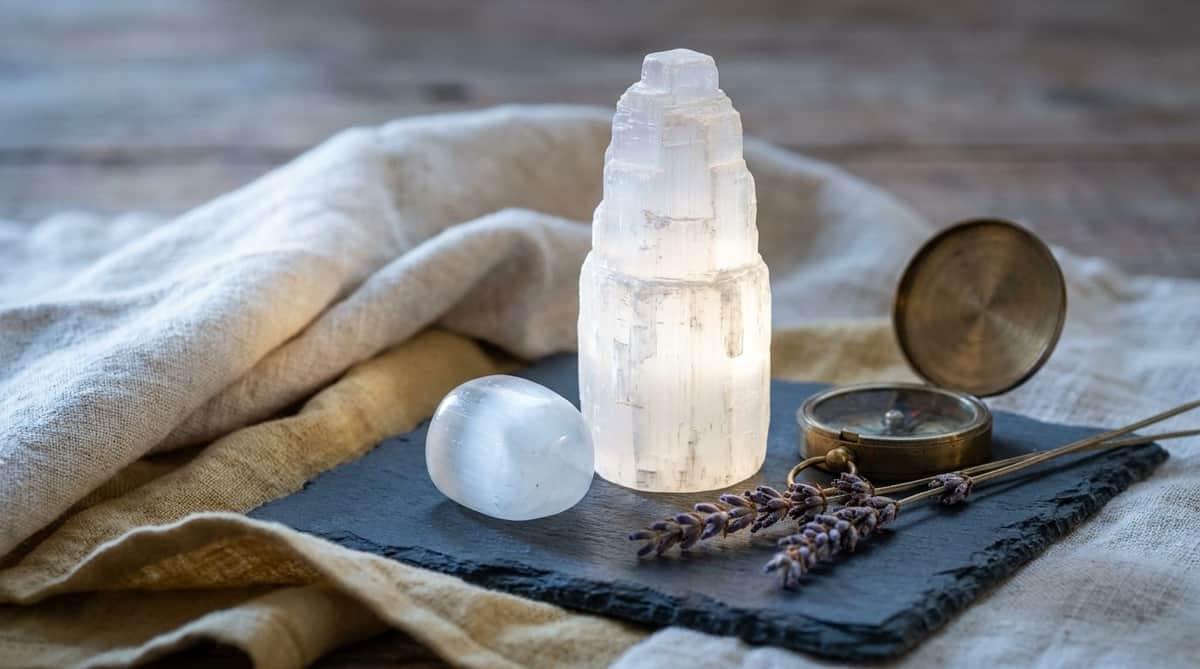
Selenite doesn't look like it should exist in nature — thin, glassy sheets that seem to hold moonlight inside them, sometimes stacked into towers as tall as a person. It's also one of the softest, most fragile materials sold as a “crystal,” which makes it an unusual case: genuinely striking geology, wrapped in a layer of internet folklore that has little to do with the mineral itself. Here's what selenite actually is, where the biggest deposits on Earth are found, and how to keep a piece from dissolving on your nightstand.
What Selenite Actually Is
Selenite is the clear-to-translucent crystalline variety of gypsum, a hydrous calcium sulfate with the chemical formula CaSO₄·2H₂O — “hydrous” meaning water is built directly into its crystal structure, not just sitting on the surface. It crystallizes in the monoclinic system and has a specific gravity of about 2.3. What sets it apart from other gypsum forms, like alabaster or fibrous satin spar, is its transparency: well-formed selenite can be clear enough to read through in thin slices.
Two things about selenite matter more than anything else if you plan to own a piece: it is only a 2 on the Mohs hardness scale — soft enough to scratch with a fingernail — and it has perfect cleavage, meaning it splits cleanly along flat planes under even light pressure. Structurally, it's one of the most delicate materials sold in the gem and crystal trade.
Where the Name Comes From
The name has nothing to do with the element selenium, despite sharing a root. “Selenite” comes from the Greek selēnitēs, “of the moon,” from Selēnē, the Greek goddess of the moon — a reference to the pale, shimmering light the crystal reflects. The mineralogical name was formalized in 1747 by the Swedish scientist Johan Gottschalk Wallerius in his mineralogy text Mineralogia. Long before that, ancient writers had already linked the stone to lunar cycles, with some reportedly believing thin sheets of it visibly waxed and waned like the moon — a claim with no basis in the mineral's actual optical properties, but one that stuck to its name for nearly three centuries.
The Meaning of Selenite: Physical, Mental, and Metaphysical
Modern crystal-shop language tends to flatten selenite's reputation into one word — “cleansing” — but the tradition around it actually splits into a few distinct claims, worth separating from what the mineral can verifiably do.
Physical
There is no clinical evidence that selenite affects the body, and it should not be treated as having any medical or therapeutic effect. What is physically true about selenite is its optical behavior: its fibrous, satin-spar form produces a soft chatoyant sheen, and thin slabs transmit light with a diffused, glowing quality that has made it as popular for lamps and light fixtures as for jewelry accents.
Mental
In crystal-healing traditions, selenite is described as a “clarity” stone — associated with calm and mental focus, loosely tied to its light-transmitting, clear-headed appearance. This is a belief framework, not a documented mechanism; treat it the way you would any wellness folklore.
Metaphysical
The most widely repeated claim is that selenite “cleanses” or “recharges” other crystals placed near it, and that it never needs cleansing itself. This idea has no scientific basis and no documented origin older than the modern crystal-healing movement — it's presented here as a popular belief among collectors, not as fact.
The World's Largest Crystals: Naica's Cave of Crystals
The single most extraordinary thing about selenite isn't metaphysical — it's geological. In 2000, miners drilling beneath a lead and silver mine in Naica, Chihuahua, Mexico broke into a limestone cavern roughly 300 meters underground containing the largest natural crystals ever documented: selenite beams up to 11.4 meters (about 37 feet) long, with an estimated mass around 12 tonnes each. They formed over an extraordinarily long timescale — researchers describe “ultraslow growth rates” — as mineral-rich groundwater, kept at a stable, near-boiling temperature by a magma chamber below, allowed gypsum to crystallize with almost no disturbance.
The cave itself is barely survivable: temperatures reached 58°C (136°F) at close to 100% humidity, and visitors without protective suits could last only about ten minutes before risking heatstroke. After a worker died attempting to remove a crystal illegally in 2015, the mine was allowed to flood again, and the chamber has been sealed and underwater since 2017 — meaning the largest selenite crystals on Earth are, right now, inaccessible even to the scientists who study them.
How Selenite Forms in the Desert: White Sands
Selenite doesn't only grow in hidden caves — it also forms in open desert basins, and White Sands National Park in New Mexico is the clearest example. The gypsum there was originally laid down roughly 250 million years ago, in a shallow sea that covered the region during the Permian period. Tectonic uplift later pushed that gypsum-bearing rock into the surrounding mountains; rain and snowmelt then dissolved it and carried it into the enclosed Tularosa Basin, which has no outlet to the sea. As water evaporates in low-lying areas like Lake Lucero, it leaves crystalline selenite behind on the playa floor. Wind then breaks and polishes those crystals into the fine gypsum sand that built the largest gypsum dune field on Earth — roughly 275 square miles of dunes.
Where Selenite Comes From Today
Commercially, most of the selenite sold as raw towers, slabs, and “desert rose” formations comes from Morocco, particularly gypsum deposits in the country's Oriental Region and the Western Sahara, where large, well-formed crystal formations are relatively abundant and easy to quarry. It's also found in the United States, including the gypsum beds around White Sands itself, as well as in parts of Australia, Russia, and other arid regions where gypsum deposits formed near evaporated ancient seas or lakes. Because selenite is common and inexpensive to mine compared to harder gemstones, the raw pieces sold in shops are almost always natural and untreated — there's little financial incentive to fake it.
Caring for Selenite
Selenite's biggest vulnerability — water sensitivity — follows directly from its chemistry: as a hydrous mineral, gypsum is measurably soluble in water. A brief accidental splash usually won't leave visible damage if it's dried immediately, but soaking, regular rinsing, or leaving it in a humid bathroom will gradually pit, cloud, and dull the surface over time — the opposite of the “self-cleaning” reputation it has in crystal-care folklore. Skip water-based cleaning methods entirely. Instead, wipe selenite with a soft, dry cloth, and keep it out of direct, prolonged sunlight, which can also make some pieces brittle. Given its Mohs hardness of 2, it's also worth storing it separately from harder stones or metal jewelry that could scratch it in a drawer or pouch.
If you're drawn to selenite specifically for the moon symbolism, it pairs naturally with birthstones that carry their own lunar or protective associations — moonstone is the closest match in both name and folklore, even though the two minerals are unrelated. For something wearable that keeps a personal stone close, a birthstone name necklace is a common way people combine a meaningful gem with a durable, daily-wear setting rather than a soft raw crystal.
For a broader look at how other stones compare — hardness, color origin, and the traditions behind them — see our guide to different gemstones and what they really mean, and if you're caring for stones already set in a ring, how to clean a gemstone ring covers the safer methods for set stones.
Frequently Asked Questions
Can selenite go in water?
No. Selenite is a form of gypsum, which is water-soluble. Prolonged or repeated contact with water will pit, cloud, and gradually dissolve its surface. A quick, accidental splash dried immediately is unlikely to cause visible damage, but selenite should never be soaked, rinsed regularly, or left in a humid bathroom.
Is selenite a real crystal or just gypsum?
Selenite is real gypsum — specifically, the clear-to-translucent, well-formed crystalline variety of it. “Gypsum” is the mineral name; “selenite” describes gypsum that forms in this particular transparent, crystalline habit, as opposed to the fine-grained massive form (alabaster) or the fibrous form (satin spar).
Does selenite actually cleanse other crystals?
There's no scientific basis for this claim. It's a belief within modern crystal-healing culture with no documented origin older than that movement, and no mechanism has ever been shown to support it. Selenite is popularly used this way by collectors, but it should be understood as folklore, not a demonstrated property of the mineral.
Why is selenite so soft compared to other crystals?
Selenite ranks just 2 on the Mohs hardness scale — for comparison, quartz is a 7 and diamond is a 10 — because gypsum's crystal structure is held together by relatively weak molecular bonds and contains water molecules within its lattice. That same structure gives it perfect cleavage, meaning it splits cleanly along flat planes under light pressure, rather than fracturing unevenly like harder stones.
Where does most selenite sold today come from?
The majority of the raw selenite towers, slabs, and “desert rose” formations sold commercially come from Morocco's gypsum deposits, particularly in the Oriental Region and the Western Sahara. Large deposits also exist in the United States, including the White Sands region of New Mexico, and other arid regions worldwide where ancient seas or lakes once evaporated.