Moonstone is a variety of feldspar, the same broad mineral family as labradorite and sunstone, and its signature effect — a soft, floating glow that seems to move beneath the surface as the stone turns — has a real optical explanation, not a mystical one. Its meaning, on the other hand, comes almost entirely from folklore: centuries of belief across Rome, India, and beyond, carried forward largely unchanged by today's crystal-wellness world. This guide covers what the stone actually is, where its reputation comes from, its place among June's three official birthstones, and what to know before wearing or caring for it.
What Moonstone Actually Is
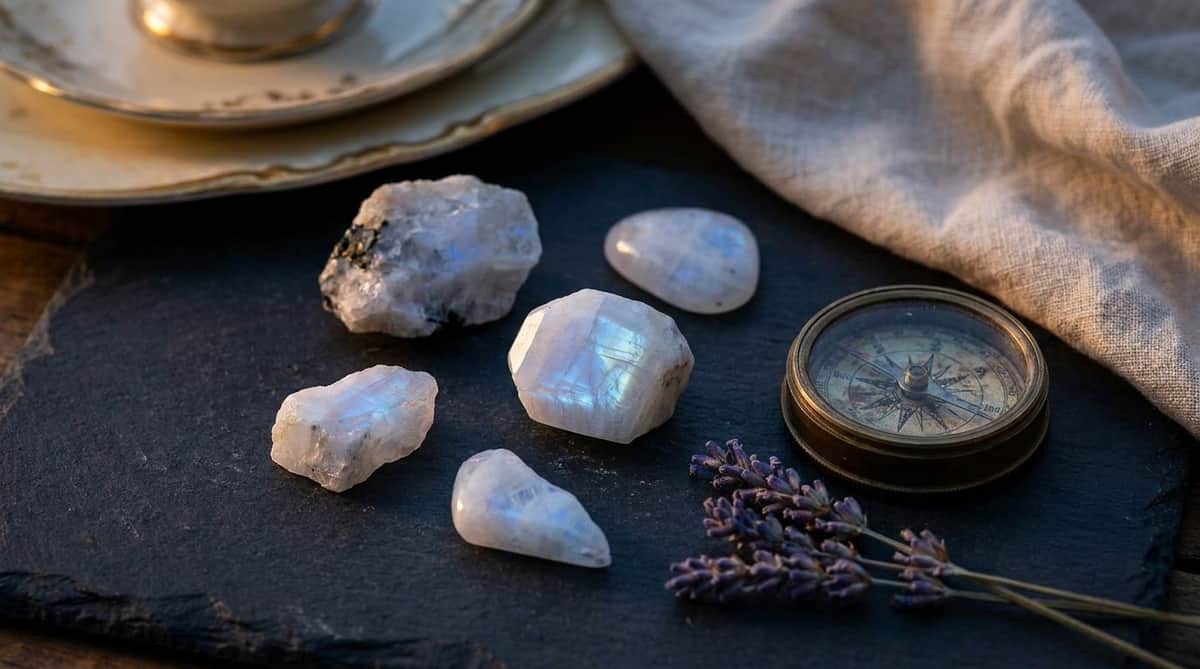
Moonstone forms from two feldspar minerals — orthoclase and albite — that begin intergrown as a single mass and separate into thin, stacked, alternating layers as the rock slowly cools. Light entering the stone scatters between those layers in an effect called adularescence: a soft blue-to-white sheen that appears to billow across the surface as the stone moves, rather than flash from a single facet the way a cut diamond or faceted quartz would.
On the Mohs hardness scale, moonstone sits at 6 to 6.5 — noticeably softer than quartz (7) or sapphire (9), which is the main thing to plan around if you wear it daily; more on that below. The best commercial-grade material, prized for a strong blue flash over a clear or colorless body, comes primarily from Sri Lanka, with additional sources in India, Myanmar, and Madagascar. The mineral itself occurs in dozens of countries, but gem-quality adularescence strong enough to sell as jewelry is comparatively rare.
Where the Meaning Comes From
Moonstone's reputation predates modern crystal-wellness culture by well over a thousand years. In ancient Rome, the stone was associated with Diana, the goddess of the moon, and Roman writers believed it was literally formed from solidified moonlight — a belief that gave the stone both its name and its lasting tie to the lunar cycle and the idea of new beginnings.
In India, moonstone has long held a separate, still-active tradition of its own: it's considered a sacred stone, given as a traditional wedding gift, and used in bridal talismans. A related, more widespread belief — sometimes called the stone's ‘traveler's’ reputation — held that carrying moonstone offered protection on a journey, particularly travel at night or over water.
None of this is a scientific claim; it's centuries of folklore that a large modern wellness market has carried forward largely unchanged. Today's version usually frames moonstone as a stone of intuition, emotional balance, and fresh starts — worth reading as belief, not as a verified effect, the same way we'd frame the meaning behind any stone in our wider gemstone meanings guide.
Moonstone and the Zodiac
Moonstone is the stone most commonly paired with Cancer (roughly June 21–July 22) on modern zodiac gemstone lists, for a fairly direct reason: Cancer is treated as a Moon-ruled sign in Western astrology, and moonstone is treated as the Moon's gemstone. It's a belief-system pairing, not an astronomical one — see our zodiac signs by month guide for how each sign's stone gets assigned.
How Moonstone Is Cut and Set
Because adularescence is a light-scattering effect between internal layers, cutters shape moonstone as a smooth, domed cabochon rather than faceting it — a high dome, precisely aligned to the stone's internal layers, shows the floating glow at its strongest, while facets would break it up. Faceted moonstone does exist and gives a brighter, more contemporary look, but it trades away some of the effect that makes the stone recognizable in the first place.
Given its Mohs 6–6.5 hardness, moonstone is set most often in pendants, earrings, and brooches, where it isn't exposed to daily knocks the way a ring would be. Rings are still common, but protective settings (bezels, or a setting that keeps the stone recessed below the metal's edge) hold up better than an exposed prong setting over years of wear.
Moonstone vs. Rainbow Moonstone vs. Labradorite
Three feldspar stones get confused constantly, and the trade naming doesn't help. True moonstone is a potassium feldspar (orthoclase) that typically shows a soft blue-to-white glow — adularescence — over a light or colorless body.
‘Rainbow moonstone,’ despite the name, isn't moonstone at all: it's a variety of labradorite (a plagioclase feldspar), usually a pale or white one, cut to show a similar-looking sheen. Labradorite proper displays a bolder, often multicolored flash called labradorescence, typically over a much darker base. As a rule of thumb: color flashes of blue, green, and gold over dark grey or black is labradorite; a lighter stone with a single, soft blue-white glow is closer to genuine moonstone.
Wearing and Caring for Moonstone Jewelry
Protect it from scratches. At 6 to 6.5 on the Mohs scale, moonstone is softer than quartz, sapphire, and diamond — store it separately from harder stones and metals that could scratch its surface, and take rings off before manual work or exercise.
Skip the ultrasonic and steam cleaner. Moonstone's layered internal structure — the same one that creates its glow — makes it more prone to fracturing under heat and vibration than harder, more uniform stones. Clean it by hand instead.
Clean it gently. Warm water, a drop of mild dish soap, and a soft cloth is enough for routine cleaning — the same gentle approach we'd recommend for any gemstone jewelry that isn't diamond-hard.
Avoid prolonged direct sun and sharp temperature swings, which can stress the internal layering over time and, in some stones, cause fine internal fractures known as crazing.
Is Moonstone a Birthstone?
Yes. Moonstone has been one of June's three official birthstones — alongside pearl and alexandrite — since the American National Retail Jewelers Association standardized the modern birthstone list in 1912; alexandrite was added to the trio later, in 1952. June is one of only three months (with August and December) assigned more than one official stone. See our June birthstone guide for how the three compare, and it's a common choice for a personalized birthstone piece for anyone born that month.
Because moonstone shows up on both the June birthstone list and the color-meaning traditions built around white and clear stones — covered in our gemstone color meanings guide — it ends up a common pick for a personalized birthstone necklace, whether the occasion is a June birthday or just the stone itself.
Frequently Asked Questions
What does moonstone mean?
Moonstone is traditionally read as a stone of intuition, emotional balance, and new beginnings, a meaning rooted in centuries-old belief that the stone was formed from moonlight and tied to the lunar cycle. It's folklore, not a scientific claim, but it's genuinely old and cross-cultural rather than a recent invention.
Is moonstone a real birthstone?
Yes — moonstone has been an official June birthstone since 1912, alongside pearl (and later alexandrite, added in 1952). It shares the month with two other stones rather than standing alone.
Is rainbow moonstone the same as moonstone?
No. ‘Rainbow moonstone’ is a trade name for a pale variety of labradorite, a different feldspar mineral. True moonstone is orthoclase feldspar and shows a softer, single-tone blue-white glow (adularescence), while labradorite shows a bolder, multicolor flash (labradorescence).
Is moonstone durable enough for an everyday ring?
With care, yes, though it needs more caution than a harder stone. At 6 to 6.5 on the Mohs scale it's softer than quartz or sapphire, so it tends to hold up better in a pendant or earrings for daily wear, or in a ring set with some protection around the edges.
Why does moonstone have that glowing effect?
It's called adularescence, caused by light scattering between microscopically thin, alternating layers of two feldspar minerals inside the stone. It's a real, well-documented optical phenomenon, best displayed by a cabochon cut — not a lighting trick or a coating.