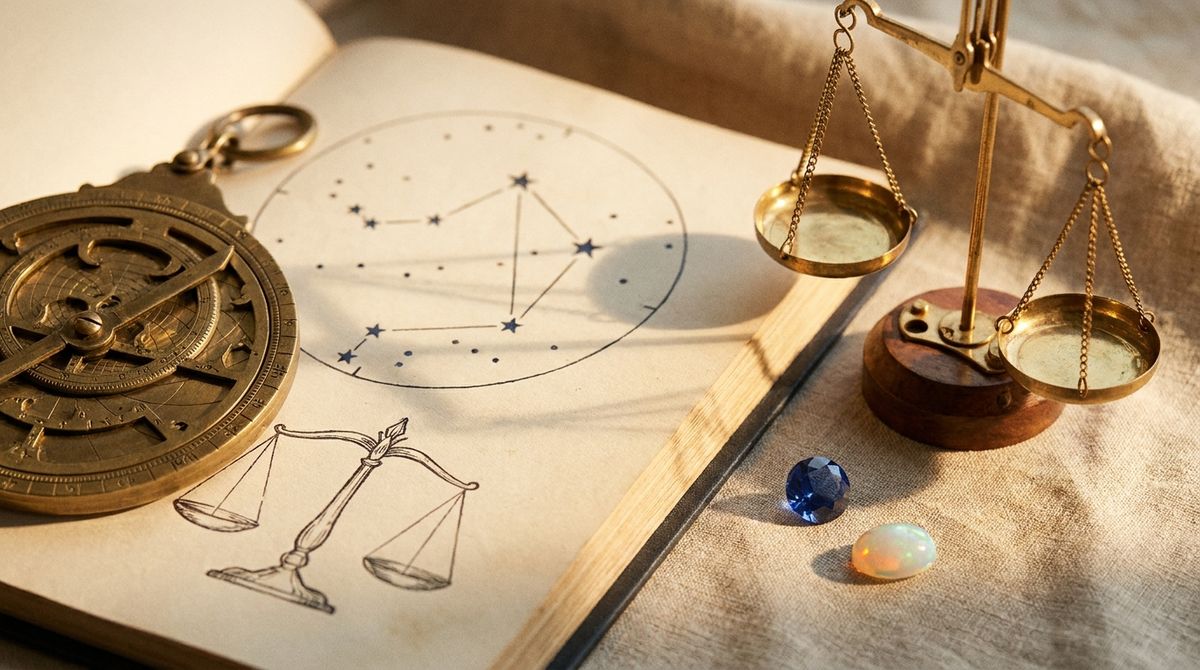
Libra is the seventh sign of the zodiac, covering everyone born between September 23 and October 22 — a window that, like Virgo's, straddles two separate birthstone months, which is why the honest answer to "what's the Libra stone" has more than one part. Libra is ruled by Venus, carries the cardinal air element, and takes its symbol from the scales — the only sign represented by an object rather than a creature. This guide covers Libra's real dates, where the scales symbol comes from, the sign's actual personality reputation, its traditional zodiac stone versus its calendar birthstones, and what that means if you're buying jewelry for a Libra.
Libra Dates, Element, and Ruling Planet
Libra runs from September 23 to October 22 in most modern tropical-zodiac calendars, following Virgo and carrying the year from the end of summer into mid-autumn. Its element is air, shared with Gemini and Aquarius, and its modality is cardinal — the opening sign of a season, associated with initiating rather than sustaining (fixed) or adapting (mutable) a cycle. Libra specifically opens autumn, arriving right around the fall equinox.
Its ruling planet is Venus, the same planet that rules Taurus, though the two signs express it differently: Taurus's Venus is sensory and grounded, Libra's is social and relational. That placement is the traditional source for Libra's association with partnership, aesthetics, and a pull toward balance — the sign is described as the zodiac's diplomat, weighing both sides before committing to either.
In plain terms: a Libra birthday falls in the last eight days of September or the first three weeks of October — there's no Libra birthday outside September 23 through October 22, and no version of the sign born in any other month. For the full rundown of how Libra fits alongside the other eleven signs — dates, elements, and ruling planets side by side — see our zodiac signs by month guide.
The Scales: Where the Libra Symbol Comes From
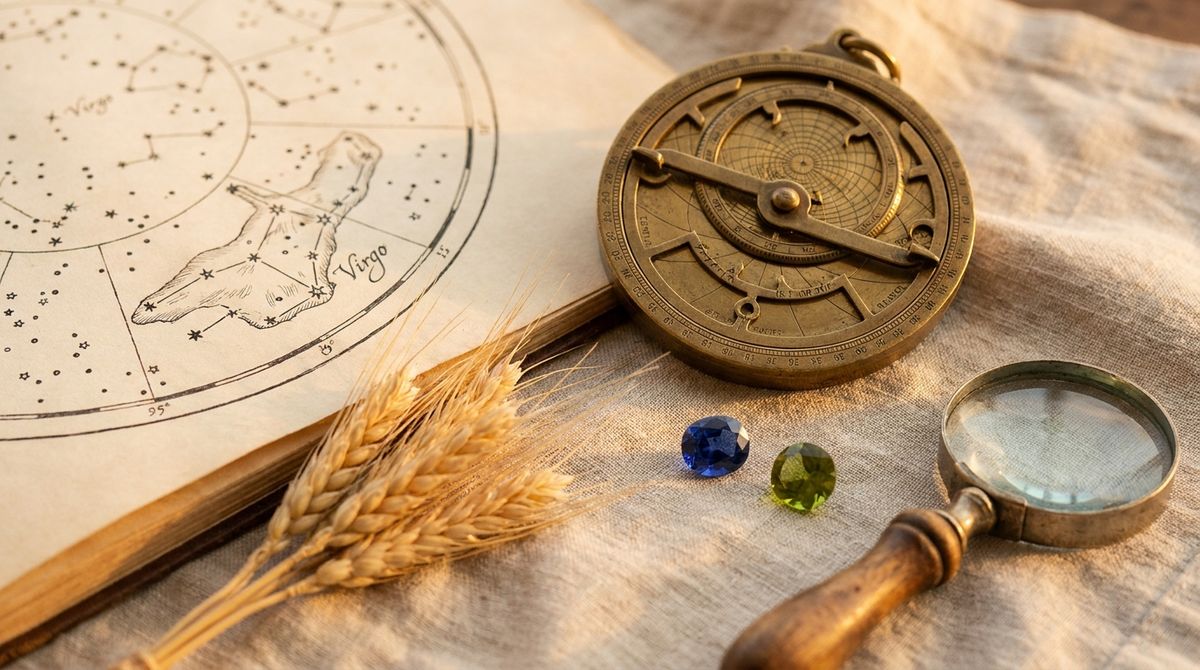
Libra takes its symbol — a set of balance scales — and its Latin name, meaning "scales" or "a balance," from a split identity it didn't originally have. For centuries, Greek astronomers treated these stars not as their own constellation but as Chelae Scorpionis, "the claws of the scorpion" — an extension of Scorpio rather than a sign in its own right.
It was Roman astronomy that formally separated the claws from Scorpio and renamed the stars Libra, tying the new sign to Roman law and to Iustitia, the Roman goddess of justice, who was depicted holding scales to weigh truth and claims. Some versions of the myth connect the symbol instead to Themis, the Greek Titaness of divine law, or her daughter Astraea — the same goddess credited with the neighboring sign Virgo — both shown in classical art holding scales as they judge the fairness of human affairs. Libra remains the only sign in the zodiac represented by an inanimate object rather than an animal or a person, which astrology writers often read as fitting for a sign about balance rather than character.
Libra Personality Traits, Honestly
Folk astrology describes Libra as diplomatic, charming, and fair-minded — traits tied directly to the scales symbol and Venus's rulership. The same sources are candid about the flip side: Libra's reputation for indecision comes from the same instinct to weigh every option before committing, which can look like charm in a negotiation and look like stalling everywhere else. Libra is also commonly described as conflict-averse to a fault, preferring to smooth over a disagreement rather than let it run its course, and as unusually attentive to how a room or a relationship feels, a trait astrology writers trace back to Venus governing both beauty and social harmony. None of this is a measured personality trait; it's a centuries-old literary archetype built around what the symbol and planet are said to represent, repeated and refined across astrology writing rather than tested against how any specific person actually behaves.
Libra's Traditional Stone vs. Its Birthstones
Ask what a Libra's "real" stone is and you'll get two different answers depending on which tradition is being quoted. The older jewelry-trade convention assigns opal to the whole sign as a single zodiac stone, regardless of exact birthday — a tradition some sources extend to tourmaline as a second, more modern option. The newer, calendar-based birthstone list instead follows the month, not the sign, which is where Libra's split comes in: a Libra born in the back half of September gets sapphire, September's stone, while a Libra born any time in October gets opal or tourmaline, the two modern October stones. Both answers are legitimate — they just come from different traditions that were never reconciled into one official list, so treat either as cultural convention rather than a single settled fact.
Libra Compatibility
In traditional Western astrology, Libra is said to pair most easily with the other air signs, Gemini and Aquarius, which share its taste for conversation and ideas, and with the fire signs Leo and Sagittarius, whose directness balances Libra's deliberation. Earth and water signs — Taurus, Virgo, Capricorn, Cancer, Scorpio, Pisces — are typically described as a slower match, needing more effort to bridge Libra's airy sociability with their own more grounded or emotional styles. Libra and Aries sit directly opposite each other on the zodiac wheel — Aries opens spring, Libra opens autumn — and that opposition is traditionally read as a complementary pull between Aries's self-focus and Libra's partnership focus rather than a flat incompatibility. As with every compatibility claim in pop astrology, these are traditional associations passed down through the genre, not a measured outcome for any two real people.
Jewelry and Gifts for a Libra
Because Libra's stone story genuinely has two honest answers, the safest personalized gift leans on the date rather than guessing at a single gem: a birthstone ring set to the recipient's actual birth month — sapphire or opal/tourmaline — sidesteps the zodiac-vs-calendar debate entirely. A scales motif is the more literal nod to the sign itself, and for a Libra who'd rather wear a name than a symbol, a custom name necklace works for the sign's own well-documented taste for things that feel considered rather than generic.
Frequently Asked Questions
What are the exact dates for Libra?
Libra runs from September 23 to October 22 in the tropical zodiac used by most modern Western astrology. A sidereal (constellation-based) zodiac shifts the window roughly a month later, but the tropical dates are what almost every horoscope and birthstone chart in everyday use is built around.
What is Libra's ruling planet?
Venus. Libra shares that rulership with Taurus, though the two signs are described as expressing Venus differently — Taurus through comfort and physical pleasure, Libra through relationships, aesthetics, and balance.
What is Libra's real stone — opal or sapphire?
Both, depending on which tradition is being used. The older single zodiac-stone convention assigns opal to the entire sign. The modern calendar birthstone list instead follows the month: sapphire for a late-September Libra, opal or tourmaline for an October Libra.
Is Libra an air sign or a cardinal sign?
Both at once — element and modality describe two different things. Libra's element is air (shared with Gemini and Aquarius) and its modality is cardinal (shared with Aries, Cancer, and Capricorn), making it specifically a cardinal air sign.
What's the mythological origin of the Libra symbol?
The scales were originally seen as the claws of Scorpio in Greek astronomy, before Roman astronomers split them into their own sign and connected them to Iustitia, the Roman goddess of justice, who was depicted holding a set of scales.