Virgo is the sixth sign of the zodiac, covering everyone born between August 23 and September 22 — a window that, like Leo's, straddles two separate birthstone months, which is why the honest answer to "what's the Virgo stone" has more than one part. Virgo is ruled by Mercury, carries the mutable earth element, and takes its symbol from the Maiden. This guide covers Virgo's real dates, where the maiden symbol comes from, the sign's actual personality reputation, its traditional zodiac stone versus its calendar birthstones, and what that means if you're buying jewelry for a Virgo.
Virgo Dates, Element, and Ruling Planet
Virgo runs from August 23 to September 22 in most modern tropical-zodiac calendars, following Leo and carrying the year from the end of summer into early fall. Its element is earth, shared with Taurus and Capricorn, and its modality is mutable — the closing sign of each season, associated with adapting and transitioning rather than starting (cardinal) or sustaining (fixed) a cycle.
Its ruling planet is Mercury, the same planet that rules Gemini, though the two signs express it differently: Gemini's Mercury is outward and curious, Virgo's is inward and methodical. That placement is the traditional source for Virgo's association with precision, analysis, and practicality — the sign is described as the zodiac's editor, refining and perfecting rather than originating.
In plain terms: a Virgo birthday falls in the last nine days of August or the first three weeks of September — there's no Virgo birthday outside August 23 through September 22, and no version of the sign born in any other month. For the full rundown of how Virgo fits alongside the other eleven signs — dates, elements, and ruling planets side by side — see our zodiac signs by month guide.
The Maiden: Where the Virgo Symbol Comes From
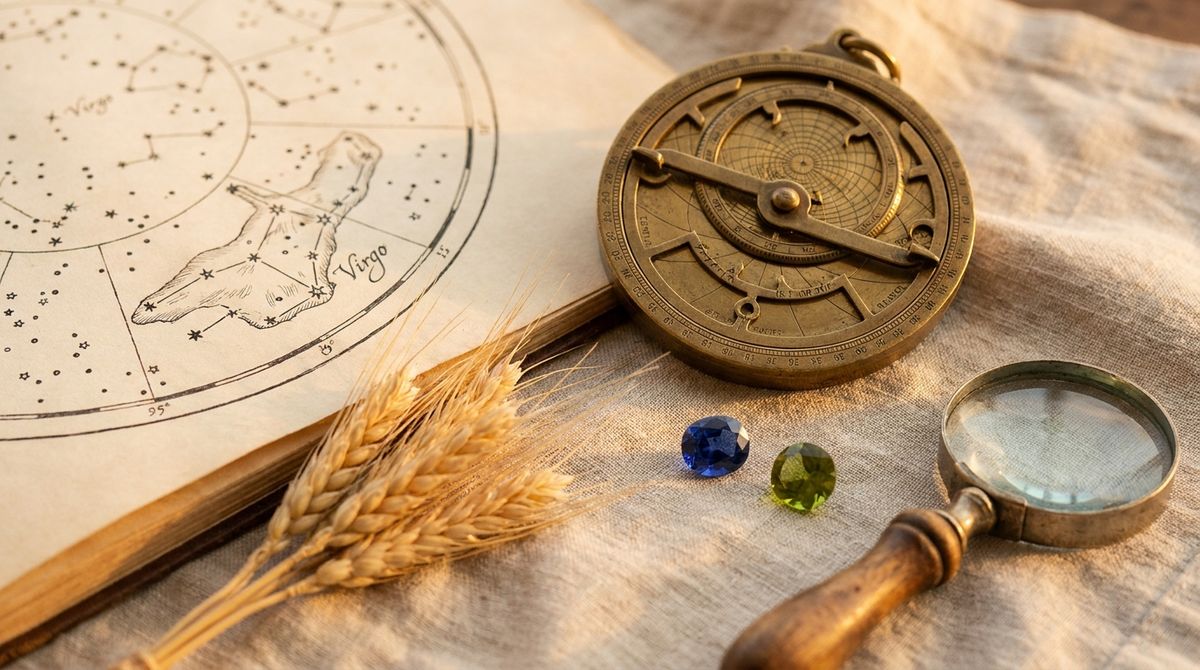
Virgo takes its symbol — a young woman, often shown holding a sheaf of wheat — and its Latin name for "virgin" or "maiden" from Astraea, the Greek goddess of justice and innocence. Astraea was said to be the daughter of Astraeus, god of dusk, and Eos, goddess of dawn; her name translates roughly to "star-maiden."
In the most common version of the myth, Astraea lived among humans during the Golden Age, a time of peace before war and greed took hold. As the Iron Age dawned and injustice spread, she was the last immortal to abandon Earth, ascending to the sky and becoming the constellation Virgo. A second strand of the tradition ties the constellation instead to Demeter, the harvest goddess, or her daughter Persephone — which is where the wheat sheaf most Virgo imagery carries actually comes from, a harvest symbol layered onto Astraea's star-maiden myth rather than competing with it.
Virgo Personality Traits, Honestly
As with any sign, Virgo's personality reputation comes from a centuries-old descriptive tradition, not measurable data, and it's worth reading it that way. The recurring traits attached to Virgo are practicality, attention to detail, and reliability — a sign described as noticing what needs fixing before anyone else does, tied back to Mercury's association with analysis and craft.
The same traits read as strengths or flaws depending on framing: a sharp eye for what's wrong and a habit of holding things to a high standard are, structurally, the same trait — wanting things done right. The sign's mutable modality is described the same double-edged way: adaptable and genuinely useful in a crisis on one hand, prone to overthinking and self-criticism on the other.
Virgo's Traditional Stone vs. Its Birthstone
Sources differ here more than for most signs. Sapphire is the most consistently cited traditional zodiac stone for Virgo in older gem-lore compilations, though a few sources cite peridot or carnelian instead — there is no single agreed-on "real" Virgo stone the way there is for some other signs.
Because Virgo spans August 23 to September 22, it crosses two birthstone months: peridot (or spinel, added as a second official August birthstone in 2016) for anyone born in the August portion, and sapphire for anyone born from September 1 onward — two stones with almost nothing in common, one a pale olive-green silicate, the other a dense blue-to-multicolor corundum.
- Traditional zodiac stone: Sapphire (most sources); peridot or carnelian in a few others
- Calendar birthstone, Aug 23–31: Peridot, or Spinel
- Calendar birthstone, Sep 1–22: Sapphire
If you're buying by the calendar date on a birth certificate, the birthstone is the traditional choice. If you're buying by star sign specifically — someone who identifies strongly as a Virgo regardless of which half of the window they were born in — sapphire is the safer default, since it's the stone actually cited as "Virgo's" most often. A birthstone necklace lets you sidestep the question entirely by matching the stone to the exact birth date instead of the sign.
Virgo Compatibility
Compatibility astrology is built more around element and modality than any single trait. Virgo, a mutable earth sign, is most often described as compatible with the other earth signs, Taurus and Capricorn, and with the water signs — Cancer, Scorpio, and Pisces — whose element is traditionally said to nourish earth rather than erode it.
The pairings flagged as harder are the other mutable signs — Gemini, Sagittarius, and Pisces — where two temperaments built around adapting to change can struggle to give each other the stability either one is quietly looking for. None of this is predictive in any measurable sense; it's a centuries-old descriptive framework, not a compatibility test with evidence behind it.
Jewelry and Gifts for a Virgo
Given Virgo's reputation for precision and a preference for things done well over things done loud, gifts tend to land best when they're genuinely considered rather than generic — a name necklace engraved with real care reads as more "Virgo" than an ornate piece picked for its own sake.
For something tied to an actual birth date rather than the sign itself, a birthstone necklace lets you match the birthstone to the day, in peridot or sapphire depending on where in the Virgo window the birthday falls.
Frequently Asked Questions
What are the exact dates for Virgo?
Virgo runs from August 23 to September 22 in most modern tropical-zodiac calendars, though the exact start and end can shift by a day depending on the year, since the zodiac follows the solar calendar rather than a fixed calendar date.
What is Virgo's ruling planet?
Mercury. Virgo shares this ruler with Gemini, but expresses it inwardly — through analysis, precision, and craft — rather than Gemini's outward curiosity, which is the traditional source of Virgo's reputation for detail and practicality.
What is Virgo's real stone — sapphire, peridot, or carnelian?
All three show up depending on the source. Sapphire is the most consistently cited traditional zodiac stone for Virgo. Peridot and spinel are the calendar birthstones for the August portion of the sign, and sapphire is the calendar birthstone for the September portion — so which one is "right" depends on whether you're buying by sign or by birth date.
Is Virgo an earth sign or a mutable sign?
Both — the two describe different things. Earth is Virgo's element, shared with Taurus and Capricorn. Mutable is its modality, shared with Gemini, Sagittarius, and Pisces, describing its tendency to adapt and transition rather than start or sustain a cycle.
What's the mythological origin of the Virgo symbol?
Most commonly, Astraea — the Greek goddess of justice and innocence, who lived among humans during the Golden Age and was the last immortal to leave Earth as injustice spread, rising to become the constellation Virgo. A second tradition connects the sign's wheat-sheaf imagery to Demeter, the harvest goddess, or her daughter Persephone.