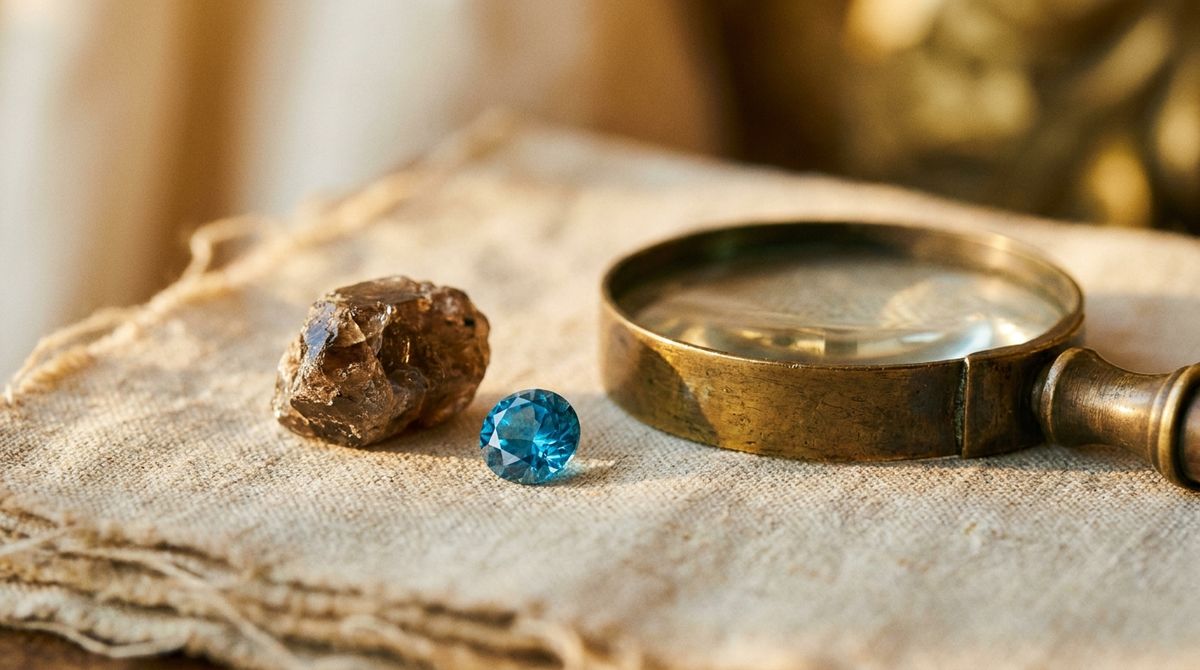
Say "opal" and most people picture October's birthstone: a pale stone flashing rainbow color as it turns in the light. Fire opal and pink opal are both opal too, but neither one usually does that. Fire opal trades the rainbow for a solid wash of orange, red, or yellow; pink opal skips it entirely for an opaque, milky pink. This guide covers what each stone actually is, why they look nothing like the opal most people expect, and how to wear and care for both. For the classic play-of-color stone and its place in the birthstone calendar, our birthstone finder covers October in full.
What Opal Actually Is
Every opal — fire, pink, or the classic rainbow kind — is hydrated silica (SiO₂·nH₂O), not a crystal in the way most gemstones are. Opal is amorphous: it has no repeating internal lattice, just a mass of tiny silica spheres packed together with water trapped between them, typically 3 to 21% of the stone's weight. In precious opal, those spheres are stacked in a regular enough grid to split light into the rainbow flashes called play-of-color. Fire opal and pink opal are both usually "common opal" instead — the spheres are present but not stacked with that precision, so the light-splitting effect is absent no matter how the stone is turned.
Fire Opal
Physical
Fire opal gets its name from its body color, not from any optical effect — a transparent to translucent orange, red, or yellow that can look genuinely lit from within under the right light. Most fire opal is cut as a faceted stone specifically because it's clear enough to show that color through the whole gem, unlike the cabochons opal is usually cut into. A small percentage of fire opal does also carry play-of-color on top of its orange base, which the trade calls "fire opal with play-of-color" — but that's the exception, not what defines the stone. Mexico is by far the dominant source, so much so that fire opal is sometimes called "Mexican opal" in the trade.
Mental and Metaphysical
In wellness and crystal traditions, fire opal is described as a stone of vitality, passion, and creative energy — an association that follows directly from its warm color rather than from any documented effect. Its history in Mexico predates that modern label: the Aztecs are recorded to have mined and worked fire opal, associating it with the quetzal bird, and some sources connect the stone's name in trade language back to that history. As with any gemstone's folklore, covered more broadly in our different gemstones meaning guide, this is tradition passed down through belief, not a measured or scientific claim.
Pink Opal
Physical
Pink opal is opaque rather than transparent, with a soft, milky pink that ranges from a pale blush to a stronger bubblegum shade depending on trace minerals — manganese is the element most often credited with the color. Because it's opaque, it's almost always cut as a smooth cabochon or used in beads rather than faceted. The best-known source is Peru, which is why the trade name "Peruvian pink opal" or "Andean pink opal" shows up on the stone as often as "pink opal" does.
Mental and Metaphysical
Crystal and wellness traditions describe pink opal as a stone of emotional healing, compassion, and calm — the same category of association most pink stones carry in that tradition, from rose quartz to morganite. That's a belief carried by folklore rather than by evidence, and worth treating the same caution as any other stone's symbolism: a tradition worth knowing, not a fact about the mineral.
Why Neither One Flashes Like October's Opal
The play-of-color that makes precious opal distinctive comes entirely from the regular stacking of its silica spheres, and that structure is what fire opal and pink opal typically lack. Fire opal's value comes from its transparency and saturated color instead; pink opal's comes from its uniform, opaque pastel. Neither absence makes them "lesser" opal — they're valued on a different set of criteria than play-of-color opal is, the same way a ruby and a star ruby are both genuine corundum valued for different things.
How to Wear and Care for Fire Opal and Pink Opal
Opal in any form sits at 5.5 to 6.5 on the Mohs hardness scale — softer than quartz and noticeably softer than the corundum or diamond used in many everyday rings, so it scratches more easily and is better suited to pendants, earrings, or occasional-wear rings than a piece worn against hard surfaces daily. Opal's water content is also its main vulnerability: extreme heat, direct sunlight for long stretches, or very dry air can cause it to lose moisture and develop fine surface cracks known as crazing. Store opal jewelry away from direct heat sources, avoid ultrasonic and steam cleaners, and clean it with a soft, slightly damp cloth rather than soaking it or scrubbing with chemicals. Both fire opal and pink opal are also more commonly treated or assembled as doublets and triplets — thin slices of opal backed or capped with other material — so if you're buying a stone represented as solid natural opal, ask specifically, since the care instructions differ for a bonded stone.
Frequently Asked Questions
Is fire opal the same mineral as regular opal?
Yes. Fire opal is hydrated silica like any other opal; what sets it apart is its transparent orange, red, or yellow body color rather than play-of-color.
Does fire opal ever show play-of-color?
A small share of fire opal does, called "fire opal with play-of-color" in the trade, but most fire opal is valued for its solid color alone.
Where does pink opal come from?
Mostly Peru, which is why it's often sold as "Peruvian pink opal" or "Andean pink opal." Smaller deposits exist elsewhere, but Peru is the dominant commercial source.
Is pink opal the same as October's birthstone opal?
They're the same mineral family, but pink opal is opaque common opal without play-of-color, while October's traditional birthstone opal usually refers to the rainbow-flashing precious variety. Our birthstone finder covers October's full birthstone list, including opal's alternate, tourmaline.
Is opal a durable everyday gemstone?
Less than most. At 5.5–6.5 on the Mohs scale and sensitive to heat and dryness, opal — fire, pink, or precious — is better suited to jewelry worn with some care than to daily hard wear.