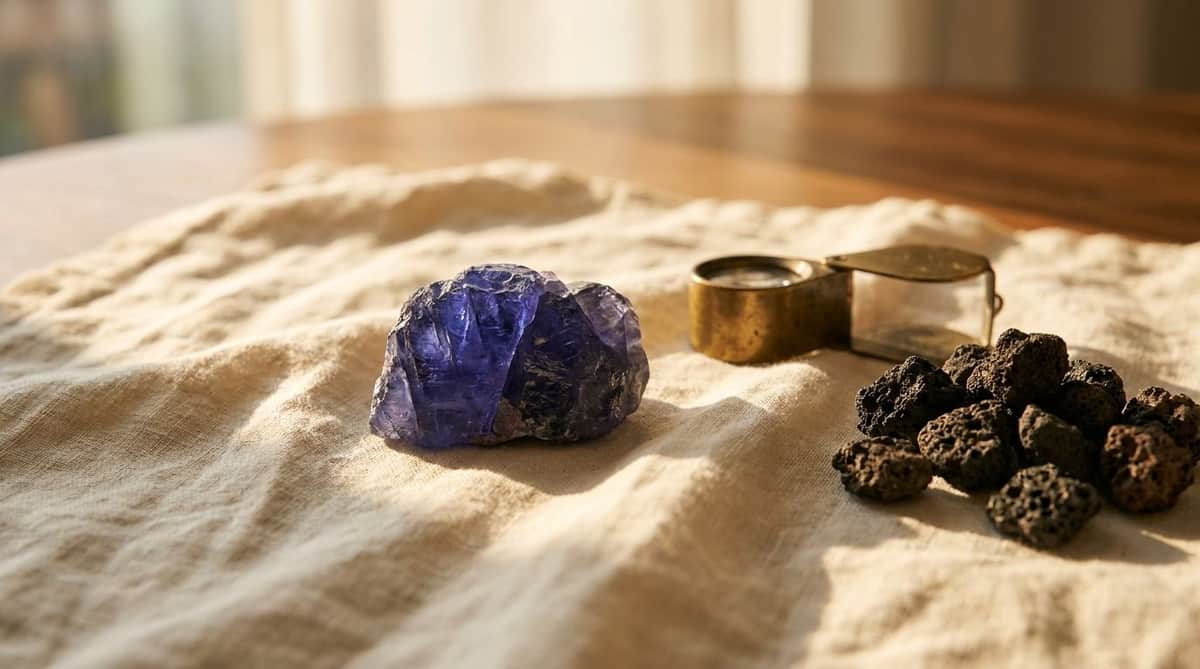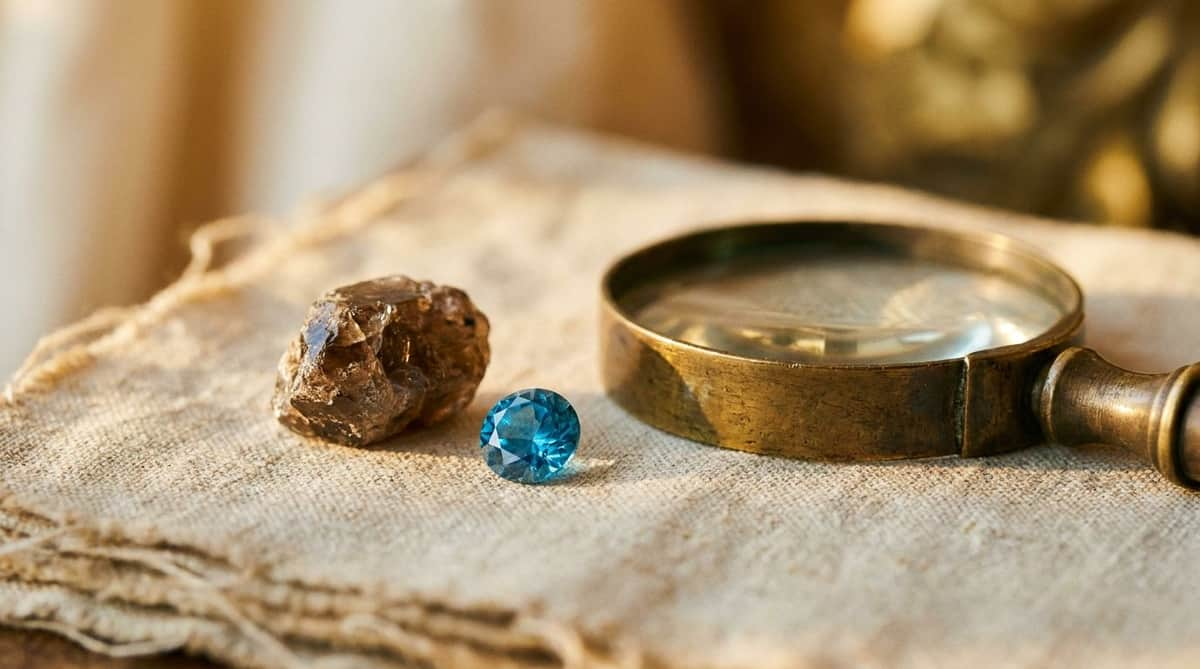
Zircon has the misfortune of sharing half its name with a stone it has nothing to do with: cubic zirconia, the lab-made diamond simulant most people think of first when they hear something close to "zircon." The confusion runs deep enough that many shoppers assume zircon is a fake, when in fact it's a natural mineral that's been faceted into jewelry for centuries, that gave diamond a run for its money in brilliance long before synthetic simulants existed, and that includes some of the oldest crystals ever found on Earth. This guide covers what zircon actually is, its real geology and history, how to tell it from its look-alikes, and how to wear and care for it. If you're not sure which month a piece should be built around, our birthstone finder can confirm it in a few seconds.
What Zircon Actually Is
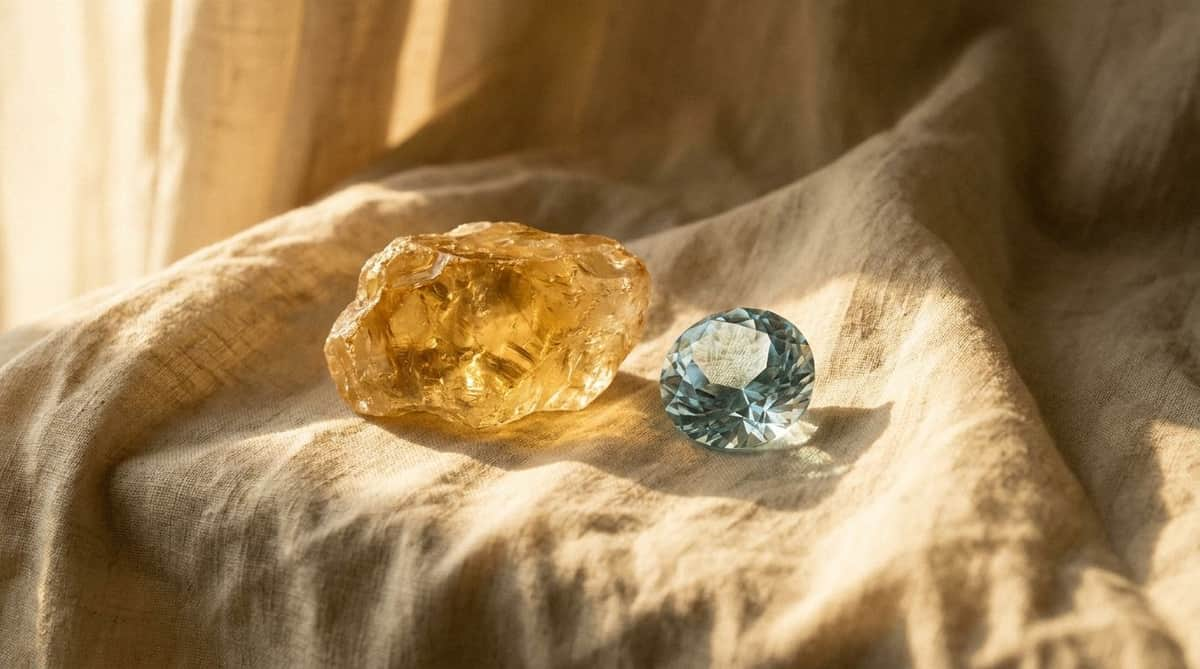
Zircon is a natural mineral, zirconium silicate, with the chemical formula ZrSiO₄. It crystallizes in the tetragonal system and occurs in a genuinely wide range of colors, including colorless, blue, yellow, brown, red, and green — colorless and blue are the two most prized for jewelry, with blue in particular carrying the strongest market recognition today.
The single most important thing to understand about zircon is what it is not: it is not cubic zirconia. Cubic zirconia is a synthetic crystal, zirconium dioxide, manufactured in a lab specifically to imitate diamond, and it has a completely different chemical composition from zircon despite the similar name. Zircon is a naturally occurring mineral that has been mined and cut for jewelry for a very long time; cubic zirconia didn't exist commercially until the 1970s. The names overlapping is a genuine and common source of consumer confusion, not a marketing accident on either side — the two words simply happen to look alike.
Properties: Physical, Mental, and Metaphysical
Physical
Zircon has a notably high refractive index and strong dispersion — the technical term for the "fire," or flashes of rainbow color, a cut stone throws off — both unusually high for a natural gemstone. That combination gives well-cut zircon a brilliance that can approach diamond's, which is exactly why, long before synthetic diamond simulants existed, natural zircon was used as a diamond substitute in jewelry. On the Mohs hardness scale, zircon rates 6 to 7.5, and the stone is somewhat brittle. That means facet edges can show wear, sometimes called abrasion, after years of daily contact — more so than harder, tougher stones like sapphire or diamond, so zircon rewards a setting that protects its edges rather than one that exposes them to constant contact.
Mental
In wellness and crystal circles, zircon is sometimes described as a stone associated with clarity, restful sleep, or grounding — language that's been attached to many gemstones across different cultures and eras. As with any stone's meaning covered in our different gemstones meaning guide, that's a belief carried by tradition and personal practice, not a measured or documented effect.
Metaphysical
Zircon has old associations in several cultures with protection, prosperity, and restful sleep, attached to the stone long before any modern gemological understanding of it existed. Those are genuine historical and folk associations — worth reading as a window into how people related to the stone across generations, not as a claim with any scientific basis.
The name itself carries meaning: gemologists trace "zircon" either to the Persian zargun ("gold-colored") or the Arabic zarkun ("vermilion"), both plausible given how widely the stone's natural color actually ranges. In medieval Europe specifically, zircon was credited with inducing sound sleep, warding off evil spirits, and bringing its wearer riches, honor, and wisdom — the documented folklore behind the looser "protection, prosperity, restful sleep" language still attached to the stone today.
Colors, Treatment, History, and Earth's Oldest Crystals
Zircon's color range in nature is unusually broad for a single mineral species, running through colorless, blue, yellow, brown, red, and green stones. Most blue zircon sold today, however, isn't mined that way — it starts as naturally brown rough and is heat-treated to bring out the blue color, a standard, disclosed practice in the gem trade rather than a deception, similar to how most commercial blue topaz reaches its color through treatment rather than occurring that way in the ground.
Zircon's place on the December birthstone list is relatively recent: blue zircon was formally added to the modern birthstone list in 1952, alongside turquoise and blue topaz, giving the month three recognized stones rather than one.
Separate from its jewelry history, zircon holds a genuinely remarkable scientific distinction: it's one of the oldest minerals on Earth. Zircon crystals recovered from the Jack Hills region of Western Australia have been radiometrically dated to roughly 4.4 billion years old — among the oldest known terrestrial materials on the planet, older than nearly everything else geologists have found. Scientists study these ancient crystals specifically because they preserve clues about the conditions on Earth in its earliest, least-documented period, long before any rock record most people are familiar with begins.
That extreme age connects to another real property of the mineral: zircon that contains trace radioactive uranium or thorium can undergo a slow internal structural breakdown over geologic timescales, a process mineralogists call metamictization, which can affect the stone's color and clarity over millions of years. It's a genuine and well-documented mineralogical phenomenon, not a safety concern for finished jewelry — zircon sold as a gemstone today isn't a radiation concern at any meaningful level, the process in question plays out over geologic time, not over a human lifetime of wear.
How to Tell Real Zircon From Look-Alikes
The look-alike that matters most here isn't really a look-alike at all — it's a name-alike. Zircon and cubic zirconia are frequently confused purely because their names sound similar, despite being chemically unrelated: zircon is a natural zirconium silicate mineral, while cubic zirconia is a synthetic zirconium dioxide crystal grown specifically to imitate diamond. If a listing or a seller is vague about which one they mean, that ambiguity is worth asking about directly, since the two occupy very different places in both geology and price.
Zircon's own historical role adds a second layer worth knowing: because natural zircon's high refractive index and strong dispersion give it brilliance that can approach diamond's, it was used as a diamond substitute in jewelry long before either cubic zirconia or moissanite existed as alternatives. Our diamond meaning guide covers diamond's own identifying properties in more depth, which is useful context for understanding why zircon, and later its synthetic name-alike, both got compared to diamond in the first place. Beyond refractive index and dispersion readings, a jeweler can confirm zircon's identity with standard gemological testing rather than relying on appearance or name alone.
How to Wear and Care for Zircon Jewelry
Zircon's hardness of 6 to 7.5 puts it in a middle range — wearable day to day, but more prone to scratching and edge wear over time than harder stones like sapphire or diamond, and its brittleness means facet edges in particular deserve some protection rather than constant exposed contact. Clean zircon jewelry with warm water, mild soap, and a soft brush; ultrasonic and steam cleaners are generally best avoided, since the vibration and heat they produce can stress a stone that's already more prone to chipping at its facet edges than tougher gems. Store zircon pieces separately from harder stones to limit surface scratching, and favor a protective setting for rings especially, where daily contact is heaviest.
Frequently Asked Questions
Is zircon the same as cubic zirconia?
No. Zircon is a natural mineral, zirconium silicate, that's been mined and cut into gemstones for centuries. Cubic zirconia is a synthetic crystal, zirconium dioxide, manufactured in a lab specifically to imitate diamond. The names sound alike, but the two have different chemical compositions and different origins.
Is zircon a real birthstone?
Yes. Blue zircon is one of three recognized birthstones for December, alongside turquoise and blue topaz. It was formally added to the modern birthstone list in 1952. Our birthstone finder can confirm which month and stone applies to a specific birthday.
Why is most blue zircon treated?
Because natural blue zircon rough is uncommon; most blue zircon sold today starts as naturally brown rough and is heat-treated to bring out its blue color. It's a standard, disclosed practice in the gem trade, not a form of deception.
Is zircon dangerous because of radioactivity?
No. Some zircon crystals contain trace uranium or thorium, which over geologic timescales can cause a slow internal breakdown called metamictization affecting color and clarity — a real mineralogical process, but not a radiation concern for jewelry-grade zircon sold today.
Was zircon really used as a diamond substitute?
Yes, historically. Natural zircon has an unusually high refractive index and strong dispersion for a natural gemstone, giving it brilliance that can approach diamond's. That's why it was used as a diamond substitute in jewelry long before cubic zirconia or moissanite existed as synthetic alternatives.
Is zircon a crystal or a gemstone?
Both, at different stages of the same material. Zircon forms naturally as a zirconium silicate crystal in the tetragonal system — that's the crystal. Once that crystal is cut and faceted for jewelry, the same material is called a gemstone. "Zircon crystal" and "zircon gemstone" describe the same mineral before and after cutting, not two different things.
Should I wear zircon as a necklace or a ring?
Either works. The hardness and edge-protection tradeoff covered above matters more for rings, which take the most daily knocks, than for necklaces. Our guide to choosing a birthstone necklace covers sizing and stone selection in more depth, and the birthstone necklaces collection lets you build a piece around any birth month, not just December.