Diamond carries more symbolism than almost any other gem, but strip away the marketing and what's left is still remarkable: a mineral made of nothing but carbon, formed under conditions no factory can casually replicate, and harder than anything else nature produces. This guide covers what diamond actually is, how it forms and gets graded, how to spot a look-alike, and how to wear and care for diamond jewelry. For the birthstone angle specifically, our birthstone finder can help you match a stone to any month on the calendar, diamond included.
What Diamond Actually Is
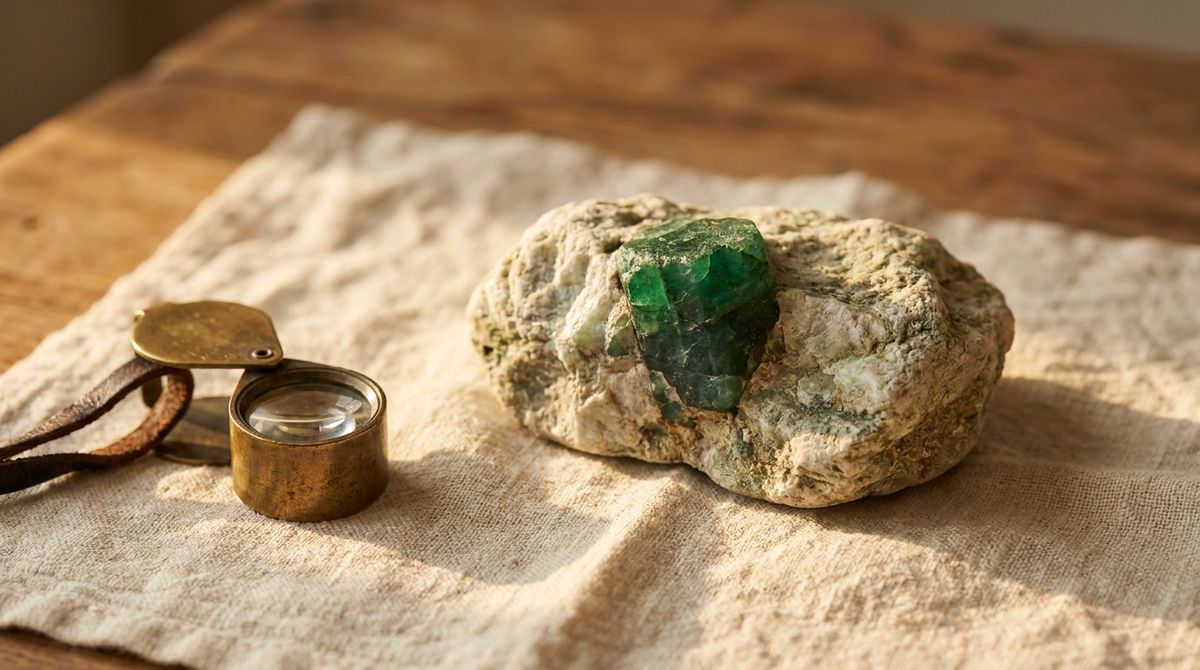
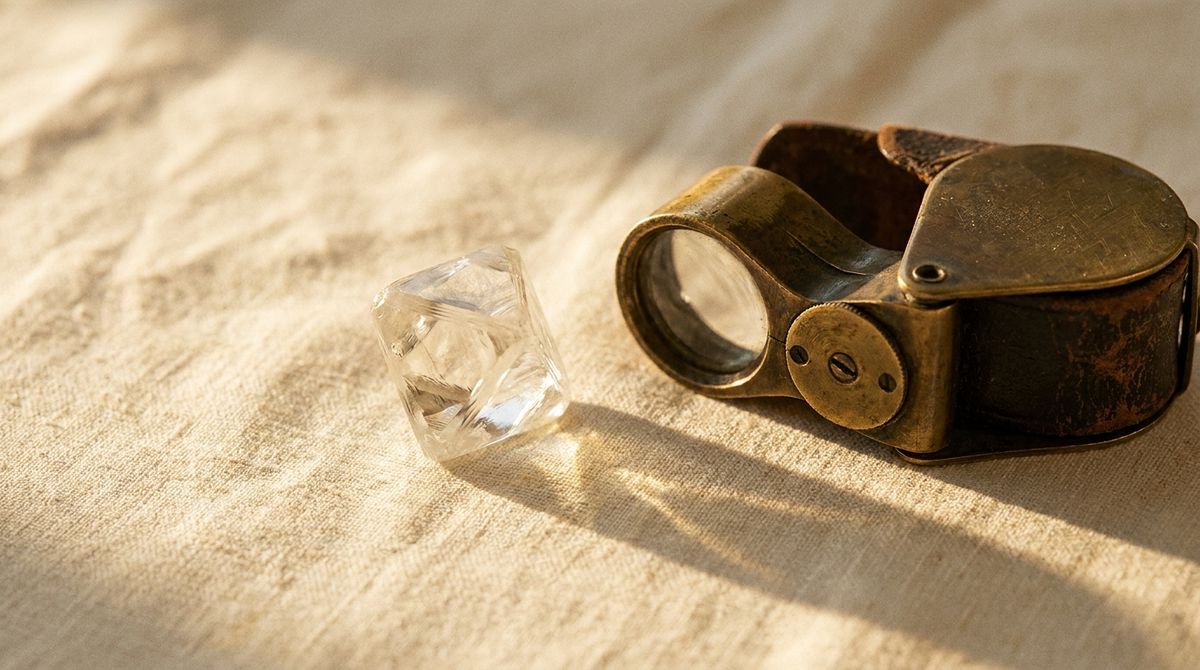
Diamond is pure carbon, crystallized under such extreme pressure that its atoms lock into a tetrahedral lattice — the same element as pencil graphite, arranged so differently that one is the softest common mineral and the other is the hardest. It crystallizes in the cubic (isometric) system, forming octahedral crystals in its natural, uncut state.
On the Mohs hardness scale, diamond sits at 10 — the top of the scale and the hardest known natural material, meaningfully harder than the next hardest minerals (corundum, which includes ruby and sapphire, sits at 9). That hardness isn't just a lab curiosity: it's why diamond is the material of choice for cutting and polishing every other gemstone, and why a diamond edge can scratch nearly anything else on Earth while almost nothing scratches it back.
Most diamonds are colorless to a pale yellow or brown, caused by trace nitrogen in the crystal lattice. Fancy colors are rarer and caused by different trace elements or structural quirks: blue diamonds get their color from boron, pink and red diamonds come from a distortion in the crystal lattice itself rather than a trace element, and red is considered the rarest diamond color of all.
Properties: Physical, Mental, and Metaphysical
Physical
Diamond's extreme hardness makes it exceptionally resistant to scratching, which is why a diamond can hold a sharp facet edge for generations of daily wear without dulling. It also has excellent thermal conductivity for a nonmetal — diamond conducts heat far better than the glass or gemstones it's most often confused with, which is the working principle behind handheld diamond testers. Despite its hardness, diamond isn't indestructible: it has perfect cleavage along four directions, meaning a sharp, well-aimed blow can still cause it to split.
Mental
In wellness and crystal circles, diamond is often described as a stone of clarity, focus, and amplified intention — language that leans on the gem's own optical clarity as a kind of metaphor for mental clarity. As with any stone's meaning in our different gemstones guide, that's a belief carried by tradition and marketing, not a measured effect.
Metaphysical
Diamond's reputation for strength and invincibility has old roots: the word "diamond" itself comes from the Greek adamas, meaning unconquerable or indestructible, a name the ancient Greeks gave the stone specifically because of its hardness. Ancient and medieval writers across several cultures believed diamond could ward off harm or grant courage in battle. Contemporary claims tying diamond to specific chakras or precise emotional effects are a modern layer added mostly by 20th-century crystal-healing writers, not an ancient one — worth reading as belief, not documented history.
How Diamond Forms, and How It's Graded
Most gem-quality diamonds form roughly 150 to 200 kilometers deep in the Earth's mantle, where temperature and pressure are high enough to crystallize carbon directly into diamond's dense lattice. That process typically takes on the order of one to three billion years or more for most stones — meaning the diamond in a piece of jewelry today usually predates complex life on land by a wide margin.
Diamonds don't travel to the surface on their own. They're carried up by violent volcanic eruptions through narrow, pipe-shaped conduits called kimberlite pipes, named after Kimberley, South Africa, where the rock type was first identified. These eruptions are rare and the geological window for them narrow, which is part of why diamond deposits are concentrated in specific, ancient regions of the planet rather than spread evenly across it.
Once a rough diamond is recovered, it's assessed using a framework known as the 4 Cs — cut, color, clarity, and carat weight — a system popularized by the Gemological Institute of America (GIA), founded in 1931. Cut refers not to shape but to how well a stone's proportions and finish return light to the eye; color measures how close to colorless a standard white diamond is; clarity grades internal and surface characteristics; and carat weight measures the stone's mass. The round brilliant, the cut most people picture when they think "diamond," descends from a 1919 mathematical model by Marcel Tolkowsky, who calculated the angles that maximize a round diamond's brightness and fire.
How to Tell Real Diamond From Look-Alikes
Diamond has more convincing imitators than almost any other gemstone, and several of them are genuinely difficult to distinguish with the naked eye. Cubic zirconia is a synthetic material made specifically to mimic diamond's brilliance at a fraction of the cost. Moissanite, originally discovered in a meteor crater and now lab-grown for jewelry, actually has more fire (more colorful flashes of light) than diamond itself, which can be a tell in strong light. White sapphire and natural zircon — a genuine mineral not to be confused with cubic zirconia — have also historically been sold or mistaken as diamond substitutes; white sapphire in particular can be readily explored in our guide to sapphire's meaning and history, and the identification challenges around natural zircon are covered in our zircon meaning guide.
The most reliable ways to separate a genuine diamond from any of these rely on physical testing rather than eyesight: refractive index and dispersion measurements taken with a refractometer, and diamond's unusually high thermal conductivity, which is exactly what a jeweler's handheld diamond tester is measuring when it's pressed against a stone. None of these tests are something a shopper can perform at home with certainty, which is exactly why a diamond's origin and identity are usually confirmed by a lab or a trusted jeweler rather than assumed from appearance alone.
How to Wear and Care for Diamond Jewelry
Diamond's extreme hardness makes it one of the most durable choices for daily wear, including rings — it resists scratching in a way that almost no other material can match. That said, hardness isn't the same as toughness: diamond's perfect cleavage means a hard, direct knock at the wrong angle can still chip or split a stone, so it's still worth being mindful during activities with a real risk of impact.
For general cleaning, warm water, mild dish soap, and a soft brush are safe for diamond, and its hardness means it tolerates ultrasonic and steam cleaning better than most other gemstones — though any diamond with significant internal fractures is still worth having checked by a jeweler before ultrasonic cleaning. Store diamond pieces separately from softer materials to avoid the diamond scratching them, since diamond's hardness cuts both ways in a jewelry box.
For pieces meant to be passed down, a diamond's durability is part of the appeal — a well-cared-for stone can realistically outlast the person who first wore it. If you're building a family piece around a birthstone, our mom and grandma rings collection is worth a look, whether the stone in question is diamond or another birthstone entirely.
Frequently Asked Questions
Is diamond really the hardest material on Earth?
It's the hardest natural material — a Mohs hardness of 10, the top of the scale. A small number of synthetic materials made in labs, such as certain forms of boron nitride, have been shown to exceed diamond's hardness under specific conditions, but among naturally occurring minerals, diamond has no rival.
What birthstone month is diamond?
Diamond is both the modern and traditional birthstone for April. If you're not sure which stone matches a given month, our birthstone finder is a quick way to check.
Why are colored diamonds so much rarer than clear ones?
Most diamonds form with at least a trace of nitrogen, which produces the colorless-to-pale-yellow range that's most common. Fancy colors require an unusual trace element or a structural distortion in the crystal lattice — boron for blue, a lattice distortion for pink and red — which occurs far less often in nature. Red diamonds are considered the rarest color of all.
How long does it actually take a diamond to form?
Most gem-quality diamonds formed over roughly one to three billion years or more, crystallizing 150 to 200 kilometers down in the Earth's mantle before being carried to the surface by a kimberlite eruption. There's no shortcut in nature for that combination of depth, pressure, and time.
Can a jeweler tell a diamond from a fake just by looking at it?
Not reliably, especially against well-made simulants like moissanite or cubic zirconia. Trained jewelers use physical tests — refractive index, dispersion, and diamond's distinctive thermal conductivity — rather than relying on the naked eye, which is why a proper diamond identification usually involves a handheld tester or a gemological lab rather than a visual inspection alone.