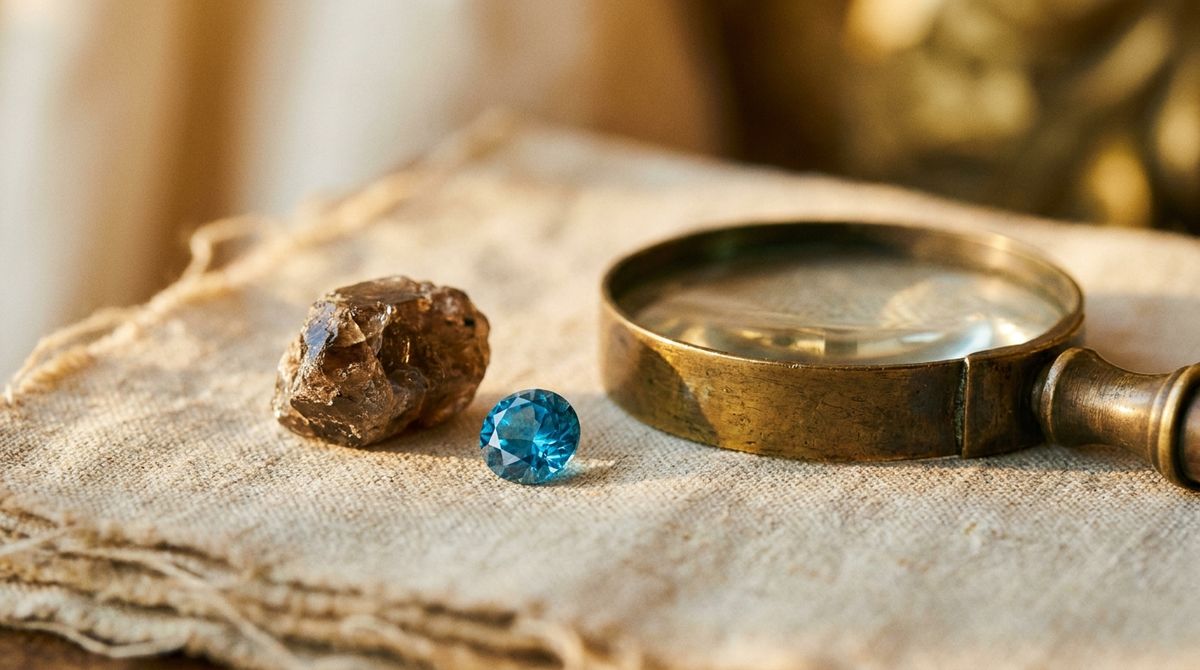
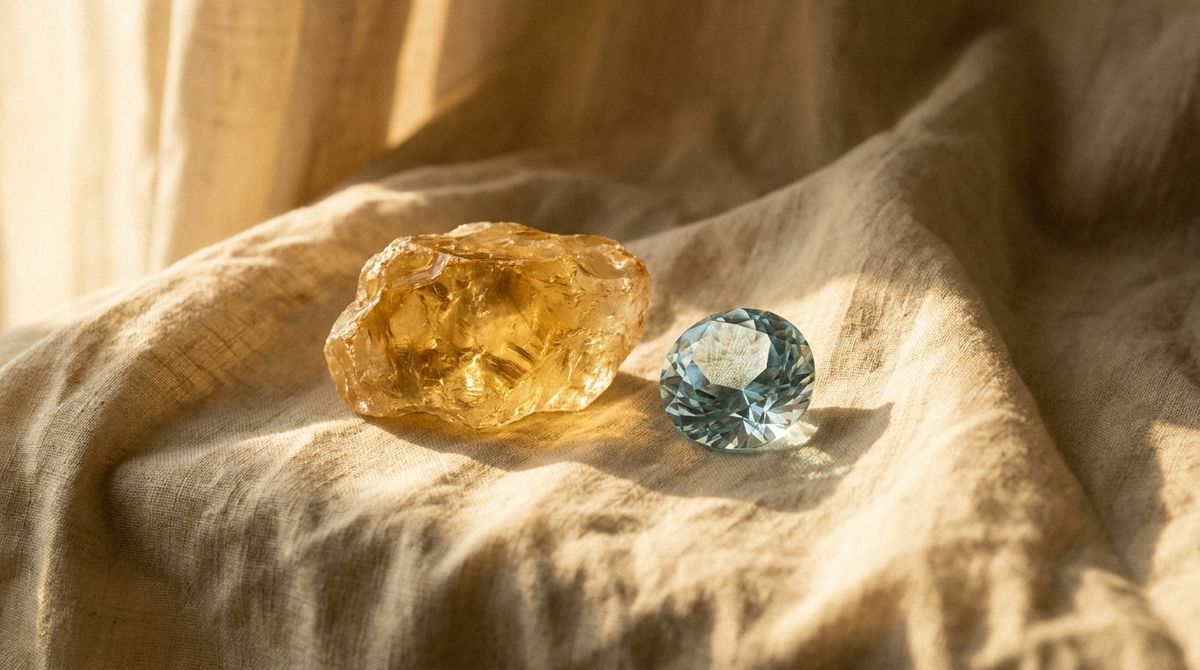
Topaz carries a strange double life in the birthstone calendar: it's the traditional stone for November, usually in its golden or brown form, but a single treated variety — blue topaz — was added to December's list decades later and is now far more widely recognized than the stone's own birth month. Add in a centuries-old naming mix-up and a long-running case of mistaken identity with citrine, and topaz turns out to be a more complicated stone than its reputation as a simple, affordable gem suggests. This guide covers what topaz actually is, its real geology and history, how to tell it from its look-alikes, and how to wear and care for it. If you're not sure which month a piece should be built around, our birthstone finder can confirm it in a few seconds.
What Topaz Actually Is
Topaz is an aluminum silicate mineral that also contains fluorine and/or hydroxyl in its crystal structure, giving it the chemical formula Al₂SiO₄(F,OH)₂. It crystallizes in the orthorhombic system and forms some of the largest gem-quality crystals found in nature — well-known large topaz crystals and carvings sit in museum mineral collections specifically because the stone can grow to sizes most gemstones never reach.
On the Mohs hardness scale, topaz rates an 8 — hard enough to resist scratching from most everyday contact, including sand and household dust. But that hardness comes with a catch: topaz has perfect cleavage in one direction, meaning a sharp blow at the wrong angle can split the stone cleanly in two, the way a log splits along its grain. A scratch-resistant gem isn't automatically an impact-resistant one, and topaz is a clear case where those two kinds of durability pull apart.
Properties: Physical, Mental, and Metaphysical
Physical
Topaz is transparent and typically faceted to maximize its brilliance, though its single direction of cleavage means cutters have to orient the stone carefully to avoid a plane that could fracture during cutting or later wear. That combination — genuinely hard, but directionally fragile — is why jewelers generally recommend protective settings for topaz rings rather than exposed, high-contact ones.
Mental
In wellness and crystal circles, topaz is often described as a stone of clarity, confidence, and calm — language that's been attached to the gem across different cultures and eras, as it has to many gemstones. As with any stone's meaning covered in our different gemstones meaning guide, that's a belief carried by tradition and personal practice, not a measured or documented effect.
Metaphysical
Historic writers in ancient Greece and Rome associated topaz with strength and protection, and medieval European lapidaries sometimes credited it with the power to dispel negative emotion or reveal poison in food or drink. Those are genuine historical associations, recorded in old gem-lore texts — not claims with any scientific basis, and worth reading the same way as any other folklore: as a window into how people related to the stone, not a statement of fact.
Colors, a Naming Mix-Up, and December's Late Addition
Natural topaz occurs in a wider range of colors than most people realize. Colorless topaz is common; light blue occurs naturally but is genuinely rare — almost all the blue topaz sold commercially today is colorless topaz that's been irradiated and then heat-treated to produce its blue color, a standard, widely disclosed practice in the gem trade rather than a deception. Yellow-to-brown topaz is the color most tied to the November birthstone tradition, and within that range sits Imperial topaz, an orange-pink-to-golden variety historically mined around Ouro Preto, Brazil, and generally considered the most prized natural color the species produces. Pink topaz also occurs naturally, though it's less common than the yellow and brown ranges.
The name "topaz" has a genuinely tangled history. One long-standing theory traces it to "Topazios," an ancient Greek name for an island in the Red Sea — modern St. John's Island, also called Zabargad. The trouble is that island never actually produced topaz; it was a historic source of peridot, and ancient writers appear to have applied the name to the wrong stone. A second theory traces the name instead to the Sanskrit word "tapas," meaning fire, which fits the warm glow of the gem's yellow and orange varieties more naturally than the Greek island story does.
Topaz's birthstone story has two separate chapters. Yellow and golden topaz is the traditional birthstone for November, a designation that predates any modern birthstone list. Blue topaz's tie to December is much more recent: it was formally added to the modern birthstone list in 1952, alongside turquoise and zircon, when the stone's irradiation treatment had made blue topaz widely and affordably available for the first time.
How to Tell Real Topaz From Look-Alikes
Yellow and golden topaz has long been confused in the gem trade with citrine, the yellow variety of quartz — the two can look strikingly similar to the eye, and "topaz" was historically used loosely enough as a trade name that citrine was sometimes sold under it outright. Our citrine meaning guide covers that confusion from the quartz side. The reliable way to tell them apart is hardness: topaz rates 8 on the Mohs scale, while citrine and other quartz varieties rate only 7, which a jeweler can confirm with standard gemological testing rather than color alone. Beyond hardness, refractive index and specific gravity readings are decisive when color isn't enough to settle the question.
Blue topaz has its own look-alike concerns, mainly around disclosure rather than identity — because nearly all commercial blue topaz is treated, any reputable seller should be able to confirm that a stone's color comes from irradiation and heat treatment, which is standard practice and not something to be concerned about, but is worth knowing rather than assuming.
How to Wear and Care for Topaz Jewelry
Topaz's hardness of 8 makes it generally suitable for everyday wear, but its single direction of perfect cleavage means it deserves more caution around impact than a hardness rating alone would suggest — a hard knock against a table edge or door frame is a more realistic risk for topaz than everyday scratching is. Clean topaz jewelry with warm water, mild soap, and a soft brush; ultrasonic and steam cleaners are best avoided, since the vibration and heat they produce can stress a stone that's already prone to splitting along its cleavage plane. Store topaz pieces separately from harder gems to prevent surface scratches, and give rings in particular a protective setting rather than an exposed one.
Blue topaz specifically is the color FARUZO offers as the December birthstone option — built in stainless steel with a gold-, rose gold-, or silver-tone plated finish rather than solid precious metal. It appears as a personalization choice on several pieces, including our birthstone rings and birthstone necklaces — worth noting that it's blue topaz specifically tied to December, not the broader topaz family, which sits with November instead.
Frequently Asked Questions
Is topaz only blue?
No — blue is actually the rarest color topaz occurs in naturally, and most blue topaz on the market is colorless topaz that's been treated to reach that color. Natural topaz also occurs colorless and in yellow, brown, orange-pink (Imperial topaz), and pink.
Is topaz a real birthstone?
Yes, in two separate ways. Yellow and golden topaz is the traditional birthstone for November, a designation that goes back well before modern birthstone lists existed. Blue topaz was added to December's modern birthstone list in 1952. Our birthstone finder can confirm which month and stone applies to a specific birthday.
What's the most valuable type of topaz?
Imperial topaz — the orange-pink-to-golden variety historically associated with Ouro Preto, Brazil — is generally considered the most prized natural color the species produces, valued well above the more common yellow, brown, and treated blue varieties.
Is blue topaz a "fake" or treated stone?
It's a real mineral, just one whose color is almost always induced by treatment rather than occurring naturally at that saturation. Irradiation followed by heat treatment to produce blue topaz is a standard, widely disclosed practice in the gem trade, not a form of deception — natural blue topaz exists but is genuinely rare.
Can topaz and citrine really be confused with each other?
Yes, and it's a long-documented trade confusion rather than a rare mix-up — yellow topaz and citrine quartz can look nearly identical, and "topaz" was historically used loosely enough in trade to be applied to citrine as well. The two are reliably told apart by hardness: topaz is an 8 on the Mohs scale, citrine only a 7.