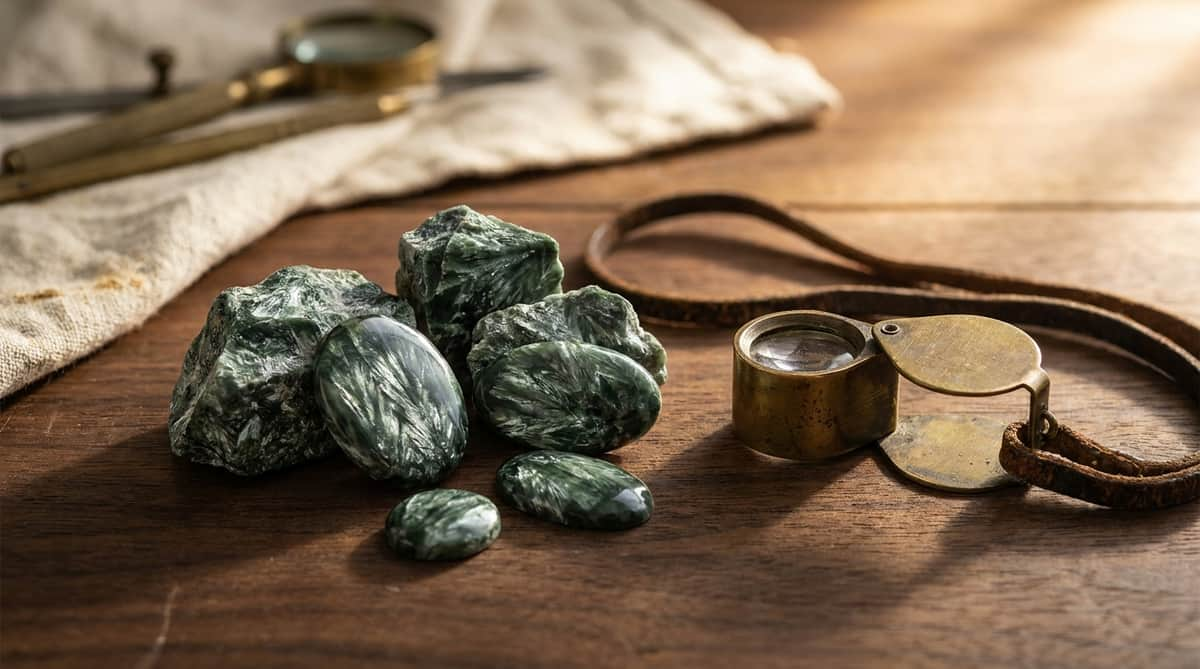
Seraphinite's silvery, feather-shaped streaks look painted on, almost too deliberate to be natural stone — and that's exactly the effect that earned it a name borrowed from the highest-ranking angels in Christian tradition.
Here's what seraphinite actually is mineralogically, where that feather pattern comes from, why nearly all of it traces back to one part of Siberia, and why it's a better fit for a pendant than for a ring worn every day.
At a glance
- Not a distinct mineral — a trade name for a form of clinochlore, in the chlorite group
- Nearly single-source — almost all commercial seraphinite comes from one part of eastern Siberia, Russia
- Mohs 2–2.5 — soft enough to scratch under daily wear; suited to pendants and earrings, not rings
- No official birthstone status for any month, despite its angel-linked name
What Seraphinite Actually Is
Seraphinite isn't a distinct mineral species the way quartz or garnet is — it's a trade name for a particular form of clinochlore, a mineral in the chlorite group of phyllosilicates (sheet silicates).
Wikipedia lists its formula as (Mg,Fe³⁺)Al(Si₃Al)O₁₀(OH)₈, while gemological retailer sources describe it more loosely as (Mg,Fe,Al)₆(Si,Al)₄O₁₀(OH)₈ — close enough to recognize as the same magnesium-iron-aluminum silicate family, with the small formula differences coming down to how much iron and aluminum substitute into the structure in a given specimen.
Either way, "seraphinite" functions in the trade the way "amazonite" or "larimar" does: a market name for a specific-looking form of a mineral that also exists, less decoratively, under other names.
Where the Feather Pattern Comes From
The silvery, plume-like streaks running through seraphinite's dark green base aren't a surface coating — they're a form of chatoyancy, an optical effect caused by the mineral's fibrous internal structure catching and reflecting light in bands as a polished surface moves under it.
Cutters and sellers describe the effect in explicitly feather-like language: some specimens show fine, down-like growths leading into longer "flight feathers," a pattern distinctive enough that "silver plume seraphinite" is used as a descriptive term on its own in the trade.
That resemblance to feathers — and by extension, wings — is the direct source of the stone's name, tied to the seraphim, the highest order of angels in Christian angelology. Russian mineralogist Nikolay Koksharov is generally credited with the discovery and naming in the 19th century.
Color, Luster, and How It's Usually Sold
Most seraphinite on the market reads as a deep, almost blackish green, though Wikipedia's mineral data lists the broader clinochlore family as also occurring in white and colorless forms. It's the dark green, feather-patterned material specifically that carries the "seraphinite" trade name.
The surface has a pearly to dull or slightly greasy luster depending on the cut and polish, and transparency ranges from translucent at the thin edges to fully opaque across most of a typical cabochon.
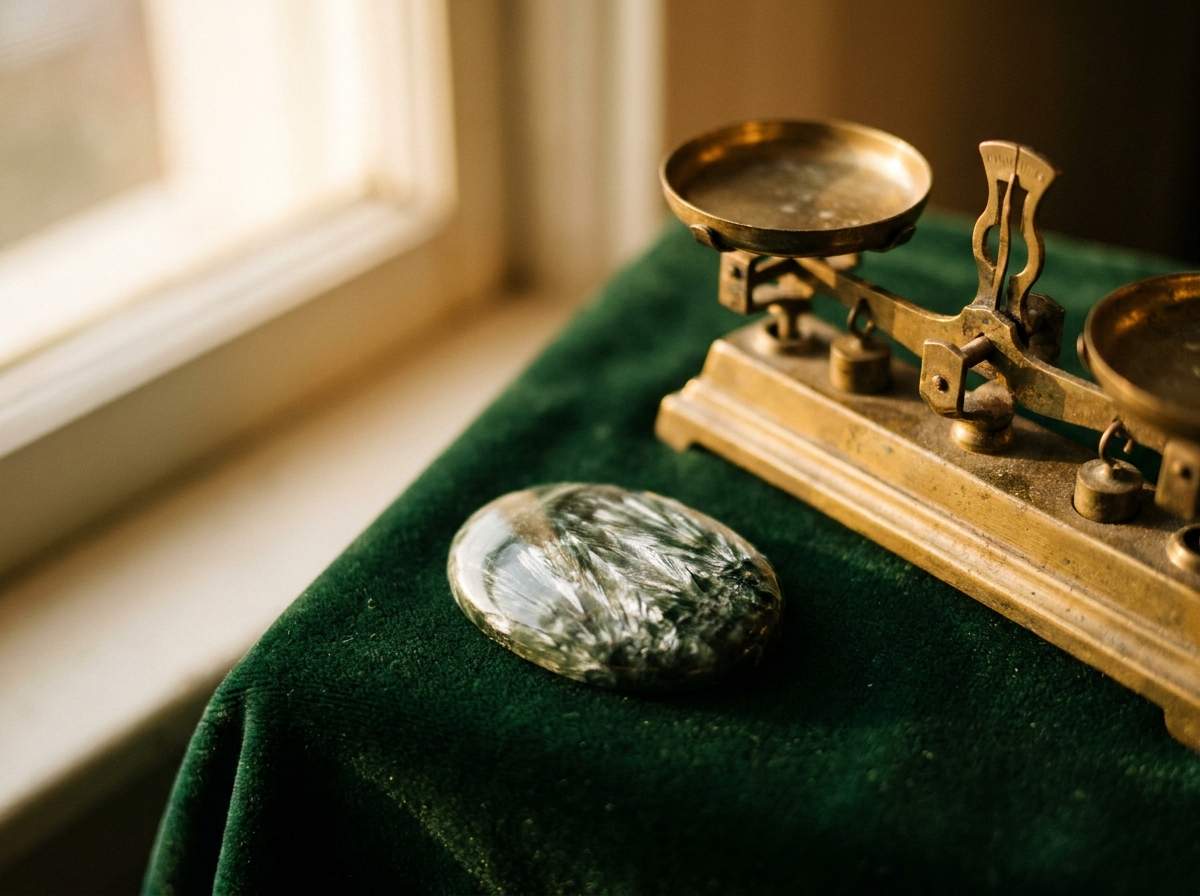
Because the pattern is the whole point, sellers tend to cut larger, flatter cabochon shapes that show off a long, uninterrupted stretch of the feathering rather than small stones that crop the pattern down to a sliver. A larger cut generally commands a real premium over a small one for exactly that reason, on top of the usual per-carat scaling.
Why It's Nearly a Single-Source Stone
Commercial seraphinite is documented as coming almost entirely from one limited area of eastern Siberia, Russia — gemological sources treat Russia as, in their words, "the important known origin," without naming a meaningfully productive second source.
That puts seraphinite in the same single-region category as stones like charoite and larimar, where the entire trade supply traces back to one part of the world rather than being spread across several active mining districts.
For a deeper look at how that kind of single-source scarcity plays out in pricing and fakes, our charoite meaning guide covers another Siberian stone with the same one-deposit story.
Hardness and Why It's a Display Stone, Not a Daily-Wear One
On the Mohs hardness scale, seraphinite sits at a soft 2 to 2.5 — both Wikipedia and gemological retail sources agree on this figure.
Wikipedia's own body text separately cites a looser "between 2 and 4" range elsewhere on the same page, a minor internal inconsistency worth flagging rather than resolving with false precision. A labeled comparison against stones more commonly set in rings:
- Seraphinite: Mohs 2–2.5 — scratches under light pressure from a fingernail or grit
- Selenite: Mohs 2 — similarly soft, also a display-only stone
- Turquoise: Mohs 5–6 — moderate, wearable with care
- Quartz-family gems (amethyst, citrine): Mohs 7 — durable enough for daily rings
- Sapphire: Mohs 9 — among the hardest gems used in jewelry
At that hardness, seraphinite is routinely cut as cabochons — smooth, domed shapes — rather than faceted, since its appeal is the chatoyant surface pattern rather than light-refracting facets. Gemological sources are explicit that it suits pendants, earrings, and protected collector settings far better than a ring that takes daily knocks.
Specific gravity runs roughly 2.6–3.0, and the stone is typically valued untreated, without the heat or dye treatments common in some other ornamental stones.
The Meaning People Attach to It
In crystal-healing and wellness circles, seraphinite's green color and angel-derived name combine into a reading built around nature, renewal, balance, and restoration — often linked specifically to the heart chakra and to themes of self-regeneration.
Some sources extend that into feng shui's "wood energy" category or a loose, non-official association with the zodiac sign Sagittarius. None of this carries scientific backing; gemological sources are explicit that these are symbolic and cultural associations rather than established properties of the mineral.
Seraphinite has no official birthstone status for any month.
Caring for Seraphinite
Because it's soft enough to scratch under ordinary daily friction, seraphinite jewelry does best stored separately from harder stones and metal pieces that could mark its surface in a jewelry box.
Clean it with a soft, dry or slightly damp cloth only — skip ultrasonic cleaners, steam cleaners, and any soak, since both heat and moisture are harder on a soft phyllosilicate than on quartz-family gems.
If you want green jewelry you can wear daily without that level of care, FARUZO's engraved necklaces are plated over 316L stainless steel — nickel-safe and far more scratch-resistant for everyday wear than a Mohs 2–2.5 natural stone, with a personalized detail a soft collector stone can't carry.
For other soft, feather- or plume-patterned green stones worth knowing the difference from, our green aventurine meaning guide covers a considerably harder, more wearable alternative in a similar color family.
Frequently Asked Questions
Is seraphinite a real mineral?
Not a distinct species on its own — it's a trade name for a form of clinochlore, a mineral in the chlorite group. Its formula is close to (Mg,Fe³⁺)Al(Si₃Al)O₁₀(OH)₈, varying slightly by source depending on how much iron and aluminum the specimen contains.
Why is it called seraphinite?
The name comes from the seraphim, the highest order of angels in Christian tradition, because the stone's silvery, feather-like chatoyant patterns resemble wings. Russian mineralogist Nikolay Koksharov is generally credited with discovering and naming it in the 19th century.
Where does seraphinite come from?
Nearly all commercially available seraphinite comes from a limited area of eastern Siberia, Russia. Gemological sources don't identify any other meaningfully productive source, making it a near-single-origin stone.
Can you wear seraphinite jewelry every day?
Not ideally. At Mohs 2–2.5, it's soft enough to scratch under normal daily friction, which is why it's almost always cut as a cabochon and set in pendants, earrings, or protected settings rather than rings meant for constant wear.
Is seraphinite a birthstone?
No. It has no official birthstone status for any month, and any zodiac associations attached to it (most often Sagittarius) are informal crystal-lore pairings, not an established or widely recognized system.