Emerald and peridot both read as “green gemstone,” and they turn up next to each other constantly — in birthstone charts (May and August sit one season apart), in vintage jewelry, and in budget alternatives marketed for one another. They're unrelated minerals from different families, with a wide price gap and different everyday wearability. Here's how to actually tell them apart, and which one fits which piece.
Two Unrelated Mineral Families
Emerald is a variety of beryl — a beryllium aluminum silicate — colored green by trace chromium and, often, vanadium; it's the same mineral species as aquamarine and morganite, just colored by different trace elements. Peridot isn't beryl at all: it's the gem variety of olivine, a magnesium-iron silicate, and unlike emerald its green color comes from iron built into the mineral's basic chemistry rather than a trace impurity. That's why peridot only ever comes in shades of green — olive, lime, or a warmer yellow-green — while emerald's chromium-and-vanadium coloring is closer to how ruby and sapphire get their color from trace elements in a otherwise colorless base mineral.
Hardness and Everyday Durability
This is the more practical difference for a piece worn often. Emerald measures 7.5–8 on the Mohs hardness scale, but almost every natural emerald is heavily included — the trade calls emerald's characteristic inclusions “jardin,” French for garden — and those inclusions make the stone more brittle than its Mohs number alone suggests, so emerald chips more easily than a harder stone with fewer inclusions would. Peridot sits lower, at 6.5–7 on the Mohs scale, and doesn't carry the same brittleness problem since it's typically cleaner, but that lower number still means it scratches more easily in daily wear than a harder gem like sapphire or ruby.
Color: How to Tell Them Apart by Eye
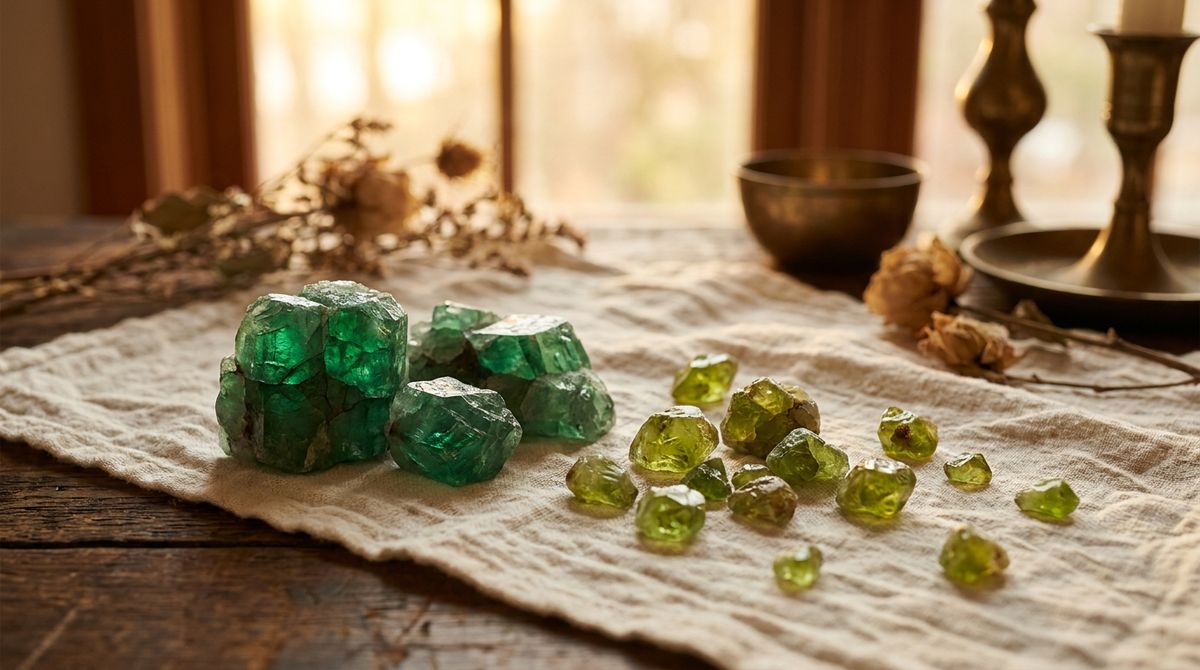
Once you've seen both side by side, they're not actually hard to confuse at a glance from across a room — but up close the difference is clear. Fine emerald shows a deep, slightly bluish green, often with visible internal inclusions (that “jardin” again) that give the stone a soft, velvety look rather than a sharp sparkle. Peridot is a brighter, warmer lime-to-olive green, almost always with better clarity than emerald and noticeably more brilliance and sparkle in direct light. If a “green gemstone” looks murky or garden-like inside and glows more than it sparkles, it's more likely emerald; if it's a clean, bright, yellowish-green with real fire, it's more likely peridot.
Price and Rarity
The price gap between these two is large. Fine natural emerald — particularly top-grade Colombian material — can run from roughly $500 to well over $10,000 per carat, putting it in the same rarity tier as ruby and sapphire among colored gemstones. Peridot is a semi-precious stone by comparison: even exceptional material rarely exceeds a few hundred dollars per carat. Part of that gap is genuine rarity — large, clean, richly colored emerald is genuinely hard to find — and part of it is that peridot, while not exactly common, is mined in large enough quantities (notably from Arizona's San Carlos Apache Reservation, one of the largest peridot deposits in the world) that supply keeps the price down even for good stones.
Birthstone and Meaning: Physical, Mental, and Metaphysical
Physical Properties
Emerald is May's birthstone; peridot is August's. The two also differ in where they form and where they're mined: emerald forms in hydrothermal veins and is concentrated in a handful of world-famous deposits — Colombia, Zambia, and Brazil chief among them, with Afghanistan's Panjshir Valley a historic smaller source. Peridot forms in igneous and even volcanic rock, and beyond Arizona, gem-quality material comes from Pakistan's Kohistan region and, historically, from St. John's Island in the Red Sea — an ancient Egyptian source that may be behind some famous “emeralds” in old European royal collections that modern gemology has since re-identified as peridot.
Mental & Emotional Associations
In traditional gemstone lore, emerald is tied to love, renewal, and wisdom — associations that trace back to its long history as a stone of royalty and rebirth. Peridot's lore leans lighter: positivity, protection, and new beginnings, a reading that fits its brighter, warmer color next to emerald's deeper, more serious green.
Metaphysical Traditions
Ancient Egyptians mined peridot on Red Sea islands as early as 1500 BCE and called it the “gem of the sun,” believing it protected the wearer from night terrors when set in gold. Emerald has an even longer royal history — Cleopatra was famously said to have favored emeralds from Egyptian mines, and the stone has been associated with fertility and eternal spring since antiquity across multiple cultures, from ancient Rome (sacred to Venus) to the Inca and Muzo peoples of Colombia, whose emerald mines still produce some of the finest material today.
Emerald vs. Peridot at a Glance
- Mineral family — Emerald is beryl (colored by chromium/vanadium); peridot is olivine (colored by iron built into its chemistry).
- Hardness — Emerald: 7.5–8 Mohs, but brittle due to typical inclusions. Peridot: 6.5–7 Mohs, generally cleaner and less brittle.
- Color — Emerald: deep, slightly bluish green with visible “jardin” inclusions. Peridot: bright lime-to-olive green with strong sparkle and typically better clarity.
- Rarity and price — Fine emerald ranks among the priciest colored gems (up to $10,000+/carat); peridot rarely exceeds a few hundred dollars per carat even at top quality.
- Birthstone — Emerald: May. Peridot: August.
- Best use — Emerald's brittleness favors earrings and pendants over a ring worn constantly; peridot's better clarity and lower cost make it a more forgiving everyday stone, though its lower hardness still calls for a protective setting in a ring.
Buying Tips for Each Stone
For emerald, ask specifically about treatment: the overwhelming majority of emerald on the market is oiled or resin-filled to reduce the visibility of its natural inclusions, a disclosed, accepted industry practice, but the degree of treatment materially affects both durability and price, so a reputable seller should state it plainly. For peridot, size matters more than most buyers expect — the gem rarely forms in large, clean crystals, so a peridot over roughly 10 carats commands a real premium even though the per-carat price stays modest by emerald standards.
Which One Should You Choose?
If you want the deeper, more traditional green and you're prepared to handle a softer, more brittle stone carefully (or set it in earrings or a pendant rather than an everyday ring), emerald is the classic choice — and it's the stone with the higher resale and heirloom value if that matters to you. If you want a brighter, more affordable green with better everyday resilience and real sparkle, peridot is the more practical pick, especially for a piece you'll wear often. Either way, the setting matters as much as the stone: FARUZO's personalized rings are built on 316L stainless steel with a plated finish rather than a soft precious-metal band, which gives a colored center stone a more scratch-resistant frame to sit in day to day.
This comparison is part of FARUZO's ongoing series on telling similar-looking gemstones apart — see also our breakdowns of ruby vs. garnet and sapphire vs. tanzanite.
Frequently Asked Questions
Is peridot a cheaper version of emerald?
Not exactly — they're unrelated minerals, not the same stone at different quality grades. Peridot has sometimes been marketed as a budget green alternative because both stones read as “green gemstone” at a glance, but peridot is its own gem with its own chemistry, hardness, and history, not a lesser-grade emerald.
How can I tell emerald and peridot apart at home?
Look at clarity and color tone first. Emerald almost always shows visible internal inclusions (“jardin”) and leans toward a deeper, slightly bluish green with a soft glow rather than sharp sparkle. Peridot is typically cleaner, with a brighter, warmer, more yellow-green tone and noticeably more brilliance in direct light. A jeweler can confirm with refractive index testing, which is the reliable method for a stone you're not certain about.
Which is more durable for an everyday ring, emerald or peridot?
Peridot, on balance, even though its Mohs number (6.5–7) is lower than emerald's (7.5–8). Emerald's typical heavy inclusions make it prone to chipping despite the higher hardness number, while peridot is usually cleaner. Neither is as tough as ruby or sapphire, so a protective setting is worth it for either stone in a ring worn daily.
Why are emerald and peridot both called birthstones so close together?
It's a coincidence of the modern birthstone calendar rather than a mineralogical connection — emerald is May's birthstone and peridot is August's, three months apart, and the two stones aren't related in composition, hardness, or origin. The color similarity is what causes the confusion, not the calendar.
Does FARUZO sell emerald or peridot jewelry?
FARUZO's pieces are 316L stainless steel with a plated finish, not set with natural emerald or peridot. This guide is here to help you tell the two stones apart if you're shopping for either one elsewhere, or comparing them against a colored center stone you're considering for a personalized piece.