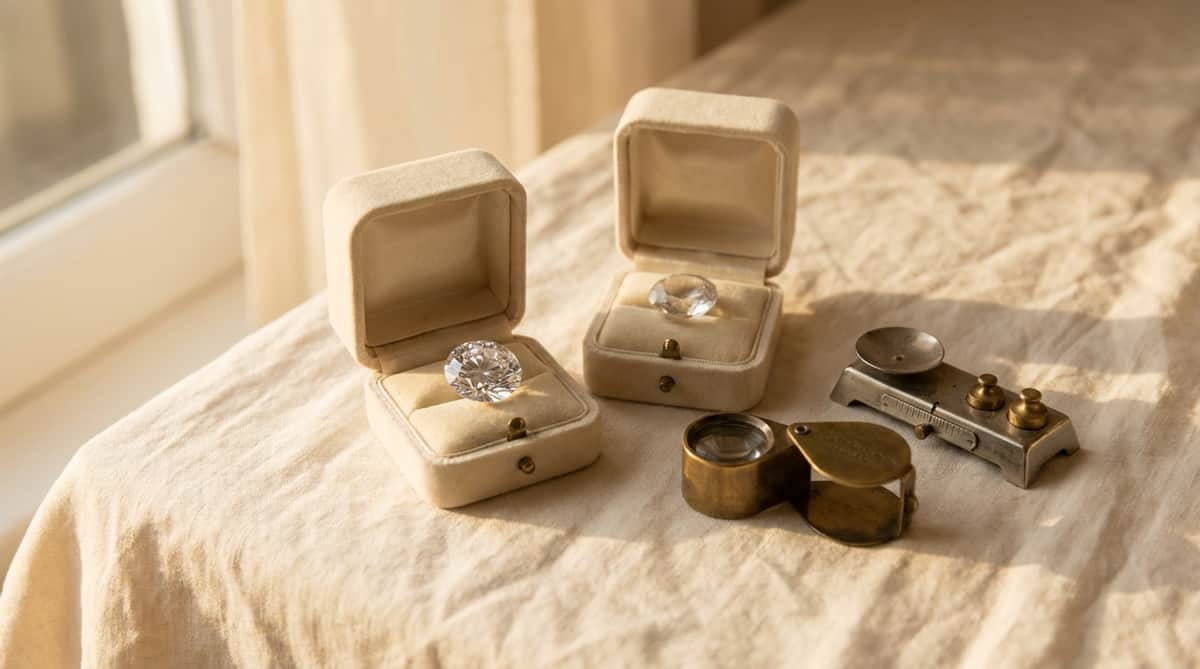
White sapphire is one of the oldest diamond substitutes in the trade — used that way before cubic zirconia or moissanite existed, and still sold that way today. Unlike those lab-made alternatives, it's a genuine natural mineral, which is part of its appeal: a real gemstone, not a synthetic one, at a fraction of diamond's price per carat. Here's what gemologists actually say about the hardness gap, the sparkle difference, and what to watch for before buying one for an engagement ring.
What Each Stone Actually Is
Diamond is pure crystallized carbon, formed under extreme heat and pressure roughly 100 miles below the Earth's surface and carried upward by volcanic activity. White sapphire is colorless corundum — the same mineral species as blue sapphire and ruby, just without the trace elements (iron, titanium, or chromium) that give those varieties their color. Both are mined as natural stones, though both are also produced synthetically at industrial and jewelry-grade quality; a lab-grown sapphire has the same optical and physical properties as a natural one, and most consumers can't tell the two apart without gemological testing.
Hardness and Durability
On the Mohs hardness scale, diamond rates a perfect 10 and white sapphire rates 9 — diamond is the hardest naturally occurring material, and corundum (sapphire and ruby) is the second-hardest. The International Gem Society frames the practical difference as smaller than it sounds: both stones comfortably resist scratches from everyday contact, including household dust, which itself rates around 7. Only a diamond (or lab-made moissanite) can actually scratch a sapphire. The two stones are also described as similarly brittle, meaning chipping from a hard knock isn't meaningfully more common in sapphire than in diamond, despite sapphire's reputation as the "softer" choice.
Sparkle: Why Diamond Still Reads as "More Brilliant"
The visible difference buyers notice first isn't hardness — it's fire. Diamond's refractive index (about 2.42) and dispersion (about 0.044) are both substantially higher than white sapphire's (refractive index around 1.76-1.77, dispersion around 0.018), which is the optical reason a well-cut diamond throws sharp, colorful flashes of light while a well-cut white sapphire gives a softer, more even white glow. Both the International Gem Society and other gemological sources describe this consistently: diamond shows more brilliance, dispersion, and scintillation than sapphire cut to the same standard, and no amount of cutting skill closes that gap, because it comes from the minerals' underlying optical properties rather than from craftsmanship.
Diamond vs. White Sapphire at a Glance
- Composition — Diamond: pure crystallized carbon. White sapphire: colorless corundum, the same mineral as blue sapphire and ruby.
- Hardness — Diamond: 10 on the Mohs scale, the hardest natural material. White sapphire: 9, the second-hardest.
- Refractive index / fire — Diamond: about 2.42 refractive index, 0.044 dispersion — sharp, colorful flashes. White sapphire: about 1.76-1.77 refractive index, 0.018 dispersion — a softer, more even glow.
- Price — White sapphire runs a fraction of diamond's per-carat price at comparable quality, so the same budget buys a noticeably larger stone.
- Treatments — Nearly all white sapphire on the market is heat-treated, a routine, permanent, trade-accepted process. Watch for surface coatings (can scratch off) and diffusion treatments (can be lost during repolishing) on lower-priced stones.
- Natural vs. lab-grown — Both stones exist in natural and lab-grown form with identical optical and physical properties; telling them apart generally requires a gemological lab, not the naked eye.
What to Watch For When Buying White Sapphire
Because white sapphire is so much less expensive than diamond, it attracts more aggressive treatments at the low end of the market. Heat treatment alone is standard and permanent — it doesn't need to be disclosed as a concern, just acknowledged as routine. Two treatments are worth asking about specifically: a surface coating, applied to make a stone look whiter, which can wear or scratch off with daily contact; and diffusion treatment, which alters only the outer layer of the stone and can be partially lost if the piece is ever repolished or resized. The International Gem Society also flags fracture-filled stones — sapphires so heavily treated with leaded glass that gemologists consider them closer to a "hybrid" material than a genuine sapphire — as worth avoiding for a piece meant to last. Buying from a seller who discloses treatments, and choosing an eye-clean stone (no inclusions visible from about six inches away, since white sapphire shows milkiness more readily than diamond does), covers most of the real risk.
Which One Actually Makes Sense
Gemological sources are fairly consistent on this: white sapphire suits a buyer who wants a large, genuinely natural, bright white stone on a limited budget and doesn't mind a softer glow instead of diamond's sharp fire. Diamond suits a buyer prioritizing maximum brilliance and the extra margin of hardness, and who's willing to pay substantially more per carat for it. Size matters to the decision too — a larger white sapphire reads less convincingly "diamond-like" than a smaller one does, so buyers going the budget route are often better served sizing down rather than maximizing carat weight. Compared with lab-made alternatives like moissanite, white sapphire's main advantage is being a natural stone rather than a synthetic one; our moissanite vs. diamond guide covers that comparison in full for anyone weighing all three side by side.
Meaning and Symbolism
Diamond's symbolism centers on durability and permanence — the hardest natural material standing in for an unbreakable commitment, a framing that goes back centuries in Western engagement traditions. White sapphire, as colorless corundum, doesn't carry a separate folklore tradition of its own the way colored sapphires do; most of its symbolic weight comes from standing in for diamond's clarity and brightness at a different price point, rather than from an independent meaning. For the fuller history and symbolism behind each stone individually, our diamond meaning guide and sapphire meaning guide both go deeper.
FARUZO doesn't set diamonds or sapphires into its pieces — our collection is plated over durable, nickel-safe 316L stainless steel rather than built around a center stone — but if it's a lasting, personal piece you're after rather than a graded gem, our personalized rings are engraved to the wearer rather than selected by carat weight.
Frequently Asked Questions
Is white sapphire a "fake" diamond?
No. It's a genuine natural mineral (colorless corundum), not a synthetic diamond simulant like cubic zirconia. It's used as a diamond alternative because it's colorless and durable, not because it's manufactured to imitate diamond's structure.
Can a jeweler tell white sapphire from diamond without special equipment?
Usually yes, with practice — diamond's sharper fire and brilliance are visible to a trained eye, and a handheld thermal diamond tester gives a fast, reliable answer either way, since diamond's thermal conductivity is far higher than sapphire's.
Is white sapphire durable enough for an engagement ring worn daily?
Yes, according to gemological sources — at 9 on the Mohs scale, it resists everyday scratches as well as diamond does in practical terms, and isn't meaningfully more prone to chipping. The real gap is in brilliance and fire, not day-to-day durability.
How much less does white sapphire cost than diamond?
The gap is substantial and widens with size and quality — gemological sources describe white sapphire as costing a fraction of a comparable diamond's per-carat price, which is the main reason buyers choose it. Exact pricing varies by seller and stone quality, so a direct quote is the only reliable comparison for a specific piece.
Is lab-grown white sapphire different from natural white sapphire?
Not in any way a consumer can see — both have identical optical and physical properties. Gemologists can sometimes distinguish them with specialized lab equipment, but the practical performance and appearance are the same either way.