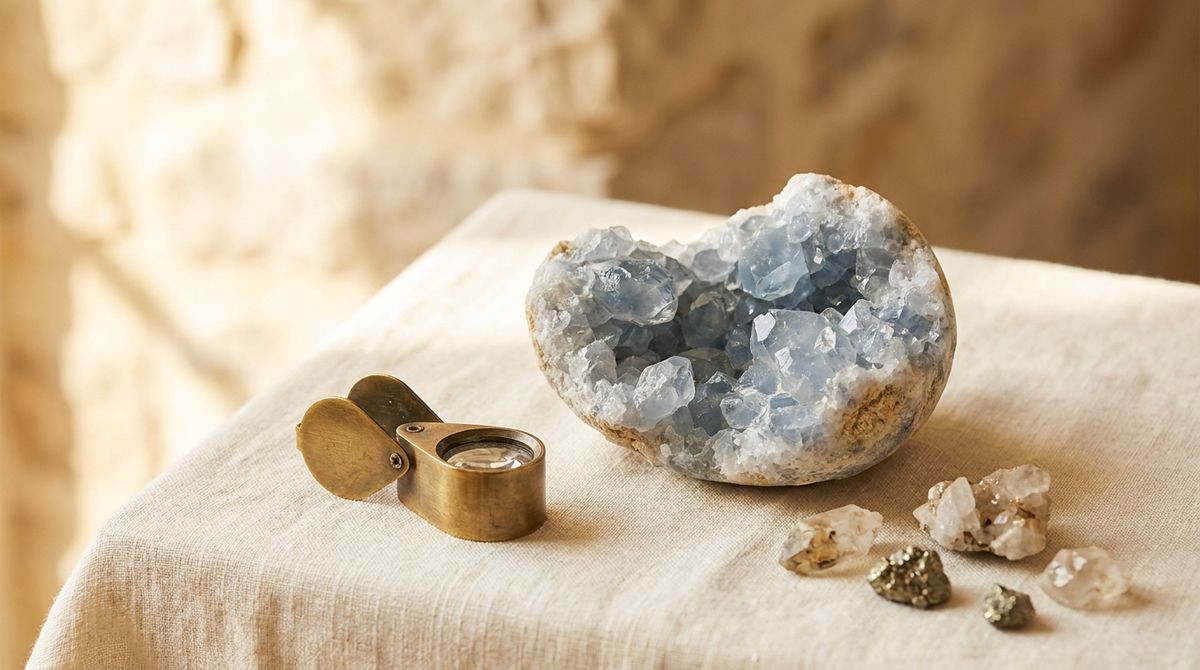
Celestite is easy to mistake for a lab-grown novelty the first time you see one — pale, faintly blue, almost translucent, like a frozen piece of sky. It's not synthetic at all. It's a real, naturally forming mineral, and its color is exactly why it got its name: "celestite" comes from the Latin *caelestis*, meaning heavenly or of the sky.
What Celestite Actually Is
Celestite is the mineral form of strontium sulfate (SrSO₄) — an orthorhombic crystal that typically grows as pale blue, white, or occasionally orange-tinted crystals, often in clusters lining the inside of a geode. It's soft as gemstones go, sitting around 3 to 3.5 on the Mohs hardness scale, which is one reason you'll rarely see it cut into a ring the way harder stones like sapphire or quartz are — it scratches too easily for everyday wear.
Most of the celestite sold to collectors and crystal shops comes from geodes mined in Madagascar, where the crystals form in large, hollow cavities that can range from fist-sized to room-sized. Industrially, celestite is the primary commercial source of strontium, an element used in fireworks (it's what produces the brilliant red color), ceramic glazes, and certain types of glass — a use with nothing to do with its reputation as a "calming" stone, but worth knowing if you ever wonder why a mineral this soft and pretty also shows up in chemistry textbooks.
How Celestite Forms
Celestite forms when strontium-rich groundwater moves through sedimentary rock — typically limestone, gypsum, or dolomite — and slowly deposits strontium sulfate in cavities and voids over thousands of years. That slow, undisturbed growth inside an enclosed pocket is exactly what produces the large, dramatic geodes celestite is best known for: without room to grow, the crystals stay small and crowded; inside a sealed cavity with steady mineral-rich water, they can grow into the fist-sized to room-sized clusters collectors prize.
This sedimentary origin is also why celestite so often turns up alongside sulfur, gypsum, and calcite — all four minerals tend to form under similar geological conditions, which is part of why celestite and calcite in particular get compared and confused so often.
Physical
Pale blue to colorless, sometimes with an orange or reddish tint from mineral impurities. Forms in orthorhombic crystal clusters, most famously inside large geodes. Soft (Mohs 3–3.5) and can cleave or scratch easily, so it's typically displayed as a raw cluster or tumbled stone rather than set into jewelry meant for daily wear.
Mental
In crystal healing traditions, celestite is associated with mental clarity and calm — people who keep a piece on a desk or nightstand often describe it as a "quieting" stone, something to hold during a stressful moment rather than a stone tied to any particular ambition or goal.
Metaphysical
Celestite's sky-blue color is the reason it's so often linked to angelic or "higher realm" communication in crystal-healing circles — the name itself nods to the heavens. It's commonly placed in a bedroom for peaceful sleep or used during meditation, though like all metaphysical properties, none of this is scientifically established; it's a belief system some people find meaningful, not a tested claim.
Celestite vs. Two Other Pale, "Calming" Crystals
Celestite gets confused with a handful of other soft, pale stones that share its reputation for a calming, gentle energy. Here's how to tell them apart:
- Celestite — pale blue to colorless, Mohs 3–3.5, usually sold as raw clusters or geode sections rather than tumbled stones; the most fragile of the three.
- Selenite — colorless to milky white, Mohs 2 (even softer than celestite), famous for its satin-like sheen and long wand or blade shapes rather than clusters.
- Calcite — comes in far more colors (celestite's blue is closer to "blue calcite," one specific variety), Mohs 3, and is the more chemically common of the three, forming almost everywhere limestone does.
The easiest visual tell: celestite crystals are typically more angular and glassy-looking, selenite has a soft fibrous or silky sheen, and calcite comes in the widest range of shapes and colors of the three.
Is Celestite Safe to Wear as Jewelry?
Technically yes, but its hardness is the limiting factor. At Mohs 3–3.5, celestite is soft enough that everyday friction — keys, countertops, a seatbelt buckle — will scratch or chip it faster than a harder stone like quartz (Mohs 7) or sapphire (Mohs 9). That's why it shows up far more often as a raw display piece, a tumbled pocket stone, or a pendant meant for occasional wear than as a ring stone meant to survive daily use.
If you do wear celestite, treat it the way you would any soft mineral: take it off before washing dishes, swimming, or exercising, and store it separately from harder stones and metal jewelry so nothing scratches it in a drawer. Our guide to cleaning gemstone jewelry covers the gentler methods that soft stones like this one actually need — skip the ultrasonic cleaner and steam, both of which can crack a stone this delicate.
If celestite's pale blue is the color you're drawn to rather than the raw mineral itself, that same soft tone translates easily into everyday jewelry that's actually built to be worn daily — a personalized necklace in a similar cool tone gets you the look without worrying about a scratch-prone stone in a ring you take on and off all day.
How to Tell Real Celestite From a Fake
Because celestite is inexpensive and not usually faceted for jewelry, outright fakes are less common than with pricier gems — but dyed or irradiated pieces do circulate, sold as a "rare deep blue" celestite when natural celestite's blue is almost always pale and subtle. A few checks:
- Color intensity. Natural celestite is pale, almost washed-out blue. A saturated, vivid blue cluster sold at a low price is more likely dyed.
- Crystal habit. Genuine celestite forms as clusters of blade-like or tabular crystals, usually inside a geode cavity — a single, oddly smooth "crystal point" shape is a red flag.
- Scratch test (on a spot you don't mind marking). At Mohs 3–3.5, a steel pin will scratch real celestite; if a piece resists a gentle scratch test, it may be a harder substitute like dyed quartz.
Frequently Asked Questions
Is celestite the same as celestine?
Yes — celestine is the older, still-used mineralogical name for the same mineral (strontium sulfate); celestite is the more common name in the gem and crystal trade today.
Why is celestite associated with angels?
The association comes mostly from its pale, sky-blue color and its name, which derives from the Latin word for "heavenly." Like most crystal-healing associations, it's a belief tradition rather than an established fact.
Can celestite fade in sunlight?
Yes — prolonged direct sunlight can fade celestite's already-pale blue color over time, so it's best displayed out of a sun-facing window if you want to keep its color from washing out further.
Where does most celestite come from?
The large, striking geode clusters sold to collectors overwhelmingly come from Madagascar, though celestite also occurs in sedimentary deposits in the United States, Mexico, and parts of Europe.
Is celestite expensive?
No — celestite is one of the more affordable crystal-shop minerals, since it forms in large, relatively common deposits. Price mostly comes down to cluster size and crystal clarity rather than rarity.
What's the difference between celestite and blue calcite?
They're often confused because both are pale, soft, blue-tinted minerals, but they're chemically different (strontium sulfate versus calcium carbonate) and blue calcite is one color variety of a mineral that comes in many colors, while celestite's pale blue is closer to its default. Our full calcite guide breaks down calcite's other color varieties if you're trying to tell the two apart.
More stones like this one — their real mineralogy alongside what crystal-healing tradition says about them — live in our full gemstones library.