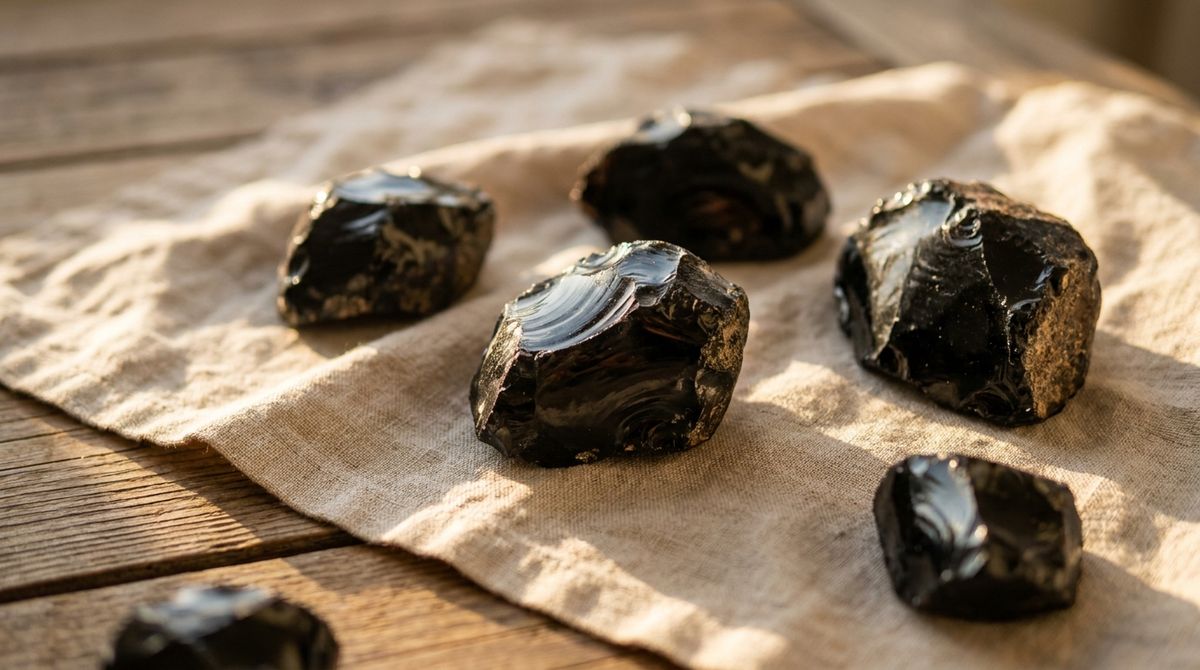
Black obsidian is the plain, unbanded, un-spotted version of volcanic glass — no rust-colored swirls, no white flecks, no rainbow sheen, just an even, glassy black. It's also the single most common form of obsidian sold in jewelry and crystal shops, which is part of why it's picked up the biggest reputation of any obsidian variety: the "Stone of Truth," a protection stone said to shield the wearer from negativity. This guide covers what actually makes black obsidian distinct from its more patterned cousins, where its protection lore comes from, and how to wear and care for it. For the deeper geology — how obsidian forms, its surgical-blade sharpness, and full identification steps — see our complete obsidian guide; this one focuses specifically on the black variety.
What Makes "Black" Obsidian Different From Other Obsidian
All obsidian is volcanic glass, formed when silica-rich lava cools too fast to crystallize. What separates the varieties is which trace minerals ended up suspended in that glass, and how they're distributed. Black obsidian gets its color from finely and evenly dispersed magnetite and other iron-titanium oxides — spread uniformly enough through the glass that the result reads as a solid, uniform black rather than a pattern. That evenness is exactly what the other named varieties lack.
Black Obsidian Varieties at a Glance
Crystal shops sell several obsidian varieties under different names, and they're easy to confuse if you're going by color alone. Here's how the most common ones actually differ:
- Black Obsidian: solid, even black with no visible pattern — the plainest and most widely available form, and the default when a listing just says "obsidian."
- Mahogany Obsidian: black with reddish-brown swirls or patches, caused by hematite (iron oxide) inclusions rather than the magnetite behind plain black.
- Snowflake Obsidian: black with white, flower-like spots from clustered cristobalite crystals that grew within the glass after it cooled.
- Rainbow Obsidian: black at a glance, but shows a colorful iridescent sheen at the right angle, caused by nanoscale layers of mineral inclusions that diffract light.
- Apache Tear: small, rounded, translucent-at-the-edges nodules of obsidian, often left in their natural rounded form rather than cut or polished flat.
Meaning and Lore: Physical, Mental, and Metaphysical
Physical. Like all obsidian, the black variety is a Mohs 5–5.5 glass with a curved, shell-like (conchoidal) fracture rather than a crystal cleavage — it chips more easily than a true mineral gemstone, which matters for how you wear and store it.
Mental. In crystal-healing tradition, black obsidian specifically — more than the patterned varieties — is described as a mirror for the mind: a stone meant to surface uncomfortable truths and hidden emotional patterns rather than soften them. It's why it's nicknamed the "Stone of Truth" more consistently than any other obsidian type.
Metaphysical. Black obsidian is assigned to the root chakra in most crystal-healing frameworks, tied to grounding, protection, and a sense of being anchored to the present rather than pulled into anxiety about the future. None of this is scientifically established — it's a belief system, presented here as exactly that, not as a verified property of the stone.
Where the "Stone of Truth" Reputation Comes From
The protection and truth-telling associations aren't invented out of nowhere — they trace back to real history. Aztec obsidian workers polished the stone into mirrors flat and smooth enough to reflect a clear image, and one Aztec deity, Tezcatlipoca — whose name translates roughly to "Smoking Mirror" — was specifically associated with obsidian mirrors used for divination and self-reflection. That history of "a black mirror used to see hidden truth" is the throughline connecting an ancient religious practice to a modern crystal shop's tagline. The mirror-making craft itself, and how far it traveled (including into a 16th-century English court), is covered in full in our main obsidian guide.
Where Black Obsidian Comes From
Black obsidian forms wherever silica-rich volcanic activity has occurred, which makes it far more geographically widespread than most gemstones. Major sources include central Mexico (long worked by Aztec and earlier Mesoamerican cultures), the American West — particularly Oregon, California, and Idaho — along with Iceland, Turkey, and parts of Italy and Greece. Because it's abundant rather than rare, black obsidian's value in jewelry comes almost entirely from its polish and cut, not from scarcity the way it does with gemstones mined in only one or two places on Earth.
Why Black Obsidian Is a Crystal-Shop Best-Seller
Plain black obsidian is consistently one of the most widely stocked stones in crystal and wellness shops, for reasons that are as practical as they are symbolic. It's inexpensive relative to true mineral gemstones, it takes a glassy, mirror-like polish that photographs well, and its solid black color pairs with anything, which makes it an easy add-on to a bracelet stack or a beaded necklace rather than a piece that has to be styled around. The grounding and anti-anxiety framing common in crystal-healing marketing has also made it a frequent pick in the broader "calming jewelry" category alongside stones like black tourmaline — worn less as a statement piece and more as something to fidget with or simply have on hand during a stressful day.
Wearing and Caring for Black Obsidian Jewelry
Because it's glass rather than a harder mineral, black obsidian is more prone to chipping and scratching than gemstones like quartz or sapphire — treat it more like you would a delicate glass bead than a durable stone. Avoid dropping it on hard surfaces, skip ultrasonic cleaners, and wipe it with a soft, dry cloth rather than anything abrasive. For general at-home cleaning steps that work across most stone types, our gemstone ring cleaning guide applies to black obsidian pieces too.
If you want to build a piece around it rather than buy loose stone, our personalized necklaces can pair an accent stone with an engraved name or date. Black obsidian is often collected alongside other protection-associated stones — our black tourmaline guide covers a true mineral with a similar reputation but very different geology. You can browse more stone-by-stone guides in our gemstones and crystals archive.
Frequently Asked Questions
Is black obsidian the same as regular obsidian?
Black obsidian is the plain, unpatterned form of obsidian — the default most people picture. "Obsidian" as a broader term also covers patterned varieties like snowflake, mahogany, and rainbow obsidian, which get their look from different mineral inclusions distributed unevenly through the glass.
What's the difference between black obsidian and Apache tears?
Apache tears are a natural, rounded form of obsidian, often left uncut, and they're usually more translucent at the edges when held to light. Black obsidian, as commonly sold, is typically cut and polished into a solid, opaque piece rather than left in its naturally rounded shape.
Does black obsidian really protect against negative energy?
That's a belief within crystal-healing tradition, not a scientifically demonstrated effect. The association has a real historical root — Aztec obsidian mirrors used for divination and reflection — but the modern "protection stone" claim is a spiritual belief people can find meaningful, not a measurable property of the mineral glass.
Can black obsidian jewelry get wet?
Occasional light exposure is fine, but because it's a glass rather than a hard mineral, black obsidian is more vulnerable to chipping and surface wear than harder gemstones. It's better to remove it before swimming, showering, or activities where it could knock against a hard surface.
Is black obsidian a birthstone?
No. Obsidian in any color isn't one of the officially recognized monthly birthstones, and it doesn't carry a widely standardized zodiac assignment the way stones like garnet or peridot do.