Pick up a clear, glassy rhombohedron of calcite and lay it over a printed page, and something odd happens: every letter splits into two. That trick — calcite's unusually strong double refraction — turned an ordinary-looking mineral into one of the founding objects of modern optics, three centuries before it became a fixture of crystal-shop shelves. Understanding calcite means holding both stories at once: the real mineralogy, and the far newer wellness lore stacked on top of it.
What Calcite Actually Is
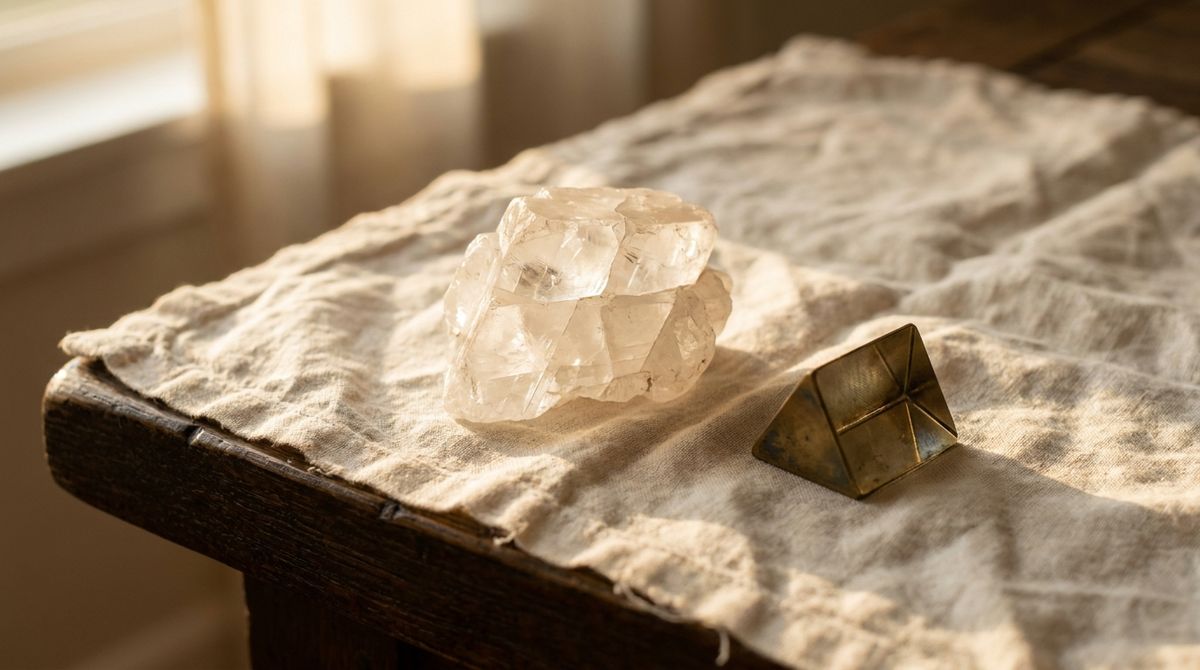
Calcite is calcium carbonate (CaCO₃), one of the most common minerals on Earth — it's the main component of limestone and marble, and it's what stalactites and stalagmites are made of. It defines hardness 3 on the Mohs scale, literally the reference mineral jewelers and geologists use to calibrate that number. Pure calcite is colorless or white, but trace elements color it constantly: manganese, iron and other impurities push it toward orange, blue, green or honey-gold, which is why "calcite" on a shelf rarely means one single look. Its most distinctive habit is perfect cleavage in three directions, so a broken piece almost always settles into the same slanted rhombohedron shape rather than a random chunk.
The Crystal That Accidentally Discovered Optics
In 1669, Danish scientist Erasmus Bartholin was studying a shipment of unusually clear calcite from Iceland — what came to be called Iceland spar — when he noticed that anything viewed through it appeared doubled. He documented the effect rigorously and named it double refraction, now known as birefringence. Calcite splits a beam of light into two rays that bend by different amounts, a property so strong in this particular mineral that the doubled image is visible to the naked eye without any instrument. Christiaan Huygens picked up Bartholin's work in 1690 to help build his wave theory of light, and in the nineteenth century Augustin-Jean Fresnel used the same mineral to demonstrate polarization. A rock from an Icelandic fjord ended up at the center of three centuries of physics — which is a stranger and better-documented story than most of what gets said about any crystal's "energy."
Calcite by Color — Which One Do You Have?
Most calcite sold today is identified by color rather than by the Iceland-spar variety that made the mineral famous. The differences are more than cosmetic:
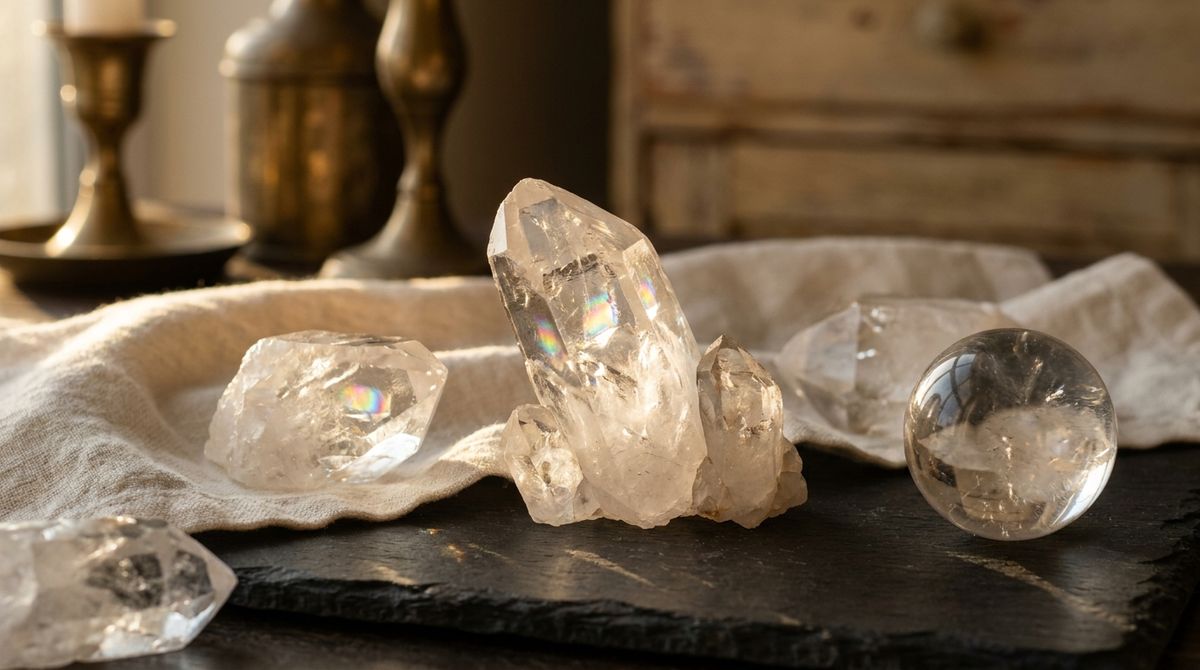
- Clear (Optical) Calcite — colorless and the most technically interesting of the group; this is the birefringent variety, still sold under the name Iceland spar, that anyone can use to split a printed letter into two just by setting a piece over it.
- Orange Calcite — colored by trace iron oxide; the most commonly sold tumbled color in metaphysical and gift shops.
- Blue Calcite — a pale, milky blue, usually sold as raw chunks rather than polished tumbles; softer-looking and less common on shelves than orange.
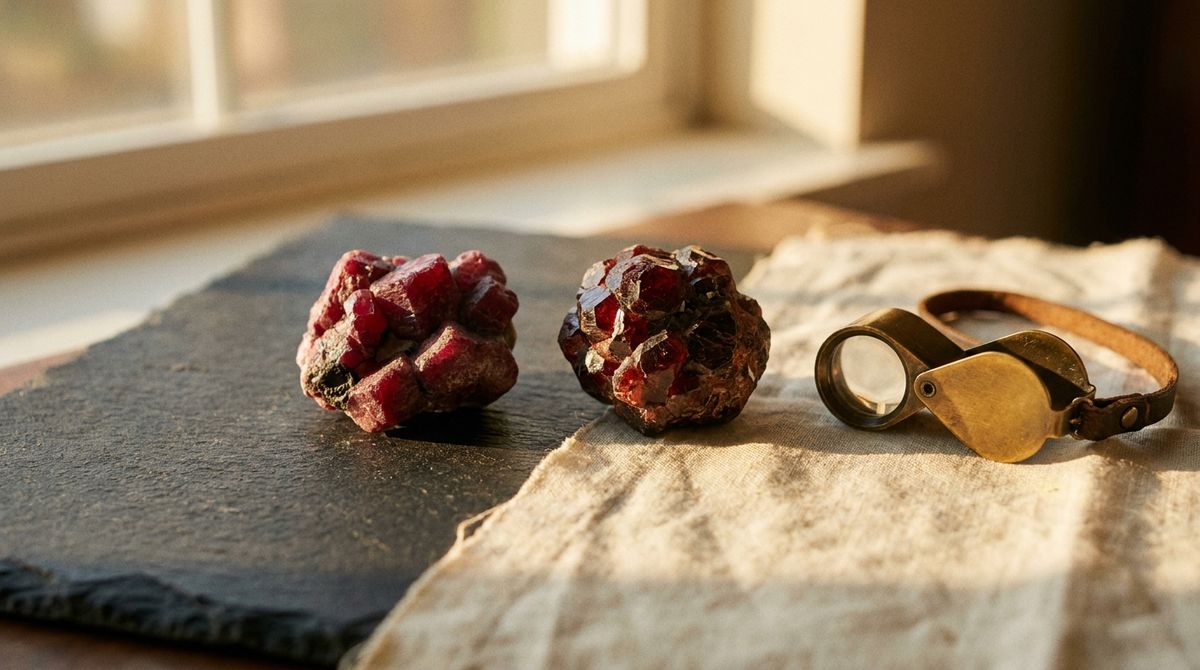
- Honey or Golden Calcite — an amber tone close to raw beeswax, frequently mistaken for citrine at a glance despite having no relation to quartz and a much lower hardness.
- Green Calcite — pale, often translucent mint-green from trace impurities; the least commonly stocked of the five.
Physical, Mental and Metaphysical Meanings
Physical: beyond optics, calcite's industrial footprint is enormous — it's the raw material behind ordinary chalk, agricultural lime, cement and the calcium carbonate in some antacid tablets. None of that has anything to do with jewelry, but it's why calcite is mined and processed at a scale most decorative stones never approach.
Mental and Metaphysical: in crystal-healing traditions, calcite is associated with claims of mental clarity and emotional release, with blue calcite specifically linked to communication and orange calcite to motivation. These are wellness-community beliefs passed down through that tradition, not properties with scientific support, and they're worth naming honestly as folklore rather than fact — the same way this guide names calcite's real optical history as fact rather than folklore.
Why Calcite Rarely Ends Up in Everyday Rings or Bracelets
A Mohs hardness of 3 is genuinely soft — for comparison on the Mohs hardness scale, a fingernail sits around 2.5 and a copper penny around 3.5, so calcite can be scratched by things that wouldn't mark most other gemstones. That's exactly why it shows up far more often as a tumbled display stone, a raw display cluster or a pendant in a protective setting than as a ring or a bracelet bead, where daily knocks would dull and scratch it within months. FARUZO doesn't set loose gemstones into its pieces — its personalized rings and necklaces are engraved metal, plated over 316L stainless steel rather than built around a stone — so if a soft, decorative mineral like calcite is what draws you in, it's worth pairing it as a separate display piece alongside a personalized ring built to actually survive being worn.
Calcite Care (Real, Not Folklore)
Calcite is calcium carbonate, which means it reacts to acid — geologists use a drop of vinegar as a field test for the mineral, and it will visibly fizz and etch. That single fact should drive how it's cleaned: wipe with a soft, dry or barely damp cloth, skip vinegar or any other acidic household cleaner entirely, and avoid ultrasonic jewelry cleaners, which are built for hard stones and metal and can chip or cloud something this soft. Store it apart from harder stones, keys or metal jewelry in a drawer, since almost anything else in a jewelry box is hard enough to scratch it.
Frequently Asked Questions
Is calcite a birthstone?
No. Calcite doesn't appear on any modern birthstone list. Traditional birthstones tend to be harder, more durable stones meant for daily-wear jewelry, and calcite's Mohs-3 softness is a large part of why it was never adopted for that role.
Can calcite go in water?
A brief, gentle rinse in plain water is generally fine, but it shouldn't be soaked, and it should never be cleaned with vinegar or another acidic cleaner — calcite is calcium carbonate and will visibly react and etch on contact with acid.
What's the difference between calcite and selenite?
Both are soft, pale minerals often sold side by side in crystal shops, but they're chemically unrelated. Calcite is calcium carbonate at Mohs 3; selenite is a form of gypsum, calcium sulfate, at Mohs 2 — even softer. FARUZO's selenite guide, linked below, covers that stone's own separate mineralogy and lore in full.
What's the difference between calcite and quartz?
They're unrelated minerals that happen to share shelf space. Quartz is silicon dioxide at Mohs 7, more than twice as hard as calcite, and quartz won't fizz in vinegar the way calcite does. Honey calcite in particular is sometimes mistaken for citrine, a quartz variety, at a glance, despite the wide hardness gap between them.
How do you clean calcite?
Wipe it with a soft, dry or barely damp cloth. Skip soaking, ultrasonic cleaners and any acidic product, and store it apart from harder stones or metal jewelry so nothing in the same drawer scratches the surface.
Calcite shares shelf space with dozens of other stones sold for the same wellness claims — FARUZO's Gemstones & Crystals guide and its selenite meaning guide cover the rest of that shelf, mineral fact separated from metaphysical claim the same way as here.