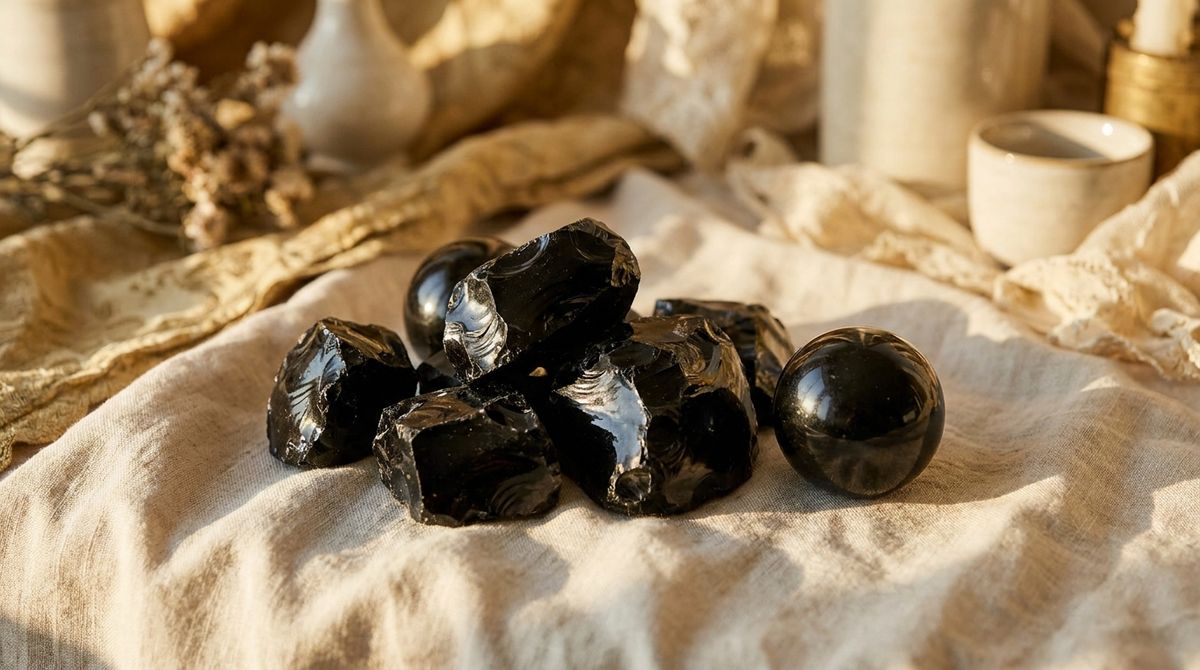
Obsidian looks like it belongs in a jewelry case, but it isn't a crystal at all — it's volcanic glass, born in seconds when lava cools too fast to form the mineral structure every other gemstone on this list relies on. That accident of geology is also why it holds the sharpest edge found in nature, why an Aztec god was named after it, and why a 16th-century English astrologer used a piece of it to talk to angels.
What Obsidian Actually Is
Obsidian forms when felsic lava — lava unusually rich in silica, typically around 70–75% — cools so quickly, usually after contact with air or water, that its atoms never have time to arrange into a crystal lattice. The result is a natural glass rather than a true mineral: no crystal structure, no cleavage planes, just a uniform, amorphous solid. It sits at roughly 5 to 5.5 on the Mohs hardness scale — harder than a fingernail or a knife blade, softer than quartz — and it breaks with a conchoidal fracture, the same smooth, curved break pattern you see in a thick shard of window glass.
That fracture is the whole reason obsidian mattered to humans for thousands of years before anyone cared how it looked. A well-struck flake of obsidian tapers to an edge only a few molecules thick — sharper than a razor, sharper than surgical steel — which made it the preferred material for blades, arrowheads and tools across multiple continents long before metalworking existed.
Sharper Than Steel: Obsidian's Surgical Second Life
The same edge that made obsidian valuable to Stone Age toolmakers has a genuine modern use. Under a microscope, a steel scalpel's edge is jagged and saw-like — a byproduct of the metal's crystal structure — while a properly knapped obsidian blade cleaves into a continuous edge about 3 nanometers thick, up to five times sharper than surgical steel. A published comparison of obsidian and steel scalpel wounds in rats found measurably less scarring with the obsidian blade at multiple points during healing. Some plastic surgeons use obsidian scalpels off-label today for exactly that reason, though the material's brittleness, cost, and lack of FDA approval for general surgery keep it a niche choice rather than a standard one.
The Aztec Smoking Mirror — and the One in the British Museum
Long before Europeans reached the Americas, Aztec obsidian workers were already producing mirrors polished flat and smooth enough to reflect a clear image — a genuine technical feat in a material this hard and brittle. The god Tezcatlipoca, whose name translates to “smoking mirror,” was associated with obsidian directly, tied to prophecy, fate and self-reflection in Aztec religion.
One particular obsidian mirror ended up in the hands of John Dee, court astrologer to Queen Elizabeth I, who reportedly used it in the late 1500s to try to contact angels and spirits. For centuries its origin was assumed but unproven; a 2021 geochemical study published in the journal Antiquity finally traced its composition to the Pachuca obsidian source in Mexico, confirming the mirror — and three others in the same collection — really were Aztec-made. It's on public display today in the British Museum's Enlightenment Gallery.
Obsidian's Meaning and Lore: Physical, Mental, and Metaphysical
Physical Properties
Beyond its hardness and fracture pattern, obsidian's defining physical trait is that it isn't a mineral in the strict sense — it lacks the ordered atomic structure gemologists use to classify true minerals, which is why some geology references call it a “mineraloid” instead. Trace mineral inclusions create obsidian's named varieties: gas bubbles aligned in layers produce the gold or silver “sheen” types, tiny cristobalite crystal clusters create the white-spotted “snowflake” pattern, and iron oxide banding produces reddish-brown “mahogany” obsidian.
Mental & Emotional Associations
In crystal-healing tradition, obsidian — especially the black variety — is described as a “truth-telling” stone, one said to surface feelings a person has been avoiding rather than soothe them away. It's commonly recommended in that tradition for cutting through self-deception and denial, framed less as a comfort stone and more as a confrontation one.
Metaphysical Traditions
Crystal-healing practice most often assigns obsidian to the root chakra, tying it to grounding and protection — a natural extension of its real history as a protective mirror and weapon material. None of this is a scientifically established property of the stone; it's a belief system some jewelry buyers value and others simply enjoy as folklore, and it's worth being clear about which is which.
Obsidian, Black Tourmaline, or Black Onyx? How to Tell the Black Stones Apart
Black gemstones get lumped together constantly, but they're geologically unrelated. Here's how the three most common ones actually differ, including black tourmaline, obsidian's closest rival for “protection stone” branding:
- Obsidian — volcanic glass, not a mineral. Mohs 5–5.5, conchoidal (curved, glass-like) fracture, and often shows a faint translucency or sheen when held up to light. Feels notably lighter than tourmaline for the same size.
- Black Tourmaline (Schorl) — a true crystalline mineral with a hexagonal crystal structure and rough, striated crystal faces when uncut. Mohs 7–7.5, meaningfully harder and denser than obsidian, and completely opaque even in a thin edge.
- Black Onyx — a banded form of chalcedony (a quartz variety), Mohs 6.5–7. Most commercial black onyx jewelry is dyed, since naturally solid-black onyx is rare; a giveaway is a slightly grayish tint at the edges of a stone under strong light, where dye concentration is thinner.
Where Obsidian Comes From
Obsidian forms wherever felsic volcanic activity has occurred, which makes it far more widespread than most gemstones. Major sources include the Pachuca and Sierra de las Navajas deposits in Mexico — the same region that supplied the Aztec mirror trade — along with Oregon, Idaho, and the Yellowstone region in the United States, Lipari in Italy, several sites in Armenia and Georgia, and Cappadocia in Turkey, another region with a long history of obsidian toolmaking.
How to Identify Real Obsidian (and How to Care for It)
Real obsidian's conchoidal fracture — smooth, curved, almost shell-like — is the fastest way to distinguish it from a manufactured black glass imitation, which tends to fracture in flatter, more angular planes and often carries visible mold seams or bubbles from industrial casting. Genuine obsidian jewelry stones are also cooler to the touch initially than glass, though this test takes practice to trust on its own. For a harder-edged comparison method, see our guide to the Mohs hardness scale.
Because it's a glass, obsidian chips and scratches more easily than a harder mineral gemstone — avoid dropping it on hard surfaces, and skip ultrasonic and steam cleaners, which can stress existing micro-fractures. A soft cloth and mild soapy water is the safest cleaning method; see our full gemstone ring cleaning guide for stone-by-stone care notes. If you like the look of a single, story-rich black stone set simply, browse FARUZO's personalized necklaces for pieces built around one meaningful centerpiece.
Frequently Asked Questions
Is obsidian a crystal or a mineral?
Neither, technically. Obsidian is volcanic glass — it cooled too fast to form the ordered atomic structure that defines a true mineral, so geologists sometimes classify it as a “mineraloid” instead of a crystal.
Is obsidian rare or expensive?
No — obsidian is abundant wherever felsic volcanic activity has occurred (Mexico, the American West, Turkey, Italy, and more), and common black obsidian is inexpensive compared to true gemstones. Rarer varieties like gold-sheen or rainbow obsidian, which need specific mineral inclusions to form, cost more.
Can obsidian jewelry get wet or be worn every day?
Light everyday wear is fine, but obsidian is softer and more brittle than harder gemstones like sapphire or quartz, so it's more prone to chipping on impact. Avoid ultrasonic cleaners and prolonged soaking, and store it separately from harder stones that could scratch it.
What's the difference between obsidian and black tourmaline?
They're unrelated materials that both happen to be black. Obsidian is volcanic glass at Mohs 5–5.5 with a curved, glass-like fracture; black tourmaline is a true crystalline mineral at Mohs 7–7.5 with visible striated crystal faces when uncut. Tourmaline is noticeably harder and denser.
Are obsidian scalpels actually used in surgery today?
In a limited way. Some plastic surgeons use obsidian blades off-label because their edge is thinner and smoother than surgical steel, which some studies link to reduced scarring. They aren't FDA-approved for general surgical use, mainly because the glass is more brittle and costlier to produce reliably than steel.
What is snowflake or rainbow obsidian?
Both are naturally occurring varieties defined by trace inclusions: snowflake obsidian gets its white spotting from tiny clustered cristobalite crystals, while rainbow and gold/silver sheen obsidian get their color play from microscopic gas bubbles aligned in layers within the glass.