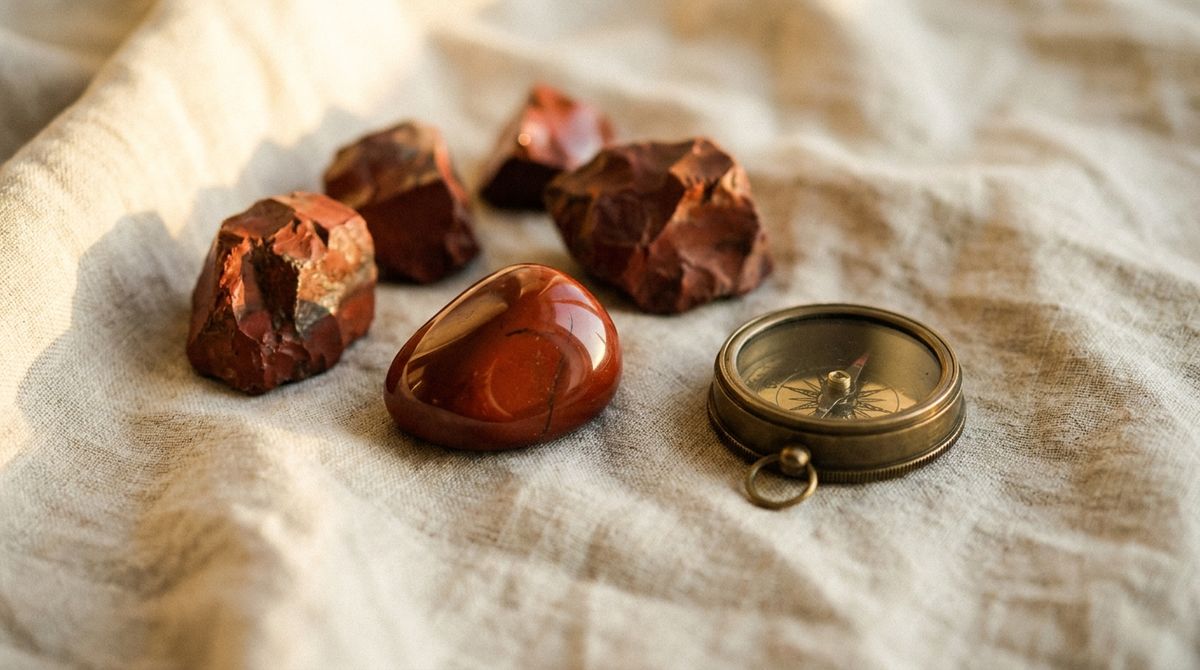
Red jasper looks like it should be rare — a deep, brick-red stone with an earthy, banded-looking texture that seems pulled from a dig site. It isn't rare at all. It's one of the most common gem-grade minerals on the planet, which is exactly why it turns up everywhere from a genuine ancient Egyptian funerary amulet to the clearance bin at a strip-mall crystal shop. Here's what red jasper actually is geologically, the real history behind its reputation as a protective stone, how to tell it apart from the half-dozen other red stones it gets confused with, and what to know before buying it as jewelry.
What Red Jasper Actually Is
Red jasper is a color variety of jasper, an opaque, microcrystalline quartz that belongs to the same chalcedony family as agate, carnelian, and onyx — see our breakdown of different gemstones and what they really mean for how these families relate. What separates jasper from its clearer cousins is opacity: rather than forming as one large, transparent crystal, jasper grows as a dense mass of microscopic quartz grains packed with mineral impurities, which is what makes it solid-colored and light-blocking instead of see-through.
The red color comes from hematite and other iron-oxide impurities distributed through the silica as the stone forms — the same iron chemistry that turns steel rust-red gives red jasper its color. On the Mohs hardness scale, red jasper sits at 6.5 to 7, the standard range for the whole chalcedony family: hard enough to resist scratching from sand, keys, and everyday wear, but soft enough that quartz crystal, topaz, sapphire, or a diamond can still scratch it.
Gem-grade red jasper deposits exist on nearly every continent — sourced from Australia, Madagascar, Brazil, India, and parts of the western United States, among other places. Because it forms from ordinary silica-rich groundwater or volcanic ash rather than the rarer conditions that produce transparent gems, it's abundant and inexpensive — a generous tumbled piece typically costs less than a cup of coffee.
A Stone With a 4,000-Year Paper Trail
Red jasper's use goes back further than almost any other stone on this site's list, because it was also a practical toolstone: like flint and chert, jasper fractures with a sharp conchoidal edge, and archaeological sites worldwide have turned up jasper arrowheads, scrapers, and blades from long before anyone was setting stones in jewelry.
Ancient Egypt is where the documentary record gets specific. Spell 156 of the Egyptian Book of the Dead prescribes a tyet amulet — the “Knot of Isis,” a symbol resembling an ankh with downward-curving arms — carved specifically from red jasper and placed at a mummy's throat during burial. The spell invokes the protective power of Isis over the deceased's body; in Egyptian symbolism, the stone's red color stood for Isis's blood and her life-giving, protective force. Surviving examples of these red jasper tyet amulets are held in museum collections today, including the Metropolitan Museum of Art.
That documented funerary use is the real historical root of red jasper's modern reputation as a “protection stone” in crystal-healing circles — a continuous thread back to a specific, sourced ancient ritual rather than an invented backstory.
Properties: Physical, Mental, and Metaphysical
Physical Properties
At 6.5–7 on the Mohs scale, red jasper is durable enough for daily-wear beads, cabochons, and bracelets, and its opacity means it never shows internal fractures or inclusions the way a transparent gem would — flaws that would ruin a citrine or amethyst are simply invisible in jasper. It takes a high, glassy polish and is almost always cut into cabochons, beads, and tumbled stones rather than faceted, since faceting only pays off with light passing through a stone.
Mental & Emotional Properties
In crystal-healing literature, red jasper is often called a grounding, stabilizing stone — sometimes nicknamed the “supreme nurturer” for a steady, patient energy said to support focus and emotional endurance through stressful stretches. As with any stone, these are traditional beliefs, not measurable clinical claims.
Metaphysical Properties
Modern crystal-healing traditions link red jasper to the root chakra, the energy center associated in that system with security, survival, and physical vitality — an association that follows naturally from the stone's blood-red color. Its reputation as a protective stone specifically traces back to the documented Egyptian funerary use above, rather than being a purely modern invention.
How Red Jasper Differs From Its Lookalikes
“Jasper” is really an umbrella term for any opaque, impurity-rich chalcedony — picture jasper, ocean jasper, and leopard-skin jasper are all the same base mineral in different color patterns, so “red jasper” specifically means the solid brick-to-rust-red variety, not a banded or multicolor jasper.
The most common mix-up is with carnelian, which is also colored by iron oxide but forms as translucent chalcedony rather than opaque — hold a piece up to a strong light and carnelian glows orange-red at the edges, while red jasper stays solid and opaque all the way through. Bloodstone (heliotrope) is a jasper too, but it's a dark green base flecked with red iron-oxide spots, not solid red. Plain red agate, meanwhile, is banded rather than uniform, showing concentric or wavy lines where jasper reads as one flat color.
The practical test for all of these is the same: shine a bright light directly behind the stone. Anything that glows or shows internal banding isn't solid red jasper.
How to Wear and Care for Red Jasper Jewelry
At 6.5–7 Mohs, red jasper handles daily wear well in rings, bracelets, and beaded pieces — it won't scratch from typical use, though it's still worth removing before anything abrasive like gardening or heavy manual work. Clean it with warm water, mild soap, and a soft cloth; skip the ultrasonic cleaner and steam, which can stress natural inclusions in some chalcedony specimens over time.
Because it's opaque and available in large, affordable pieces, red jasper shows up most often in beaded stretch bracelets and mala-style strands rather than faceted centerpieces — it pairs well with other earth-toned stones like tiger's eye, or as a grounding anchor in a birthstone necklace for anyone whose favorite palette runs warm rather than cool.
Frequently Asked Questions
Is red jasper a birthstone?
No. Red jasper isn't one of the twelve modern birthstones, though its warm color kinship to garnet (January) and ruby (July) sometimes gets it grouped informally with warm-toned birthstone jewelry.
Can red jasper get wet?
Yes, briefly — a quick rinse won't damage it. What to avoid is prolonged soaking or exposure to harsh chemicals, which isn't jasper-specific advice so much as good practice for any gemstone jewelry.
What's the difference between red jasper and regular jasper?
“Jasper” describes the whole family of opaque, impurity-colored chalcedony — red jasper is simply the solid brick-red color variety within that family, alongside picture jasper, ocean jasper, and dozens of other patterned and colored types.
How rare is red jasper?
Not rare at all — it's one of the most widely distributed gem materials on Earth, found on nearly every continent, which is part of why it's been used continuously for tools and jewelry for thousands of years rather than reserved for royalty.
Does red jasper's color fade?
No. Unlike some dyed or heat-treated stones, natural red jasper's color comes from stable iron oxide locked into the quartz structure and doesn't fade with normal light exposure over time.