Tiger's eye is one of the most recognizable stones in any bead shop or crystal display case — that warm, silky band of light that seems to slide across the surface as you turn it. The effect has a real name (chatoyancy) and a real cause: parallel fibrous mineral inclusions that once ran through the rock before quartz replaced them. Here's what tiger's eye actually is, where its protective reputation comes from, how to tell natural stone from a dyed or synthetic imitation, and how to wear it if you're adding it to jewelry. It's part of the same gemstone-by-gemstone series covering what each stone actually is versus what it's marketed as.
What Tiger's Eye Actually Is
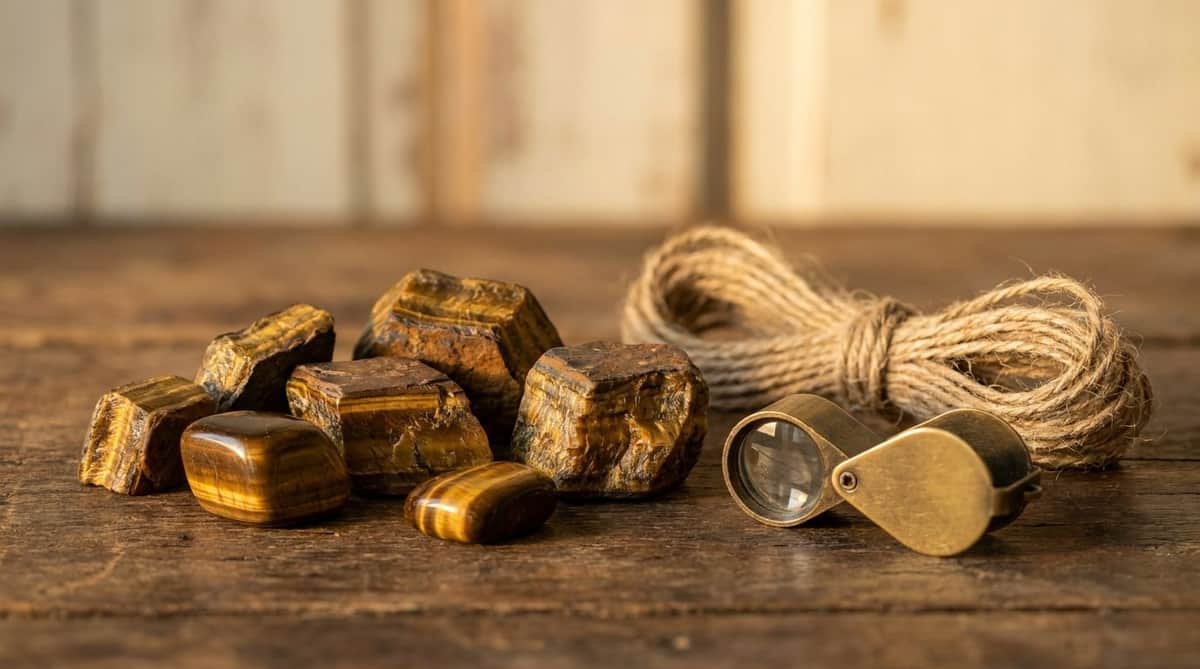
Tiger's eye is a variety of chalcedony-free quartz — specifically, it's an intergrowth of fine quartz with altered fibers of crocidolite, a blue asbestiform amphibole also known as blue asbestos. The silky, banded shimmer comes from chatoyancy: light reflecting off those parallel fibers, which appears to move in a single band as the stone is tilted, the same optical effect (on a coarser scale) behind cat's-eye chrysoberyl. Geologists have proposed two explanations for how the fibers end up quartz-replaced rather than staying as raw crocidolite: an older pseudomorphic-replacement model, where silica gradually substitutes for the asbestos fiber by fiber, and a more recent crack-seal model, where quartz and crocidolite fibers grow together through repeated microscopic fracturing and sealing. Either way, the host rock is the Asbestos Hills Subgroup, part of a roughly 2.6-billion-year-old banded iron formation that underwent greenschist-facies metamorphism — mild heat and pressure, not the intense conditions that would destroy the fibrous structure entirely.
Where Tiger's Eye Comes From
The overwhelming majority of the world's tiger's eye is mined in South Africa's Northern Cape Province, in the Griqualand West region around the town of Prieska, on a small-scale, intermittent basis by local operators rather than large industrial mines. Secondary deposits exist in Western Australia, India, Brazil, Namibia, and parts of the United States (notably California and Arizona), but none rival the South African supply in volume or consistency of quality. That single-region concentration is part of why tiger's eye stays affordable at scale — unlike stones spread thin across many small deposits, one region has quietly supplied most of the global market for decades.
Physical, Mental, and Metaphysical Properties
Physical
Tiger's eye sits at 6.5–7 on the Mohs hardness scale, with a specific gravity around 2.64–2.71 — comparable toughness to agate or citrine, and hard enough for daily-wear jewelry with reasonable care. Its color runs from golden-brown to deep amber in its natural state, with the direction of the fibers determining how the light-band moves across a cabochon or bead as it's rotated.
Mental
In the modern wellness market, tiger's eye is marketed as a grounding, confidence-building stone — associated with mental clarity, willpower, and steadying anxious or scattered thinking. As with any crystal-healing claim, there's no clinical evidence behind this; it's a belief framework, not a scientific one.
Metaphysical
Tiger's eye carries one of the oldest continuous protective reputations of any commonly worn stone. Different colors carry somewhat different modern associations within the wellness community — golden for confidence and personal power, red (heat-treated) for motivation and vitality, blue (natural, sometimes called hawk's eye) for calm and intuition — following the same logic behind gemstone color meanings more broadly, the same logic that shapes the pink, love-associated reputation covered in Rose Quartz Meaning.
The History Behind Tiger's Eye's Reputation
Tiger's eye's protective lore is old and widely repeated, though most of the specific claims trace back to crystal-trade and wellness writing rather than peer-reviewed archaeology, so they're worth reading as folklore rather than settled history. The most common version holds that ancient Egyptians used the stone in the eyes of deity statues to suggest divine sight, and that Roman soldiers carried or wore it into battle believing it would deflect harm and steady their courage — a plausible-sounding story given how widely quartz-family stones were used ornamentally in both cultures, but one that isn't backed by a specific, citable primary source in the material available online. What's better documented is the stone's much more recent commercial history: tiger's eye only became a mainstream jewelry and lapidary material in the 20th century, once the Northern Cape deposits were identified and small-scale mining made the material widely available and cheap enough for mass-market cabochons and beads.
Tiger's Eye Colors and Varieties
Golden or brown tiger's eye is the natural, untreated color — the iron oxide (limonite) that replaced the original crocidolite fiber gives it that honey-to-amber tone, and it's typically enhanced only by cutting and polishing. Red tiger's eye, sometimes called bull's eye or ox eye, is golden tiger's eye that's been heat-treated to deepen the iron oxide toward a red-brown color; this is a standard, disclosed lapidary treatment, and by most trade estimates well over 90% of the red tiger's eye on the market has been heat-treated rather than found that color naturally. Blue tiger's eye, known as hawk's eye, is the rarest and most valuable of the three — it forms when the quartz-replacement process is incomplete, so the fiber retains more of the crocidolite's original blue-grey color instead of fully oxidizing to gold. If you're buying red tiger's eye specifically, ask whether it's heat-treated; a seller who doesn't know, or won't say, is a bigger red flag than the treatment itself, which is accepted industry-wide and doesn't affect durability.
How to Tell Real Tiger's Eye from Fakes
Genuine tiger's eye has a specific, banded chatoyant sheen that moves as a single sharp line across the stone when tilted under a point light source — glass and resin imitations either have no chatoyancy at all or fake it with a diffuse, evenly-spread glow that doesn't sharpen into a line. Real tiger's eye also feels notably heavier than glass of the same size (specific gravity 2.64–2.71 versus roughly 2.5 for typical glass), and it will scratch a copper penny (Mohs 3.5) without effort, which soda-lime glass imitations generally will not do as cleanly. Dyed magnesite or howlite — both much softer, chalky white stones when undyed — sometimes get sold as "tiger's eye" in cheap novelty jewelry; a quick acetone-swab test on an inconspicuous spot will pull color off a dye job, while genuine tiger's eye's color is structural, not surface-applied, and won't budge.
Wearing and Caring for Tiger's Eye Jewelry
At 6.5–7 on the Mohs scale, tiger's eye holds up well to regular wear in rings, bracelets, and earrings, though its fibrous internal structure makes it somewhat more prone to chipping on a sharp impact than a solid, non-fibrous quartz like citrine or amethyst. Clean it the same way you'd clean any gemstone ring: warm water, a drop of mild dish soap, a soft brush for any detail in the setting, and a full pat-dry before it goes back into a jewelry box. Skip ultrasonic cleaners on heat-treated red tiger's eye specifically — repeated vibration and heat exposure can, over time, dull the finish on stones that were already color-treated once. Store tiger's eye away from harder stones like sapphire, ruby, or diamond in the same tray, since those can scratch its surface if they're left to knock against each other.
Frequently Asked Questions
Is tiger's eye a real gemstone or just a decorative rock?
It's a real, well-defined mineral variety — a quartz-crocidolite intergrowth with true chatoyancy — used in gemology and the jewelry trade, not a marketing name for generic rock. Its formation, hardness, and optical properties are all documented and consistent across specimens from its main source region.
Is all tiger's eye heat-treated?
No. Golden (natural brown) and blue (hawk's eye) tiger's eye are typically untreated beyond cutting and polishing. Red tiger's eye is the exception — the vast majority on the market has been heat-treated to deepen its color, a standard and disclosed practice rather than a defect.
What's the difference between tiger's eye and hawk's eye?
They're the same mineral at different stages of the same replacement process. Tiger's eye (gold/brown) formed when the original crocidolite fiber fully oxidized to iron oxide; hawk's eye (blue) formed where that oxidation stayed incomplete, so more of the crocidolite's original blue-grey tone survived. Hawk's eye is the rarer, less commonly seen of the two.
Is tiger's eye durable enough for an everyday ring?
Yes for typical daily wear — its 6.5–7 hardness holds up to normal use — but its fibrous structure makes it a bit more chip-prone than solid quartz varieties on a hard impact, so it's worth removing before manual work, sports, or anything that could knock it against a hard surface.
Does tiger's eye fade in sunlight?
Natural golden and blue tiger's eye are colorfast — the color is structural (iron oxide or retained crocidolite tone), not a surface dye, so ordinary sun exposure won't fade it. Extended, extreme heat exposure is a different question and best avoided regardless of stone type, since heat can alter iron-oxide coloration in quartz over time.