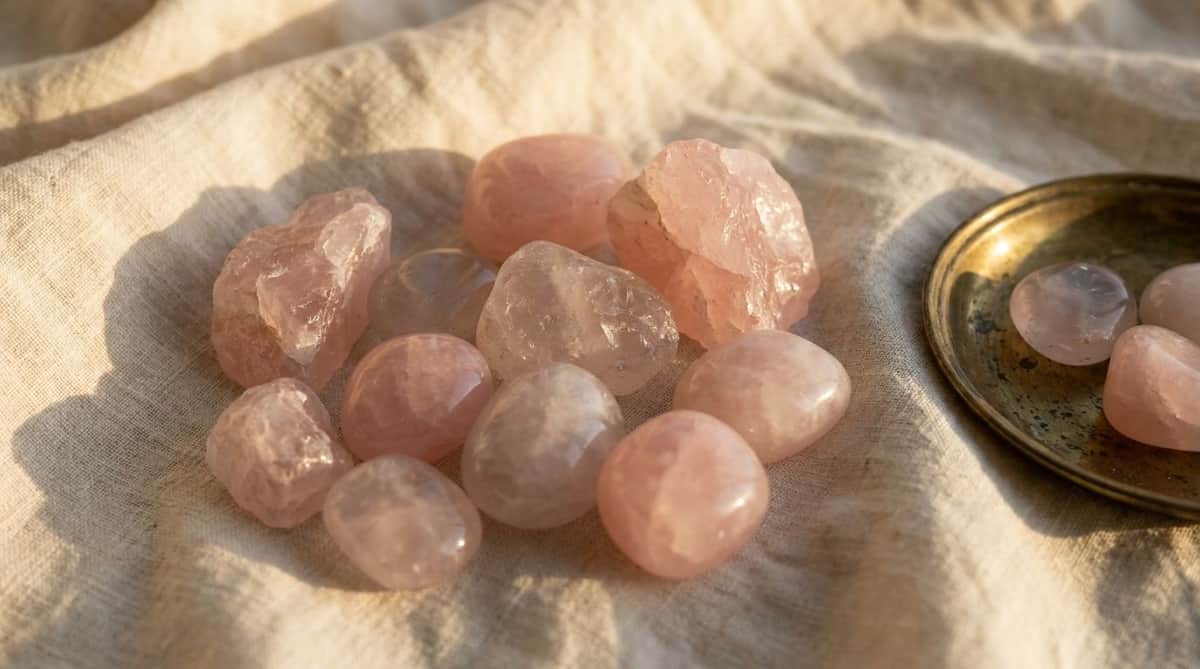
Rose quartz is the pink variety of quartz, the same mineral family as amethyst and citrine, colored by trace amounts of titanium, iron, or manganese locked into its crystal structure. It has been carved, worn, and gifted for love and comfort for roughly six thousand years, longer than almost any other stone still in common use. This guide covers where it actually comes from, what its love-and-self-love reputation is built on, how people use it today, and the practical side of wearing and caring for it.
What Rose Quartz Actually Is
Geologically, rose quartz is unremarkable in the best way: it is one of the most common minerals on Earth, silicon dioxide, wearing an uncommon color. Clear quartz gets its pink cast from trace titanium, iron, or manganese impurities, and in some deposits from microscopic mineral fibers that also give the stone a soft, slightly cloudy look rather than the sharp clarity of clear quartz or amethyst. That cloudiness is normal for rose quartz, not a flaw.
It sits at 7 on the Mohs hardness scale, the same as clear quartz and amethyst, which puts it well above most everyday hazards like a fingernail (2.5) or a steel knife blade (5.5) but below sapphire (9) and diamond (10). Practically, that means it resists scratching from daily wear but can still be scratched by harder stones or abrasive cleaning.
Most of the rose quartz sold today is mined in Brazil and Madagascar, with additional sources in South Africa, India, and the United States. Unlike gem-quality sapphire or emerald, large, clean pieces of rose quartz are relatively abundant, which is part of why it has stayed affordable even as demand for crystal jewelry and home decor has grown.
Where the Love Symbolism Comes From
The association between rose quartz and love is not a modern wellness invention. Archaeologists have found rose quartz jewelry and carved amulets in Mesopotamia dating back roughly six thousand years, and beauty masks made from ground rose quartz have been recovered from ancient Egyptian sites, reportedly used to prevent wrinkles and improve complexion. In Egyptian mythology, the stone was tied to the goddess Isis and to youthfulness.
The love connection specifically traces to Greek and Roman mythology, where rose quartz was said to form from the blood of Aphrodite (or, in the Roman version, Venus) as she rushed to the aid of her wounded lover Adonis, or alternately from a mix of the blood of Adonis and Aphrodite as she wept over him. Either version ties the stone directly to romantic devotion and grief, which is likely the origin point for its enduring reputation as "the love stone."
The Romans also used rose quartz seals to mark property, a practical use that had nothing to do with romance, which is a good reminder that most stones accumulate several layers of meaning over centuries rather than one clean origin story. By the Victorian era, rose quartz had become popular in mourning jewelry and sentimental gifts, a role pink stones and rose gold jewelry still play today.
How Rose Quartz Is Used in Crystal Practice Today
In the modern crystal-healing and wellness world, rose quartz is most often described as the stone of unconditional love, self-worth, and emotional healing, distinct from stones like garnet or ruby that are more associated with romantic passion. Practitioners commonly place it near the heart, either as a pendant, in a pocket over the chest, or on the heart-center point in meditation practice, and it appears often in self-care and journaling routines built around a single small object as a reminder rather than a cure.
None of this is a medical or scientific claim; it is a centuries-old belief system that a large number of people find genuinely grounding, in the same way a worry stone or a meaningful photograph can be. If you want to read it that way, it costs nothing and there is a real, if unmeasurable, comfort in carrying an object with a clear story attached to it.
A simple version of the ritual, borrowed from how crystal-jewelry brands frame their own pieces: hold the stone for a moment before putting it on, say or think one honest sentence about what you need that day, then wear it and let it go. The stone is not doing the emotional work; the pause is. That is also why rose quartz shows up so often paired with an engraved word or initial on a personalized necklace — the two are doing the same job, giving a private meaning a physical anchor.
Rose Quartz vs. Other Pink Stones
Rose quartz is often confused with, or swapped for, a handful of other pink stones, and the differences matter if you are buying rather than just admiring one.
Morganite
Morganite is a pink variety of beryl, the same mineral family as emerald and aquamarine, and it is both harder (7.5–8 on the Mohs scale) and considerably rarer and more expensive than rose quartz. Morganite tends toward a more peachy or salmon pink and is usually cut and faceted for engagement and statement rings, while rose quartz is more often left semi-polished or carved.
Pink Sapphire
Pink sapphire is corundum, the same mineral as ruby, at 9 on the Mohs scale, which makes it durable enough for daily-wear rings in a way rose quartz was never meant to be. It is also a fine gemstone by definition, priced closer to sapphire and ruby than to quartz. If you are comparing colored stones for an engagement ring specifically, this is closer territory to moissanite and diamond than to a rose quartz pendant.
Kunzite
Kunzite is a lilac-pink variety of spodumene, softer than rose quartz at 6.5–7, and it is notorious among gemologists for fading in strong sunlight over time, a problem rose quartz does not share to the same degree. Kunzite is prized for its strong pleochroism, meaning it can show different color intensity depending on the angle it is viewed from, which rose quartz does not do.
None of this makes rose quartz a lesser stone; it makes it a different one, closer in spirit and price to the broader family covered in our guide to what different gemstones actually mean, where color and story tend to matter more than rarity.
Wearing and Caring for Rose Quartz Jewelry
Rose quartz holds up well to normal daily wear, but a few habits keep it looking its best for decades rather than years.
Keep it out of direct, prolonged sunlight. Rose quartz can fade or turn a paler, chalkier pink after extended UV exposure, which is why jewelers store it in a drawer or pouch rather than a sunny display case. A few hours on a windowsill will not hurt it, but a stone left on a bright sill for months is a different story.
Take it off before swimming, showering, or cleaning. Chlorine and household chemicals can dull the surface polish over time, and sudden temperature changes, like jumping into a cold pool while wearing warm jewelry, put stress on the internal structure of any quartz and can cause fracturing in rare cases.
Clean it gently. Warm water, a drop of mild dish soap, and a soft cloth or very soft toothbrush is enough for the stone itself; avoid ultrasonic cleaners on rose quartz specifically, since the internal fractures common in the stone can widen under vibration. For the general approach to cleaning a set stone without damaging the setting, our gemstone ring cleaning guide covers the same principles.
Store it separately. Rose quartz at 7 on the Mohs scale can scratch softer metals and stones, and can itself be scratched by anything harder, so keep it in its own compartment or pouch rather than tossed in a jewelry box with everything else.
Is Rose Quartz a Birthstone?
Rose quartz is not one of the twelve modern birthstones recognized by Jewelers of America, so it will not appear on a standard birthstones by month chart. It is sometimes listed as a secondary or historical birthstone for January alongside garnet, and some modern lists tie it to Taurus and Libra rather than a calendar month. If you are buying by birth month specifically rather than by meaning, a true birthstone piece is the more traditional choice; if you are buying for what a stone represents, rose quartz stands on its own regardless of when someone was born.
Frequently Asked Questions
What does rose quartz actually mean?
Rose quartz is traditionally called the stone of love, most often described as representing unconditional love and self-worth rather than romantic passion specifically. The meaning traces to Greek and Roman mythology, where the stone was said to have formed from the blood of Aphrodite or Venus, and to earlier Egyptian and Mesopotamian use in beauty rituals and amulets going back roughly six thousand years.
Is rose quartz good for everyday jewelry?
Yes, with normal care. At 7 on the Mohs hardness scale it resists everyday scratching about as well as amethyst or citrine, though it should come off before swimming, showering, or cleaning, and should be kept out of prolonged direct sunlight to avoid fading.
Why is rose quartz sometimes cloudy instead of clear?
The cloudiness is a natural feature of the stone, caused by microscopic mineral fibers and internal fractures within the quartz, not a sign of low quality. A completely transparent, flawless piece of rose quartz is unusual; the soft, slightly milky look is what most rose quartz naturally has.
Is rose quartz a birthstone?
Not on the modern list of twelve official birthstones. It appears on some historical or alternate lists as a secondary January stone and is sometimes associated with Taurus and Libra, but garnet remains the standard January birthstone.
How can you tell real rose quartz from dyed glass or quartz?
Genuine rose quartz has natural color variation and internal cloudiness or fine fractures, while dyed imitations often show unnaturally uniform color, sometimes pooling more heavily in cracks or crevices. Glass imitations feel noticeably lighter than real quartz of the same size and often contain small round air bubbles visible under light, which never occur in natural stone.