Rose quartz and morganite are two different minerals that happen to land on almost the same shade of pale pink, and shoppers mix them up constantly — especially while browsing engagement rings and pink pendants, where both show up as budget-friendly alternatives to pink sapphire. They aren't related, they don't perform the same way in a ring setting, and they aren't priced the same either. Here's what actually tells them apart, verified against GIA's own gemstone reference pages rather than the seller copy that tends to blur the two together.
Two Different Minerals That Happen to Share a Color
Rose quartz is a variety of quartz — silicon dioxide (SiO₂) — the same base mineral as clear quartz, amethyst and citrine, just with a different set of trace inclusions. Morganite is a variety of beryl (Be₃Al₂Si₆O₁₈), putting it in the same mineral family as emerald and aquamarine rather than anywhere near quartz. That's a meaningful difference beyond trivia: beryl and quartz crystallize differently, cut differently, and — as covered below — wear differently in a ring you put on every day.
Color and Clarity: How to Tell Them Apart at a Glance
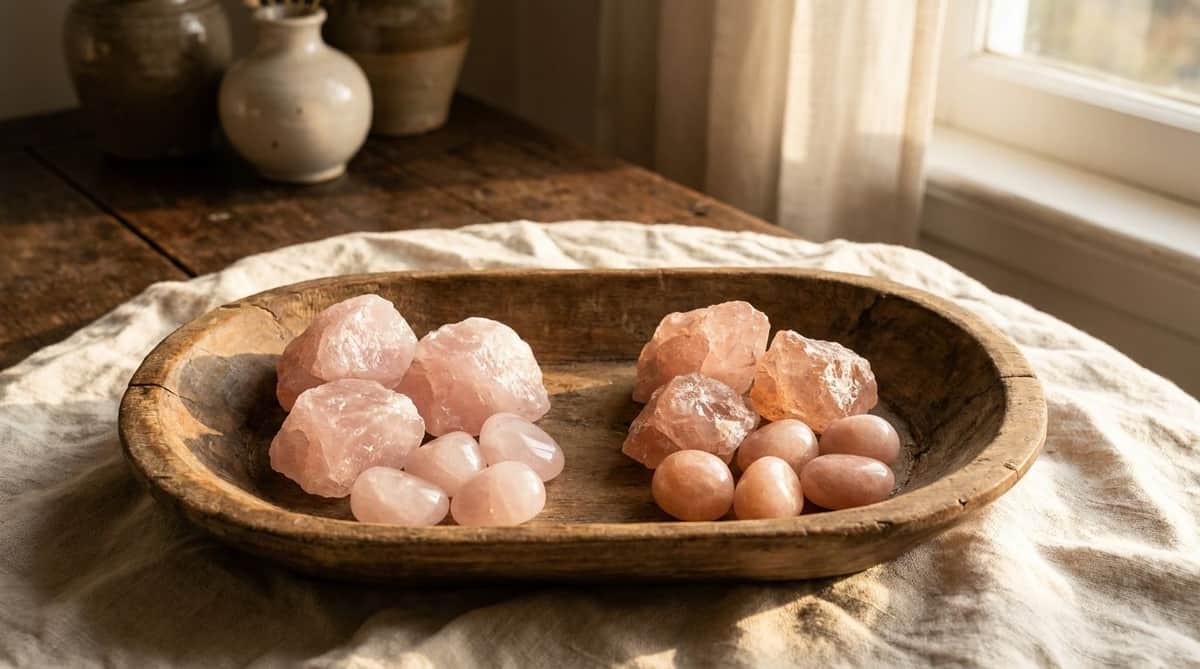
The fastest tell is transparency. Per GIA, rose quartz owes its color to microscopic mineral inclusions that give it a “cloudy translucence” — even fine rose quartz tends to look soft and slightly hazy rather than glassy-clear, which is also why it's almost always cut as a smooth cabochon or bead rather than faceted. Morganite, by contrast, is typically eye-clean once faceted: GIA notes that faceted morganite in light to medium color usually shows no inclusions visible to the naked eye, and its color comes from trace manganese rather than internal inclusions. If a pale pink stone is cut with sharp, sparkling facets and reads clear rather than milky, it's almost certainly morganite, not rose quartz.
Color intensity is a second clue. Rose quartz holds a fairly consistent, muted pastel pink regardless of size. Morganite's color is more size-dependent — GIA notes that strong, saturated pink in morganite typically only shows up in larger stones, and untreated material often leans more salmon or peach than pink. Much of the morganite sold today has been heat-treated specifically to shift that salmon undertone toward a cleaner pink, which is standard practice in the trade and not something sellers are required to disclose stone-by-stone the way lab-grown-vs-natural is disclosed for diamonds.
Hardness and Everyday Wear
On the Mohs scale, rose quartz measures 7 and morganite measures 7.5 to 8 — both durable enough for regular jewelry wear, and both harder than the 6.5 steel-file test threshold that separates “fine for a ring” from “better as a pendant.” Morganite's slightly higher hardness gives it a real edge for a piece worn daily, like an engagement or stacking ring, though neither stone is remotely close to a diamond's 10, and both chip on a hard direct knock the way any gemstone can. A protective setting — a bezel or a low profile — matters more for either of these stones than it would for a harder gem.
Price and Rarity
Rose quartz is one of the most abundant colored gemstones on the market, mined in large, consistent deposits, which keeps it inexpensive even at sizes that would be exceptional in almost any other stone. Morganite is comparatively scarcer — large, saturated-color crystals are genuinely uncommon, which is part of why GIA singles out big morganite specimens (some Brazilian crystals have topped 10 kilograms in the rough) as notable rather than routine. That scarcity, plus morganite's clean faceted clarity, is why it generally commands a meaningfully higher price than rose quartz of a comparable size — the tradeoff buyers are actually making isn't just “which pink,” it's clarity and rarity versus budget.
Size behaves differently between the two as well. Because rose quartz is mined in large, consistent deposits, big rose quartz pieces — even fist-sized carved stones — are common and still affordable. Large morganite is the opposite: GIA points to Brazil as the source of the biggest specimens, but a big, well-colored morganite crystal is genuinely notable rather than routine, which is part of why jewelry-scale morganite tends to top out in a more modest carat range than a decorative rose quartz piece would.
Meaning and Metaphysical Reputation
Rose quartz carries the older and far more widely recognized reputation of the two — it's the stone most consistently called the “stone of unconditional love” across crystal-healing traditions, a meaning covered in more depth in our rose quartz meaning guide. Morganite's meaning is a newer, narrower tradition, often described in the modern wellness market as a “divine love” or heart-opening stone — language that echoes rose quartz's reputation closely, which is likely part of why the two get shopped as interchangeable in the first place. Neither association is a documented effect; both are belief-system framing, the same as any gemstone folklore covered in our gemstone color meanings guide.
Which One Should You Choose?
If the goal is an affordable, soft pink accent — beads, a cabochon pendant, a casual everyday piece — rose quartz does the job at a fraction of morganite's cost, and its lower price makes it far more forgiving if the piece gets knocked around. If the goal is a faceted centerpiece stone, especially for a ring meant to read as a genuine alternative to pink sapphire or pink diamond, morganite's clarity and sparkle get you there in a way rose quartz's cloudier structure can't; our moissanite vs. diamond guide covers a similar clarity-and-budget tradeoff if you're comparing options for a ring specifically. Either stone pairs well with an engraved setting — browse our personalized necklaces for ideas that work with a gemstone accent. Whichever you land on, clean it the same gentle way: warm water, a drop of mild dish soap, and a soft cloth, the same approach we cover in our guide to cleaning a gemstone ring.
Rose quartz and morganite are just one branch of the pink-gem mix-up — the same color-first confusion shows up with other gemstone pairs too. Our citrine vs. yellow topaz guide walks through the yellow-stone version of this exact comparison, and our gemstone meanings hub rounds up every stone we've profiled this way if you're weighing a different color match.
Frequently Asked Questions
Is morganite more expensive than rose quartz?
Generally, yes. Morganite is rarer, especially in larger, well-saturated pieces, and is almost always faceted with clean clarity, while rose quartz is abundant and typically cut as a cabochon. That combination of scarcity and cut quality is why morganite usually costs meaningfully more per carat.
Can you tell rose quartz and morganite apart just by looking?
Usually. The clearest tell is transparency: rose quartz has a cloudy, translucent quality from internal mineral inclusions, while faceted morganite is typically eye-clean and glassy. Cut is a second clue — rose quartz is almost always a smooth cabochon or bead, while morganite is more often faceted.
Is morganite a real, natural gemstone?
Yes. Morganite is a genuine variety of beryl, the same mineral family as emerald and aquamarine, colored by trace manganese. Much of the morganite sold today is heat-treated to shift its natural salmon undertone toward a cleaner pink — a standard, accepted trade practice, not a sign of a fake or synthetic stone.
Which stone is more durable for an everyday ring?
Morganite, slightly. It measures 7.5 to 8 on the Mohs hardness scale versus 7 for rose quartz. Both hold up fine to daily wear, but morganite has a small edge, and either stone benefits from a protective setting like a bezel.
Why do people confuse rose quartz and morganite?
Mainly the color — both land in a similar soft pink range, and both carry a strikingly similar “love stone” reputation in modern crystal and wellness circles, which makes them easy to conflate even though they're unrelated minerals with different hardness, clarity and price.