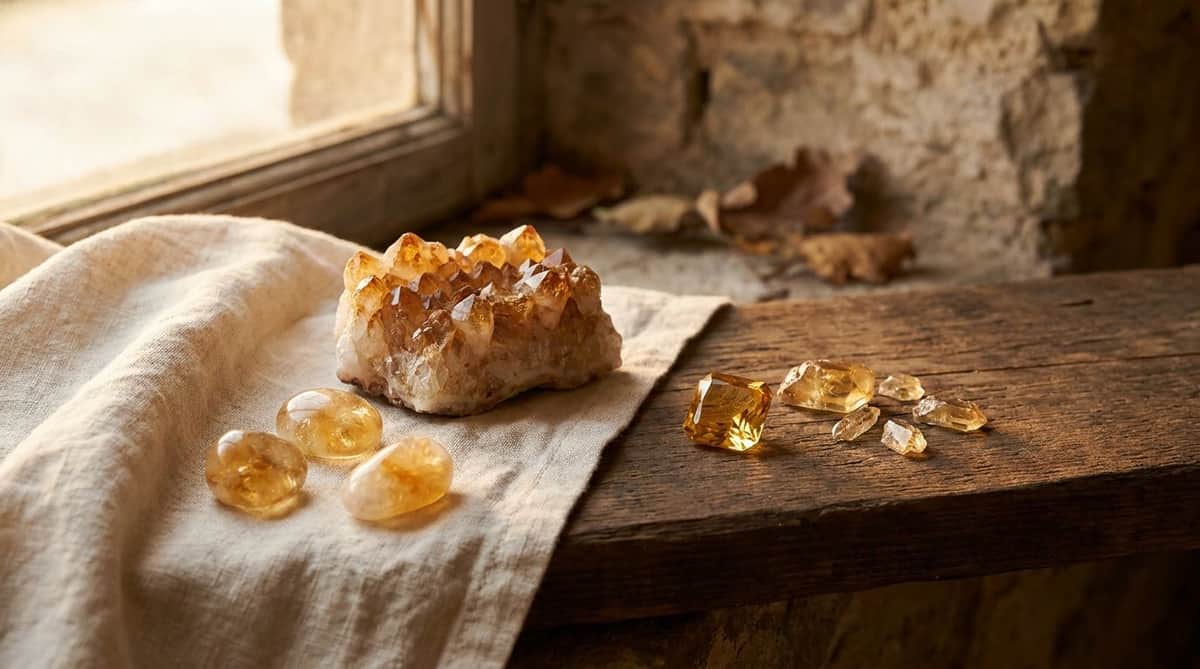
Citrine and yellow topaz are the two official birthstones of November, and on a jewelry counter they can look like the exact same warm honey-gold gem. They aren't. One is a variety of quartz, the other belongs to an entirely different mineral family, and the two behave differently on your hand, price out very differently, and even break in different ways if you hit them hard enough. Here's what actually separates citrine from yellow topaz, sourced against the mineral data itself rather than the interchangeable seller copy that tends to blur the two together.
Two Different Minerals That Share a Golden Color
Citrine is a variety of quartz — silicon dioxide (SiO₂) — in the same tectosilicate family as clear quartz, amethyst and rose quartz, crystallizing in the trigonal system. Topaz is a nesosilicate, aluminum fluorosilicate with the formula Al₂SiO₄(F,OH)₂, crystallizing in the orthorhombic system. They share nothing mineralogically beyond both containing silica and both occurring in a similar yellow range — the resemblance is entirely coincidental, the same way rose quartz and morganite happen to land on the same shade of pink without being related stones.
Color and Clarity: How to Tell Them Apart at a Glance
Where citrine's color actually comes from is still debated among mineralogists — most evidence points to aluminum-based color centers in the crystal structure, similar to what produces smoky quartz's brown, though iron has long been cited too. What's not in dispute is that almost all citrine sold commercially is heat-treated amethyst or smoky quartz: heating either above roughly 200–300°C (392–572°F) drives an iron-oxidation reaction that shifts the color to yellow or brown. Natural, untreated citrine exists but is genuinely rare in the market.
Topaz in its unaltered natural state is usually colorless or carries only a faint grey tint — the familiar blue topaz sold everywhere is almost always the product of irradiating and then heat-treating that colorless material, since natural blue topaz is rare. Yellow and golden hues are different: they do occur naturally, and the finest of them — genuine golden-to-pink-orange stones, mostly from Ouro Preto in Brazil's Minas Gerais state — are traded specifically as “Imperial topaz,” prized as the most valuable topaz color. Visually, topaz tends to show a deeper, more saturated glow and sharper facet brilliance than citrine, which reads a shade lighter and softer even at a comparable depth of color.
Hardness, Cleavage, and Everyday Wear
On the Mohs scale, citrine measures 7 and topaz measures 8 — on paper, topaz is the harder, more scratch-resistant stone. But hardness only tells you how a stone resists abrasion, not how it resists a sharp knock, and that's where the comparison flips. Topaz has perfect cleavage along one plane, meaning a hard, precisely angled impact can split it cleanly in two. Quartz, including citrine, has no cleavage at all — it breaks with an irregular conchoidal fracture, the way glass does, which in practice makes it less prone to a single clean split from everyday knocks. Neither weakness is a reason to avoid either stone in a ring, but a protective, low-profile setting matters more for topaz than its higher hardness number alone would suggest.
Natural Rarity and Treatment
The citrine on a store shelf is, in almost every case, heat-treated amethyst or smoky quartz rather than stone that grew yellow underground — genuinely natural citrine is uncommon enough that most gemologists assume treatment unless told otherwise. Topaz sits on the opposite side of that question for the color being compared here: while blue topaz is reliably a treated stone, yellow and golden topaz — including true Imperial topaz — occur naturally far more often, even though heat or irradiation can still be used on lower-grade material to improve its color. If “is this natural” matters to you, it's the more loaded question for citrine than it is for a yellow topaz.
Price and Value
Citrine is one of the more affordable colored gemstones on the market, precisely because so much of the supply is manufactured by heat-treating comparatively cheap amethyst or smoky quartz — abundance and an easy treatment process keep the price low even in large sizes. Topaz is far more variable: ordinary colorless and light-toned material is inexpensive, but genuine Imperial topaz is treated as one of the more valuable topaz varieties in the trade, and fine, saturated stones — especially in larger carat weights — command meaningfully more than a citrine of the same size. If a “yellow topaz” ring is priced close to a citrine one, it's very likely lower-grade or lightly-colored material rather than true Imperial-grade stone.
Meaning and Symbolism
Citrine and yellow topaz are, jointly, the official modern birthstones for November — part of why the two get confused for each other so often at the jewelry counter, beyond just sharing a color.
In crystal folklore — belief with no scientific backing, not a factual claim — citrine is often called the “merchant's stone,” associated with abundance, confidence and warmth, a reputation covered further in our citrine meaning guide. Topaz carries an older folk reputation for clarity and strength, tracing back to ancient Greek and Egyptian writers who associated the stone's glow with the sun — again, tradition and belief, not established fact.
Which One Should You Choose?
If the goal is an affordable, everyday golden-yellow accent — a stacking ring, a pendant, a piece you won't worry about — citrine does the job at a fraction of the cost and holds its color consistently. If you want a stone with more brilliance, a deeper natural glow, and don't mind paying more for it, a genuine yellow or Imperial topaz is the better choice, provided it sits in a setting — a bezel or protective prong height — that shields its one cleavage plane from a hard edge-on knock.
Either stone pairs well in a birthstone ring set for November, and both are gentle enough for daily wear once you know which weak point to protect against — see our full guide to cleaning and caring for a gemstone ring for the specifics on each stone type.
Frequently Asked Questions
Is citrine the same stone as yellow topaz?
No. Citrine is a variety of quartz (silicon dioxide); yellow topaz is a chemically unrelated aluminum fluorosilicate. They only resemble each other in color, not in mineral family, hardness, or how they form.
Which is harder, citrine or yellow topaz?
Topaz, at 8 on the Mohs scale versus citrine's 7. That makes topaz more scratch-resistant, but it also has a perfect cleavage plane that citrine, as a form of quartz, does not have — so topaz is more vulnerable to a clean split from a hard, precisely angled knock despite its higher hardness number.
Why is citrine so much cheaper than topaz?
Mainly supply. Most commercial citrine is made by heat-treating comparatively inexpensive amethyst or smoky quartz, keeping prices low even at large sizes. Fine yellow or Imperial topaz is naturally occurring, mined in far more limited quantities — principally in Brazil's Minas Gerais region — and is priced accordingly higher, especially in larger, well-saturated stones.
Is yellow topaz natural or treated?
It depends on the shade. Blue topaz is reliably a treated stone (irradiated and heat-treated from colorless material), since natural blue topaz is rare. Yellow and golden topaz, including true Imperial topaz, occur naturally far more often, though lower-grade material can still be treated to improve its color.
Can citrine and yellow topaz be worn together?
Yes — both are November's official birthstones, so the pairing is traditional as well as visually harmonious. Because they sit close in hardness (7 and 8) and share a similar color family, they wear and photograph well side by side in the same piece or as a matched set.