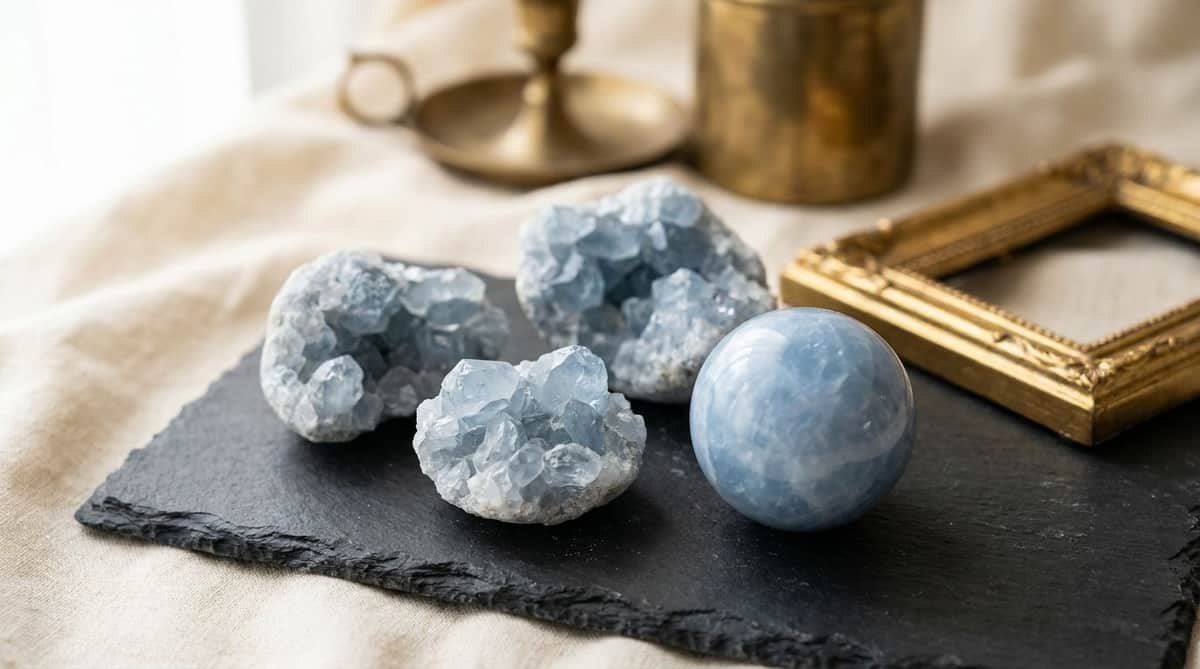
Crystal shops sell "blue calcite" as a soft, powdery-blue stone, usually tumbled into spheres or left as a raw cluster, and marketed for calm and clear communication. The mineralogy underneath the marketing is almost comically ordinary: it's the same mineral, calcium carbonate, that makes up limestone, marble, and the chalk in a piece of sidewalk chalk. What makes blue calcite worth knowing about isn't rarity — it's how soft it is, and what that means if you're deciding where it belongs in your home or on your body.
What Blue Calcite Actually Is
Calcite is calcium carbonate, CaCO3, crystallizing in the trigonal system with a specific gravity of about 2.71. It's so common and so consistently identifiable that mineralogists use it as the literal reference point for 3 on the Mohs hardness scale — the official "defining mineral" for that hardness level, which sits between gypsum (2) and fluorite (4). Pure calcite is colorless or white; the blue, like calcite's other color varieties (pink, green, orange, honey-yellow), comes from trace impurities or mineral inclusions trapped in the crystal as it formed, not from calcium carbonate itself.
What causes the blue specifically isn't settled the way, say, iron causing red calcite is. Mineral dealers and specimen records most often point to two different culprits depending on the deposit: trace copper impurities within the crystal lattice, or visible inclusions of aurichalcite — a separate copper-zinc carbonate mineral that forms alongside calcite in copper-ore deposits and can tint it blue-green. Both explanations show up in specimen descriptions from Mexican localities, and neither has the kind of rigorous published confirmation that calcite's basic hardness and formula have. Treat the color-cause claim as informed observation from people who handle a lot of specimens, not as settled mineralogy.
Why It's So Soft (and What That Means for Wearing It)
A Mohs hardness of 3 means blue calcite can be scratched by a copper penny, a kitchen knife, or even firm fingernail pressure in places (fingernails sit at roughly 2.5). Compare that to the stones that typically go into rings and bracelets: quartz-family gems (amethyst, citrine, rose quartz) sit at 7, sapphire and ruby at 9, and diamond, the hardest natural material, at 10. Blue calcite is roughly 200 times less scratch-resistant than diamond on the practical hardness scale jewelers use, which is also, not coincidentally, why you'll see it sold as spheres, towers, and raw clusters for a shelf or altar far more often than as a ring or everyday bracelet stone.
Calcite has a second property that compounds the softness problem for jewelry: it reacts visibly with acid. Diluted hydrochloric acid fizzing on a rock is literally the standard field test geologists use to identify calcite, and the same reaction happens, more slowly, with household acids like vinegar or lemon juice. Sweat, skin oils, and everyday hand lotion are mild enough that they won't dissolve a specimen outright, but between the acid sensitivity and the low hardness, blue calcite is a poor candidate for a piece worn daily against skin.
Calcite as a species also has a genuinely impressive resume outside the crystal shop, even if the blue variety doesn't share the spotlight. Transparent calcite, sold historically as "Iceland spar," is strongly birefringent — it splits a single ray of light into two, visibly doubling any image seen through a clear piece — with refractive indices of about 1.658 and 1.486. That property made it useful in Nicol prisms for polarizing light before synthetic polarizing film existed, and even in optical gun sights during the Second World War. The largest single calcite crystal ever documented, also from Iceland, weighed around 250 tons. None of that trivia is specific to the blue variety, but it's the same underlying mineral, which is part of why geologists find calcite more interesting than its soft, workaday reputation suggests.
Where Blue Calcite Comes From
Much of the blue calcite sold in the US crystal trade traces back to Mexico. Specimen dealers and locality records point to the Ojuela Mine in Mapimí, Durango — a mine worked for lead, zinc, and silver since the 18th century and one of the most prolific mineral-specimen localities in the world — where calcite crystals take on a blue tint from aurichalcite inclusions. Bluish calcite is also recorded from the Santa Bárbara Mine in Chihuahua. Separately, general (non-blue) calcite is mined at industrial scale worldwide: the Calcite Quarry in Rogers City, Michigan, has operated for more than 85 years and is described as the largest carbonate mine on Earth, though its output is overwhelmingly ordinary white limestone-grade calcite for industrial use, not display-grade blue specimens.
Blue Calcite vs. Similar Blue Crystals
Blue calcite gets confused with a handful of other pale-blue stones at a glance. By hardness and composition:
- Blue Calcite — Mohs 3, calcium carbonate, soft and acid-reactive, usually the most matte/chalky-looking of the group.
- Celestite (Celestine) — Mohs 3–3.5, strontium sulfate, similar softness but typically forms in sharper, more glassy druzy clusters and geodes.
- Angelite — Mohs 3.5, a trade name for massive blue anhydrite (calcium sulfate), slightly harder than calcite but still soft and water-sensitive.
- Blue Chalcedony — Mohs 6.5–7, a form of quartz, dramatically harder and more durable, waxy rather than chalky in luster — the realistic choice if you want a similar pale-blue color in a piece you'll actually wear.
The Meaning and Lore Behind Blue Calcite
In crystal-healing traditions, blue calcite is associated with calm, emotional release, and clearer communication — it's sometimes described as a stone for "soothing the throat," which practitioners connect to the throat chakra in that system. None of this is scientifically established; it's belief and folk tradition, the same category as most crystal-meaning claims, and worth treating as such rather than as fact. What is verifiable is the physical object: a genuinely soft, genuinely common mineral that happens to catch the eye in a pale, chalky blue.
How to Care for Blue Calcite
Keep it dry and away from acidic cleaners — no vinegar, no citrus-based sprays, and skip the ultrasonic jewelry cleaner entirely. A soft, dry cloth is the safest way to dust a piece. Store it separately from harder stones and metal jewelry so nothing in a drawer or pouch scratches the surface, and keep it out of a bag or pocket where keys or coins could do the same. If you do want a similar pale-blue tone in something you can wear daily, a genuinely durable stone like aquamarine (Mohs 7.5–8) will hold up to normal wear in a way blue calcite structurally cannot — browse personalized rings if you'd rather keep the color and skip the fragility.
Frequently Asked Questions
Is blue calcite the same as calcite?
Yes. Blue calcite is ordinary calcite (CaCO3, Mohs hardness 3) in a blue color variety, caused by trace impurities or inclusions such as aurichalcite rather than by any difference in the base mineral.
Can you wear blue calcite jewelry every day?
It's not a good choice for daily wear. At Mohs 3, it scratches easily and reacts with acids including sweat-adjacent household products like vinegar, so pieces set with it are better suited to occasional wear or display than to a ring or bracelet worn constantly.
Can blue calcite get wet?
Brief contact is unlikely to cause visible damage, but prolonged soaking should be avoided — calcite is chemically reactive with acidic water and can lose polish or surface detail over time. Always dry it immediately rather than letting water sit on the surface.
Where does blue calcite come from?
Much of the blue calcite in the mineral trade comes from Mexico, particularly the Ojuela Mine in Mapimí, Durango, and the Santa Bárbara Mine in Chihuahua, where copper-bearing minerals in the deposit are the likely source of the blue tint.