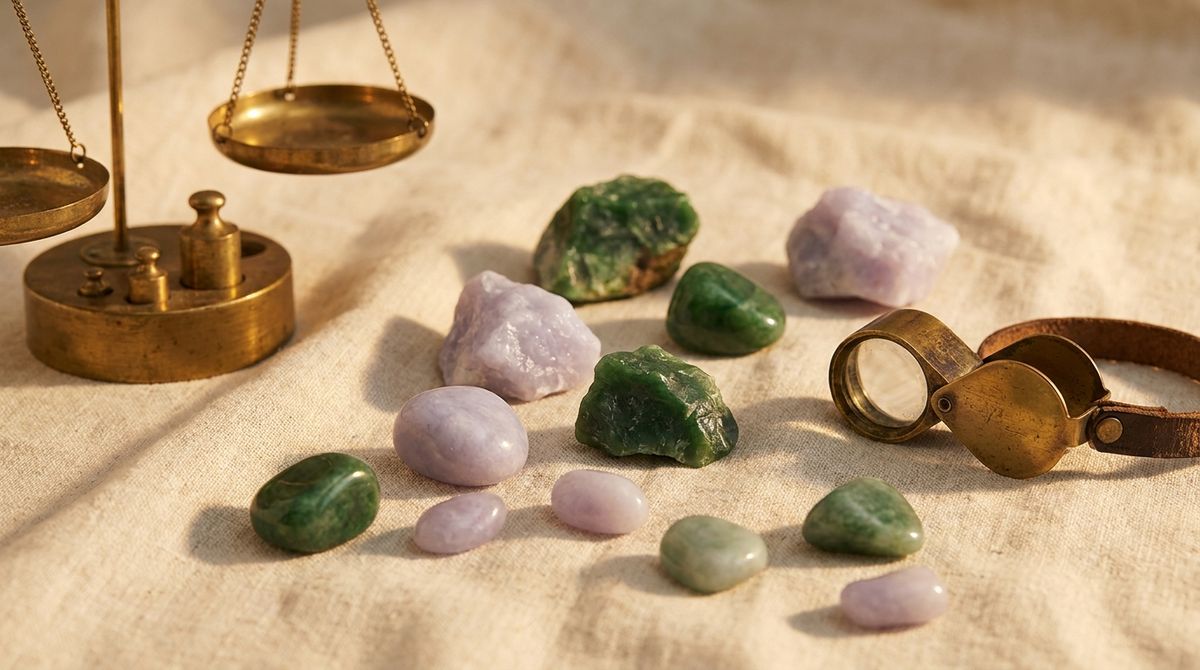
Ask for “jade” at most jewelry counters and you'll get one stone in one shade of green. Ask a gemologist and you'll learn jade is actually two unrelated minerals — nephrite and jadeite — and that jadeite, the rarer of the two, is the one capable of the vivid “imperial green” that has sold for tens of millions of dollars at auction. FARUZO's jade guide already covers that two-mineral split and how to spot dyed jade in general; this one goes deeper on jadeite specifically — the chemistry that separates it from nephrite, the auction record that shows what the difference is actually worth, and where the real stone comes from.
What Makes Jadeite a Different Mineral From “Jade” in General
Jadeite is a sodium aluminum silicate pyroxene (NaAlSi₂O₆) — chemically unrelated to nephrite, the calcium-magnesium-iron amphibole that's also sold under the name “jade.” The two minerals aren't cousins; they just happen to form similarly tough, fine-grained rock that two different cultures independently prized long before anyone realized they weren't the same material. Jadeite runs slightly harder and denser than nephrite, and it takes a noticeably higher, glassier polish — part of why jadeite, not nephrite, became the stone associated with the saturated “imperial” look prized at the Qing Dynasty court.
- Jadeite: Mohs 6.5–7, density roughly 3.3–3.5 g/cm³, refractive index about 1.66; capable of the vivid, translucent “imperial green” and the rarer, more valuable of the two true jades.
- Nephrite: Mohs 6–6.5, density roughly 2.9–3.0 g/cm³, refractive index about 1.61–1.63; more fibrous and tougher, and the historically dominant jade in China before jadeite arrived from Myanmar in the 1700s.
- Dyed quartzite or serpentine: often marketed as “jade” but neither true mineral at all; under magnification the dye pools unevenly in surface fractures, and the stone typically reads noticeably lighter than genuine jadeite of the same size.
Meaning and Lore: Physical, Mental, and Metaphysical
Physical Properties
Jadeite's tight, interlocking micro-crystal structure is what gives it both its toughness and its glassy polish — the same structural trait that let carvers cut extremely thin bangles and plaques without the material chipping. That structure is also why jadeite takes a mirror-like finish that nephrite, with its more fibrous grain, generally can't match.
Mental & Emotional Associations
In crystal-healing traditions, jadeite is described as a stone of calm and clarity — said to quiet an overactive mind and support level-headed decisions. As with any stone in this category, that's a centuries-old belief system worth naming honestly rather than a claim backed by clinical evidence.
Metaphysical Traditions
The same traditions link jadeite to the heart chakra and to luck and prosperity, which is why carved jadeite coins, cabbages and Buddha figures are common gifts in Chinese culture. “Imperial jade” specifically carried an added layer of meaning: because gem-quality jadeite was rare and difficult to import, wearing it at the Qing court signaled status in a way plain nephrite, however historically significant, no longer could.
Imperial Jade and Where Jadeite Actually Comes From
Unlike nephrite, which occurs in multiple deposits worldwide — China, Siberia, New Zealand, British Columbia — gem-quality jadeite comes from remarkably few places. The overwhelming majority of the world's fine jadeite, including virtually all true “imperial green” material, comes from a single mining region: Kachin State in northern Myanmar, centered on the Hpakant mines, which have supplied the Chinese market since jadeite was first imported there in the 18th century. A smaller, geologically unrelated jadeite deposit in Guatemala's Motagua River valley supplied the Maya and Olmec civilizations more than a thousand years before Myanmar's deposits were tapped, and is still mined on a much smaller scale today.
The clearest illustration of how much fine jadeite can be worth is the Hutton-Mdivani Necklace — a strand of 27 graduated jadeite beads once owned by Woolworth heiress Barbara Hutton. It sold at Sotheby's Hong Kong in 2014 for HK$214.04 million, about $27.4 million USD, making it, at the time, the most expensive jadeite jewel and one of the most expensive jewels of any kind ever sold at auction — a level of value nephrite, for all its history, has never approached.
How to Identify Real Jadeite (and Avoid the Fakes)
Because fine jadeite is worth so much more than the materials used to imitate it, the gem trade uses a formal treatment classification built specifically around this stone: Type A jadeite is untreated aside from a wax coating, Type B has been bleached and resin-impregnated to improve color and clarity, and Type C has been dyed outright. FARUZO's jade guide covers that A/B/C system and the dye-in-fractures test in full detail; the short version for jadeite specifically is that only untreated Type A material holds long-term value, and reputable dealers disclose the grade upfront rather than making a buyer guess.
A few checks that don't require a lab: genuine jadeite feels notably dense for its size, heavier in the hand than glass or plastic imitations of similar volume. It also takes a distinctly glassy, almost wet-looking polish rather than the slightly waxy sheen common to nephrite and most imitators, and tapping two loose jadeite beads together produces a higher-pitched, more resonant click than the duller sound glass or plastic makes.
At Mohs 6.5–7, jadeite is durable enough for daily wear — more so than nephrite's already-tough Mohs 6–6.5 — but resin-treated Type B material is more porous and can dull or discolor with repeated contact with lotions, perfume and skin oils, so it's worth knowing which type you own before treating a bangle as indestructible. Our guide to cleaning a gemstone ring safely covers the gentler cleaning routine that porous, treated stones like Type B jadeite need. If you like the idea of a single meaningful stone set simply, browse FARUZO's personalized necklaces for pieces built around one central gem.
For more stone-by-stone guides like this one, the Gemstones & Crystals archive covers the meaning, chemistry and identification checks for dozens of other stones FARUZO has written up in the same depth.
Frequently Asked Questions
Is jadeite the same as jade?
Jadeite is one of two minerals sold under the single name “jade” — the other is nephrite. They're chemically unrelated: jadeite is a sodium aluminum silicate, nephrite a calcium-magnesium-iron silicate. Jadeite is the rarer of the two and the only one capable of the vivid “imperial green” color.
What's the difference between jadeite and nephrite?
Jadeite is harder (Mohs 6.5–7 versus nephrite's 6–6.5), denser, and takes a glassier polish. Nephrite is more fibrous and slightly tougher against chipping, and historically was the dominant jade in China before jadeite arrived from Myanmar in the 18th century.
Why is jadeite so much more valuable than nephrite?
Gem-quality jadeite is rarer — the finest material comes almost entirely from one mining region in Myanmar — and only jadeite reaches the vivid, translucent “imperial green” that commands the highest prices. The 2014 sale of the Hutton-Mdivani jadeite necklace for roughly $27.4 million at Sotheby's Hong Kong illustrates the ceiling that top-grade jadeite can reach; nephrite has no comparable auction record.
Where does jadeite come from?
Almost all fine jadeite comes from Kachin State in northern Myanmar, centered on the Hpakant mining region. A smaller, separate deposit in Guatemala's Motagua River valley supplied the ancient Maya and Olmec long before Myanmar's jadeite reached China.
How can I tell if a piece of jadeite jewelry is real?
Check the weight (genuine jadeite feels dense for its size), look under magnification for dye pooled unevenly in surface fractures rather than following the stone's natural structure, and ask the seller directly whether the piece is Type A (untreated), Type B (bleached and resin-impregnated), or Type C (dyed) — a reputable dealer will know and disclose the grade.
Is jadeite jewelry durable enough for everyday wear?
Untreated Type A jadeite, yes — at Mohs 6.5–7 it holds up well to daily wear. Type B material, which has been resin-treated to improve clarity, is more porous and can dull or discolor over time with regular contact with lotion, perfume and skin oils.