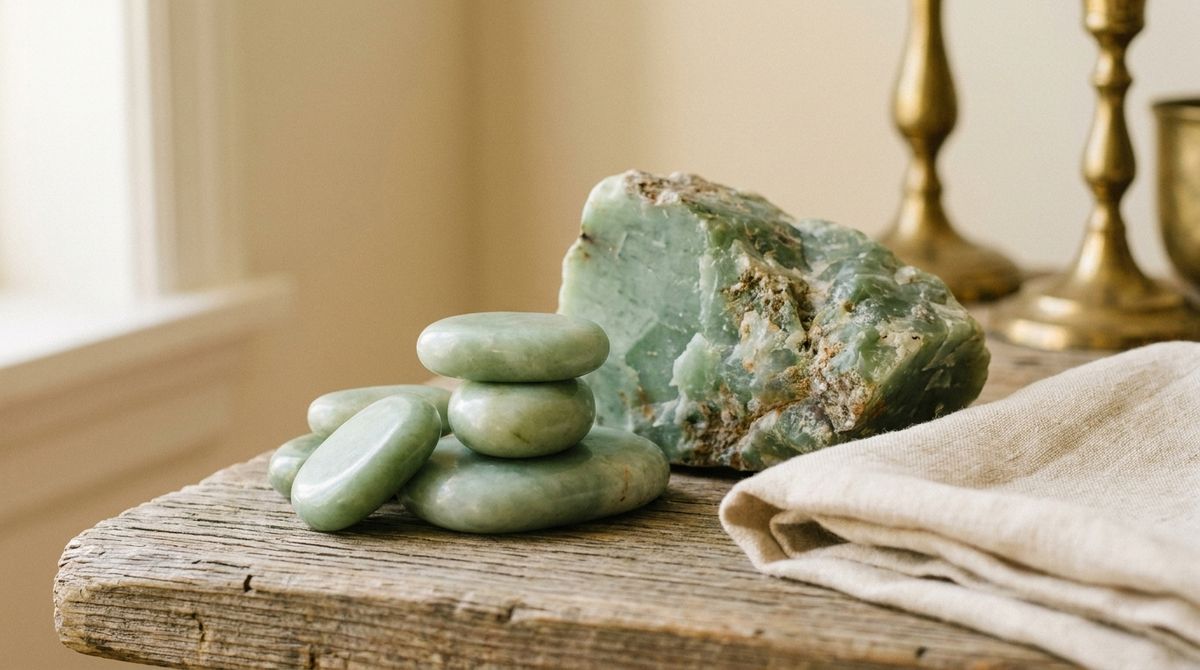
Jade has a claim almost no other stone can make: an entire civilization treated it as more valuable than gold. In China, jade — yu — was linked to purity, immortality, and moral virtue for thousands of years before diamonds meant much of anything as a jewelry gemstone. What most people don't realize is that "jade" isn't one mineral. It's a name shared by two chemically different stones that only look alike, which is exactly why so much of what's sold as jade today isn't quite what the label implies.
What jade actually is
Gemologists recognize two separate minerals under the single name "jade": nephrite, a calcium-magnesium-iron silicate, and jadeite, a sodium-aluminum silicate in the pyroxene family. They aren't variations of the same rock — they're unrelated minerals that happen to form in similarly tough, fine-grained masses, and were used interchangeably by cultures that had no way to tell them apart chemically.
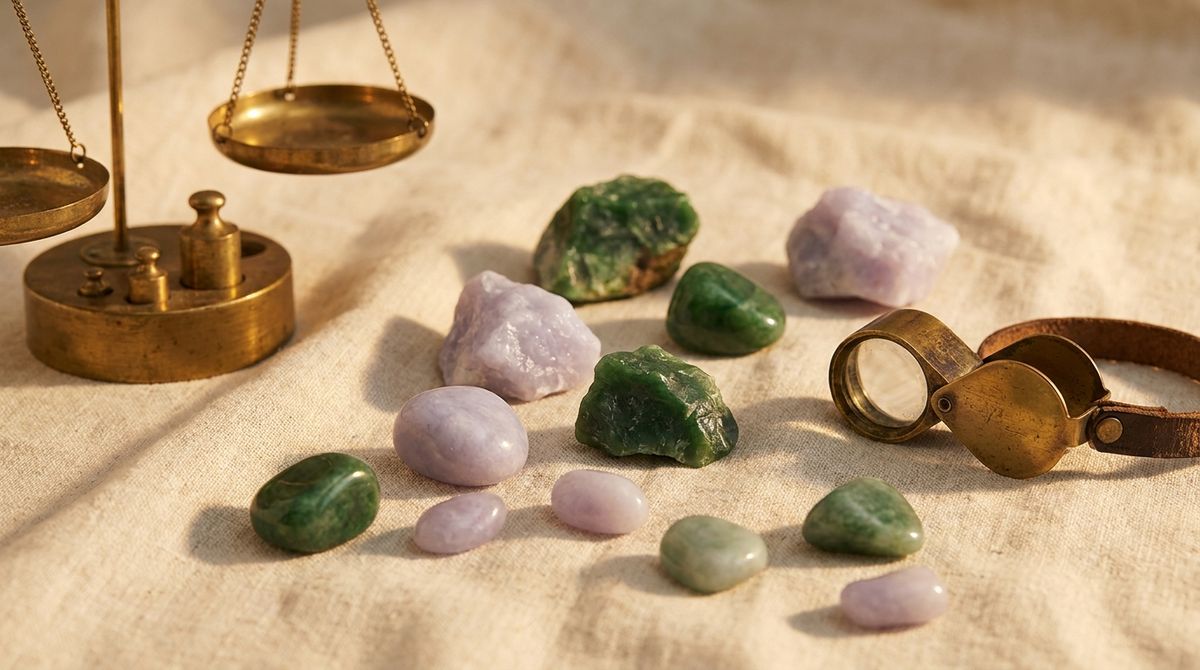
Jadeite is the rarer of the two and capable of the vivid, saturated "imperial green" that commands the highest prices at auction; it also occurs in lavender, yellow, black, and white. Nephrite has a narrower color range — usually spinach green, cream, or the prized "mutton fat" white — but makes up for it in toughness. Both stones resist fracturing far better than their Mohs hardness numbers (nephrite roughly 6 to 6.5, jadeite 6.5 to 7) would suggest, because of how their microscopic crystals interlock rather than sitting in clean, breakable layers.
Where it comes from
Nephrite came first, historically. China was carving Xinjiang and Hotan nephrite into ceremonial objects by the Neolithic Liangzhu culture, roughly 3400 to 2250 BCE — cong tubes and bi discs that predate jadeite's arrival in Chinese hands by thousands of years. Jadeite didn't reach China in quantity until gem-quality deposits were identified in Myanmar's Kachin State around 1784, after which Qing dynasty demand made Burmese jadeite the material the word "jade" now conjures for most people. On the other side of the world, the Olmec, Maya, and Aztec independently carved jadeite mined from Guatemala's Motagua River valley — the Maya king Pakal's funerary death mask at Palenque is a jadeite mosaic built from several hundred individual pieces. In New Zealand, nephrite pounamu is so central to Māori identity that its ownership was legally vested in the iwi Ngāi Tahu by the Ngāi Tahu (Pounamu Vesting) Act 1997 — there, it isn't simply a gemstone, it's a taonga, a treasure with its own legal status.
Why jade meant more than gold
In the Book of Rites (Liji), Confucius is recorded comparing jade's physical qualities directly to virtues — its smoothness to benevolence, its hardness held in restraint to wisdom, its willingness to show a flaw rather than hide it to sincerity. That framing stuck: for much of Chinese history, jade wasn't primarily a decoration, it was a moral object, carved into scholars' seals, imperial burial suits, and ceremonial discs meant to represent heaven itself. The English word "jade," for what it's worth, comes from an entirely different source — the Spanish piedra de ijada ("stone of the flank"), after conquistadors in the Americas saw it held against the body to treat kidney and flank ailments. "Nephrite" is a parallel coinage built from the Greek nephros (kidney) for the same belief, not a word borrowed from the Spanish.
Physical, mental, and metaphysical: what people say about it
Physical: nephrite's fibrous, interlocking structure makes it one of the toughest materials available in nature, which is exactly why Neolithic and pre-Columbian cultures shaped it into axe heads and blades before bronze and iron were an option — it holds an edge and resists shattering under impact better than most stones with a comparable hardness rating.
Mental: in crystal-healing traditions — not verified medical claims, but centuries-old belief systems worth naming honestly — jade is described as a stone of calm and clarity, associated with easing anxiety and supporting clear decision-making.
Metaphysical: the same traditions link jade to the heart chakra and to luck and prosperity, which is why carved jade coins, cabbages, and Buddha figures are common in Chinese and broader East Asian feng shui practice. In Western astrology-adjacent crystal lists, jade is most often paired with Taurus and Libra.
How to tell real jade from dyed or fake jade
Because fine jadeite can be worth vastly more than the minerals used to fake it, the gem trade uses a formal treatment classification: Type A jadeite is untreated aside from a wax polish; Type B has been bleached and impregnated with polymer resin to improve clarity and color; Type C has been dyed outright. Type A holds its value; B and C are legitimate to sell, but must be disclosed as treated — and often aren't.
A few things to check without lab equipment: genuine jade feels notably dense for its size — heavier in the hand than glass or plastic imitations of similar volume. Dye tends to pool unevenly in a stone's natural fractures rather than following the mineral's grain, visible under a jeweler's loupe as color concentrated along cracks. Common look-alikes sold as "jade" or "new jade" include serpentine, aventurine quartz, and dyed quartzite — all real minerals, just not jade. For anything above a casual purchase, a gemological report from a lab like GIA is the only fully reliable answer; sight identification, even by experienced buyers, gets fooled regularly.
Caring for jade jewelry
Untreated (Type A) jade is tough enough for daily wear — traditional Chinese nephrite bangles are worn constantly for exactly that reason. Treated Type B jade is more fragile: its polymer filler can degrade with heat, sunlight, or harsh chemicals over time, so skip ultrasonic cleaners and steam unless you're certain a piece is untreated. Mild soap, lukewarm water, and a soft cloth clean any jade safely.
Looking for a jade name necklace or birthstone-style piece? Browse FARUZO's personalized necklaces collection.
For the broader logic behind why different stones carry different symbolic meanings — and how much of it is documented history versus modern crystal-healing tradition — see Different Gemstones and What They Really Mean, Gemstone Color Meanings, and How to Clean a Gemstone Ring Safely. For more stone-by-stone breakdowns like this one, browse the full Gemstones & Crystals archive, including how two similarly prized stones get told apart in our ruby vs. garnet guide.
Frequently Asked Questions
Is jade one mineral or two?
Two. "Jade" is a shared name for nephrite (a calcium-magnesium-iron silicate) and jadeite (a sodium-aluminum silicate), chemically unrelated minerals used interchangeably because they look and behave similarly. Jadeite is rarer and can reach more saturated colors, including the vivid "imperial green"; nephrite is tougher and was historically more common across China, New Zealand, and Central Asia.
Is jade a mineral or a rock?
Strictly speaking, a piece of jade is a rock, not a single mineral crystal: both nephrite and jadeite form as dense aggregates of many microscopic mineral grains grown together, which is exactly what gives jade its unusual toughness — the interlocking grains distribute an impact instead of splitting along one clean plane the way a single large crystal would. Jadeite is also recognized as its own mineral species (in the pyroxene group); nephrite is a fibrous variety of the actinolite-tremolite series. So calling either one "a mineral" in casual conversation isn't wrong — it's just describing the ingredient rather than the rock it's found in.
Why is jade associated with the kidneys?
Through etymology, not medicine. Spanish conquistadors in the Americas saw jade held against the body to treat kidney and flank pain, which gave English the word "jade" (from piedra de ijada, "stone of the flank") and, separately, gave science the word "nephrite" (from the Greek nephros, kidney) for the same belief. There's no clinical evidence jade affects kidney function.
How can I tell if a jade bracelet is real?
Check the weight (jade feels dense for its size), look under magnification for dye pooled unevenly in surface cracks rather than following the stone's natural grain, and be skeptical of uniformly vivid, glassy-bright green at a low price — that combination is the classic sign of bleached and dyed Type B or C jadeite, or an imitation like dyed quartzite or serpentine. A gemological lab report is the only fully reliable test.
Is jade durable enough for everyday jewelry?
Untreated (Type A) jade, yes — its interlocking crystal structure makes it one of the toughest common gemstones, which is why traditional Chinese bangles are nephrite and are worn daily for generations. Treated jade (bleached, resin-filled, or dyed) is more fragile and should be handled like a delicate piece: no ultrasonic cleaners, no prolonged heat or sun exposure.
Jade's reputation outlasted the empires that prized it precisely because it was never really about rarity — nephrite, the historically dominant kind, was never especially rare. It was about what the stone was asked to represent: permanence, virtue, protection carried on the body. That's still the appeal now, whether the piece in question is a museum-grade jadeite bangle or a small nephrite pendant chosen for what its color happens to mean to the person wearing it.