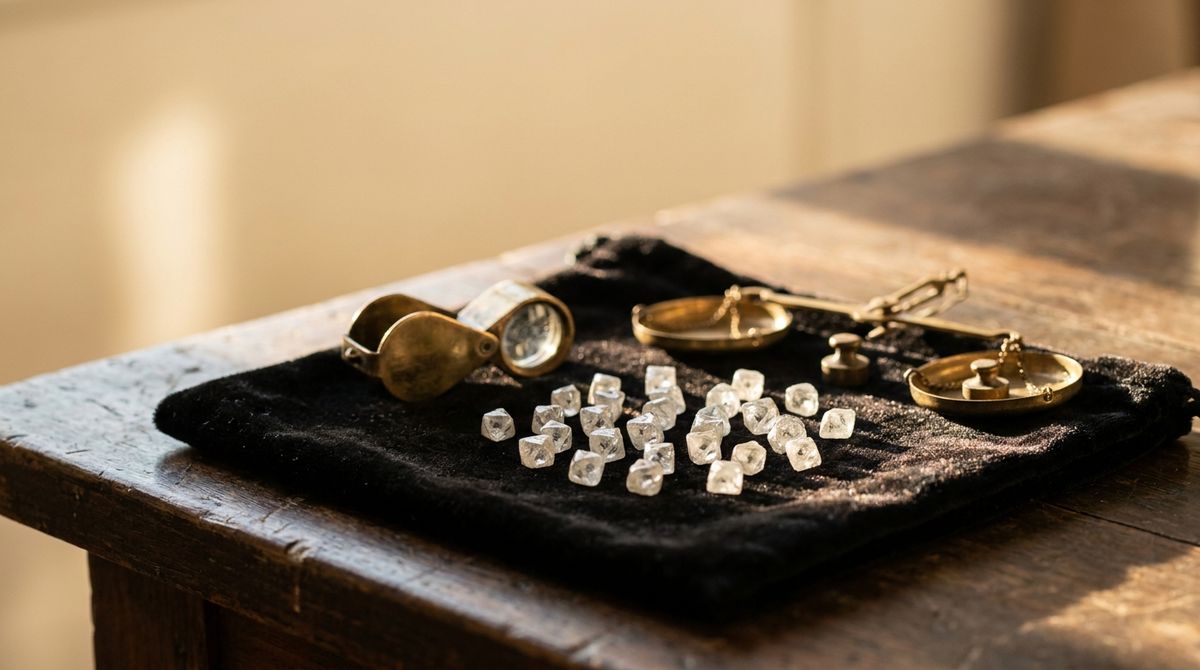
Every engagement-ring conversation eventually runs into this question, and it's not a small one: a lab-grown diamond and a natural diamond at the same size and grade can carry very different price tags, so shoppers want to know what they're actually choosing between before they spend money neither can see a difference in. Here's what's really different — and what isn't.
What a lab-grown diamond actually is
A natural diamond forms the slow way: carbon, trapped 90 to 150 miles down in the earth's mantle, held under enormous heat and pressure for somewhere between one and three billion years, then carried to the surface by volcanic eruptions that no longer happen the way they used to. A lab-grown diamond starts with the same element — carbon — and ends with the same result, just compressed into weeks instead of eons. Growers use one of two processes: HPHT (high pressure, high temperature), which recreates the mantle's conditions in a chamber, or CVD (chemical vapor deposition), which builds the crystal up layer by layer from carbon-rich gas in a vacuum.
The result in both cases is the same crystal lattice — carbon atoms bonded in the same cubic structure — which is why gemologists describe lab-grown diamonds as chemically, physically and optically identical to natural ones. Same hardness (10 on the Mohs scale), same refractive index, same fire and brilliance. A lab-grown diamond is not a diamond simulant the way cubic zirconia or moissanite are; those are different minerals shaped to look like diamond from the outside. A lab-grown diamond is diamond, grown instead of mined.
Grading and certification
Both the Gemological Institute of America (GIA) and the International Gemological Institute (IGI) grade lab-grown diamonds on the same 4Cs scale used for natural stones — cut, color, clarity, and carat weight — because the physical properties being measured are the same. What differs is the paperwork: a lab-grown stone's certificate states its origin explicitly, and reputable labs laser-inscribe "Lab-Grown" (or an abbreviation like LG) into the girdle, the thin band around the stone's widest point, visible under magnification. That inscription, backed by the certificate, is the one reliable, low-tech way to confirm which type of stone you're looking at — not the naked eye, and not a standard jeweler's loupe used on its own.
The cost difference
This is where the two diverge most. A lab-grown diamond of a given cut, color, clarity and carat weight typically costs somewhere in the range of 60 to 85 percent less than a natural diamond of the same grade — a gap driven by supply: a lab can scale production in a way a mine cannot, and the time cost of growing a stone is measured in weeks rather than geological ages. That gap has been narrowing somewhat as lab-grown supply has grown and pricing has adjusted, but it remains large enough to be the main reason most shoppers consider lab-grown in the first place — it buys meaningfully more size or clarity at the same budget, or the same stone for meaningfully less.
The flip side shows up at resale. Natural diamonds have an established, if not especially strong, secondary market; lab-grown diamonds, being newer and more easily supplied, currently hold their value less well on resale. For a stone bought to wear rather than to resell, this matters less — but it's worth knowing going in.
Can you tell them apart by eye?
No. This is the part that surprises most people: there is no visual tell, no sparkle difference, no color cast that separates a lab-grown diamond from a natural one at the same grade. A jeweler cannot look at a loose stone, or even view it under a standard loupe, and reliably call its origin. Telling them apart requires specialized equipment — spectroscopy tools that detect trace growth patterns and inclusions specific to each formation method — the kind of equipment a gemological lab has and a retail counter does not. In practice, origin is established by certification and inscription, not inspection. If a stone doesn't come with a GIA or IGI report stating what it is, there's no reliable way to know.
Which one is "right"?
This isn't really a question with one correct answer — it comes down to what a given shopper is weighing. Someone prioritizing budget or wanting the largest, cleanest stone possible for the money usually leans lab-grown. Someone who values the rarity and geological story of a stone that took a billion years to form, or who's thinking about long-term resale, usually leans natural. Sustainability arguments get made on both sides — mining has an environmental and labor footprint that's improved but not disappeared, while growing a diamond is energy-intensive in its own way — and neither side has a clean, uncontested claim to being the "greener" choice. The honest answer is that both are genuine diamonds, graded the same way, and the decision is a budget and values question rather than a quality one.
FARUZO doesn't sell diamonds — our pieces are 316L stainless steel with a gold, rose-gold or silver-tone plated finish, built for engraving rather than for a center stone. If you're putting together a gift to go alongside a diamond piece — an engraved pendant to pair with an engagement ring, say — that's the kind of personal touch we make; it's a different gift, not a diamond alternative.