Agate is the stone most people have touched without knowing its name — the banded, candy-striped slice sold as a coaster, a bookend, or a pendant at nearly every rock shop and gift stand. Underneath the novelty-shop presentation is a genuinely interesting mineral: a banded form of chalcedony that records, layer by layer, the exact conditions it formed under. Here's what agate actually is, where its meanings come from, how to tell a real one from dyed glass, and how to wear it if you're adding it to jewelry. It's part of the same gemstone-by-gemstone series covering what each stone actually is versus what it's marketed as. In short, agate’s meaning centers on grounding, balance, and protection — the same wellness-market logic behind newer entries in the series like Amazonite Meaning.
What Agate Actually Is
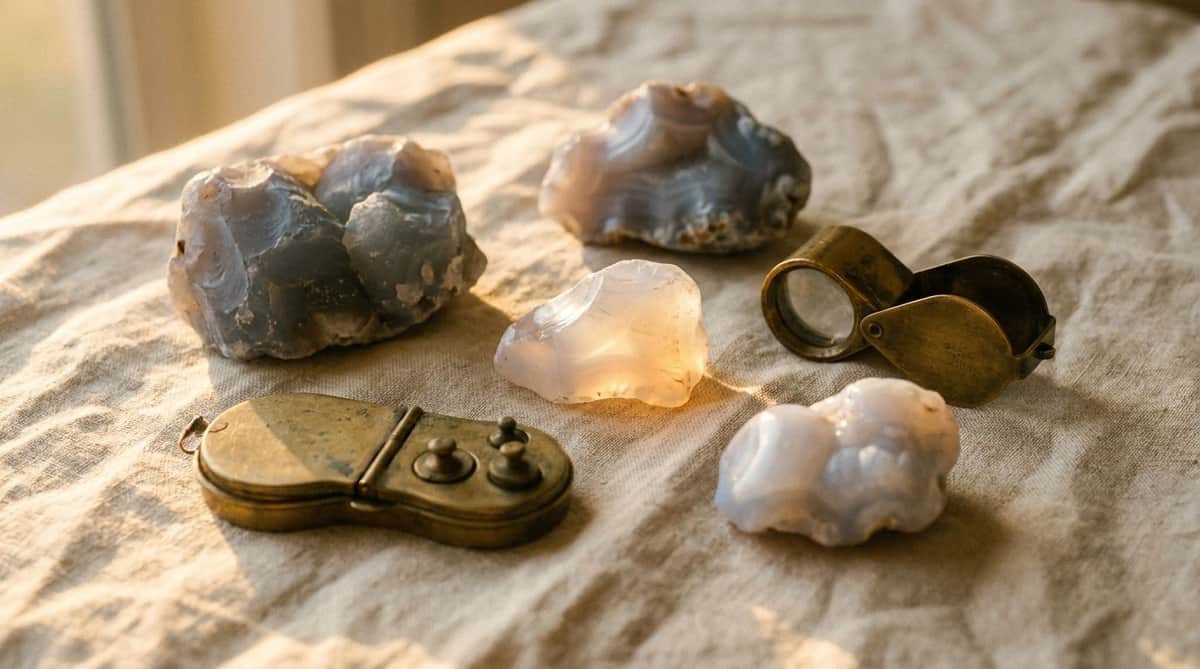
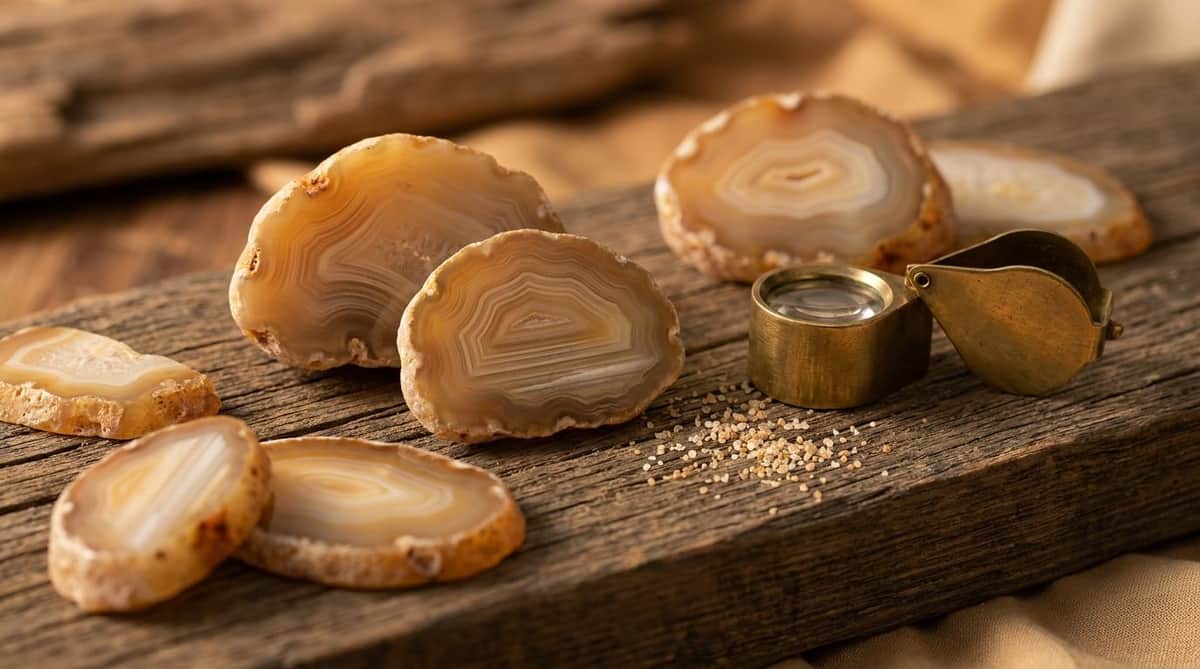
Agate is a variety of chalcedony — a cryptocrystalline form of quartz, meaning its crystals are too small to see without magnification — defined by its distinctive banding. Those bands form inside gas cavities in volcanic rock: silica-rich groundwater seeps into a hollow pocket in cooling lava and deposits mineral layers in thin, concentric bands over long stretches of time, each band reflecting a slightly different mix of trace minerals and conditions at that moment. That's why a cut agate looks almost like a topographic map or a tree's growth rings — it's the same basic idea, recorded in mineral rather than wood. On the Mohs hardness scale agate sits at 6.5–7, the same range as quartz generally, which is what makes it durable enough for everyday jewelry and, at the other end, popular for carved seals and ornamental objects for thousands of years.
Physical, Mental, and Metaphysical Properties
Physical
Agate's defining physical trait is its banding — concentric or wavy layers in translucent-to-opaque tones that range from soft grey, cream, and brown to deep amber, blue, red, or moss green depending on which trace minerals were present when it formed. Iron gives the reds, oranges, and browns; nickel and chromium can give greens; manganese can push toward pink or purple. Because it forms in cavities rather than solid veins, individual agate nodules can vary enormously even from the same deposit, which is part of why no two polished slices look quite alike.
Mental
In the modern wellness market, agate is described as a grounding, steadying stone — associated with emotional balance and calm rather than high energy or excitement. That reputation lines up with how the stone actually looks and feels: muted, banded, earth-toned, and cool to the touch, the kind of object that reads as settled rather than dramatic. As with any crystal-meaning claim, this is a wellness and folklore tradition rather than a scientifically established effect, and it's worth treating it as such.
Metaphysical
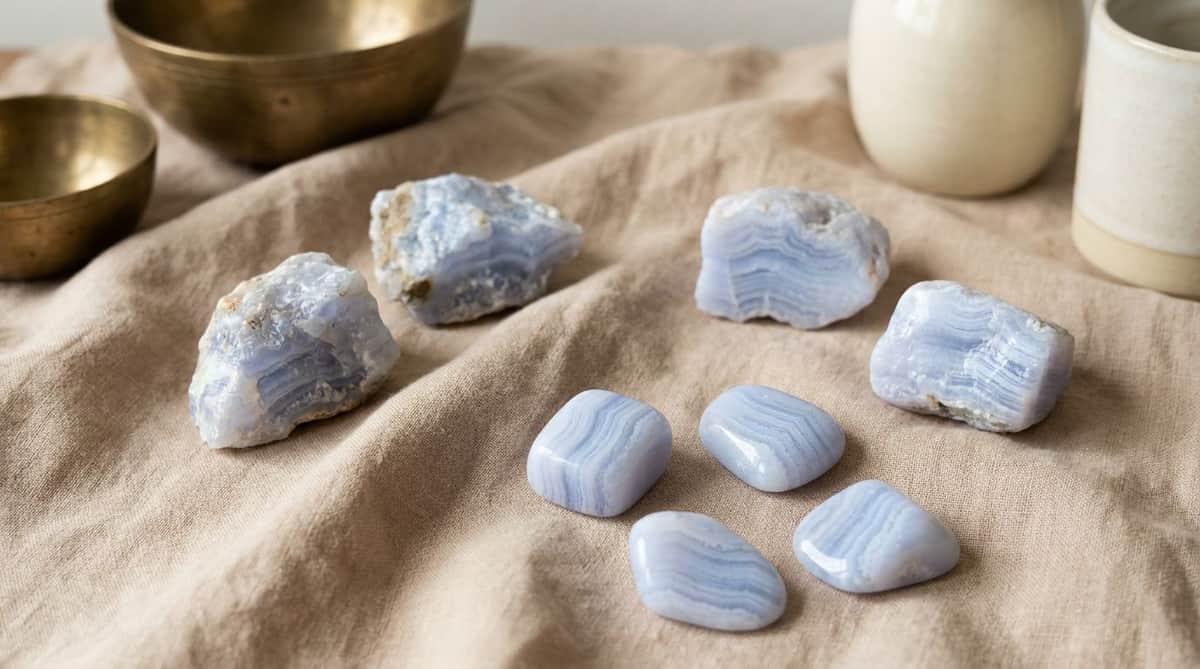
Agate's metaphysical reputation is one of the oldest of any stone still in common use — it was carried as a protective amulet in the ancient Near East and Mediterranean world, and that protective association has stuck through to the present. Different agate colors get somewhat different modern meanings within the wellness community (moss agate for growth and abundance, blue lace agate for calm communication, fire agate for courage), following the same logic behind gemstone color meanings more broadly — the same logic that shapes the pink, love-associated reputation covered in Rose Quartz Meaning.
The History Behind Agate's Reputation
Agate has one of the longest continuous records of human use of any gemstone. It was carved into seals and signet rings in ancient Mesopotamia and Egypt, prized specifically because its hardness made it hold fine detail well and resist wear — a practical reason as much as a decorative one. The name itself comes from the Achates River in Sicily, where the Greek naturalist Theophrastus recorded finding it around the third century BCE, one of the earliest named gemstones in Western writing. That combination — genuinely durable, genuinely widespread, and available in enough color variation to suit almost any use — is why agate carving stayed a continuous craft tradition for thousands of years instead of falling in and out of fashion the way rarer stones have.
Agate Varieties and What the Colors Mean
“Agate” covers a wide family of banded chalcedony rather than one single look. Moss agate isn't banded at all in the classic sense — it gets its name from green, plant-like mineral inclusions that look like moss trapped in clear-to-milky stone. Fire agate has a distinctive iridescent, flame-like play of color caused by thin internal layers of iron oxide. Blue lace agate is pale blue with fine, delicate banding and is one of the most commonly used varieties in jewelry because of its softer, more uniform coloring. Standard banded agate — the type most often cut into slices, coasters, and cabochons — is the widest category and the one most people picture by default. Picture agate (also called landscape agate) is banded material — usually in warm browns and tans — where the pattern happens to resemble a scene, like a horizon or mountain range, once the slice is cut and polished; it's prized for that resemblance rather than for any one fixed color. Worth knowing before buying: a lot of banded agate sold cheaply, especially in very saturated blues, purples, and neons, has been dyed. Dye isn't inherently a problem to disclose, but it should be disclosed, and an unnaturally uniform, saturated color across every band is usually the tell.
Agate vs. Onyx: How to Tell Them Apart
Agate and onyx are close mineral relatives — both are varieties of chalcedony — which is exactly why they're confused so often. The practical difference is banding: agate is defined by its visible, usually curved or concentric bands of contrasting color, while true onyx has straight, parallel bands, most commonly seen in the black-and-white banded form used for cameos and inlay. A lot of what's sold simply as “black onyx” in jewelry is actually dyed black chalcedony or dyed agate with the banding minimized or hidden — genuine natural black onyx with no dye is less common than the market suggests. If you're buying a piece specifically for its banded pattern, agate is usually the better search term; if you want solid, deep black, ask directly whether the stone is dyed rather than assuming from the name alone.
Wearing and Caring for Agate Jewelry
At 6.5–7 on the Mohs scale, agate is hard enough for rings, bracelets, and earrings worn regularly, though — like any quartz-family stone — it can still chip on a sharp knock, so it's worth taking off before anything high-impact. Clean it the same way you'd clean any gemstone ring: warm water, a drop of mild dish soap, a soft brush for any detail in the setting, and a full pat-dry before it goes back into a jewelry box. Skip ultrasonic cleaners on dyed agate specifically — the vibration and heat can accelerate color loss over time in stones that were treated rather than naturally colored. Store agate pieces away from harder stones like sapphire or diamond, which can scratch its surface if they're tossed together loosely in the same tray.
For a low-commitment way to try it, FARUZO’s Black Agate Bracelet — Personalized pairs polished black agate beads with an engraved bar, sized for the same everyday wear the 6.5–7 hardness above allows.
Frequently Asked Questions
Is agate a real gemstone or just decorative rock?
It's a real, well-defined mineral variety — banded chalcedony, a form of quartz — used in gemology and jewelry-making for thousands of years, not a marketing term for generic decorative stone.
Why is some agate so brightly colored?
Natural agate does occur in a wide color range because of trace minerals, but very uniform, highly saturated colors like neon blue or purple are almost always the result of dyeing — chalcedony's porous banding structure takes dye readily, which is part of why the treatment is so common in the trade.
What's the difference between agate and geode?
A geode is the hollow rock formation itself, typically lined with crystal points on the inside; agate is a specific banded mineral that can form the lining of a geode, but geodes can also be lined with other minerals entirely. Not every geode contains agate, and not every piece of agate came from a geode.
Is agate durable enough for an everyday ring?
Yes for typical daily wear — its 6.5–7 hardness holds up well to normal use — but it's not scratch-immune the way sapphire or diamond are, so it's worth removing before manual work or anything likely to knock it against something hard.