Smoky quartz is the stone that photographers, judges, and Scottish Highland gentry have all reached for over the centuries — not for glamour, but because it's genuinely useful: tough enough for jewelry, dark enough to work as sunglasses, and common enough to actually own. It's also one of the most misidentified stones on the market, sold under a name that isn't its own almost as often as it's sold under its real one. Here's what smoky quartz actually is, where its long, odd history comes from, and how to buy and wear it without getting fooled. It's part of the same gemstone-by-gemstone series covering what each stone actually is versus what it's marketed as.
What Smoky Quartz Actually Is
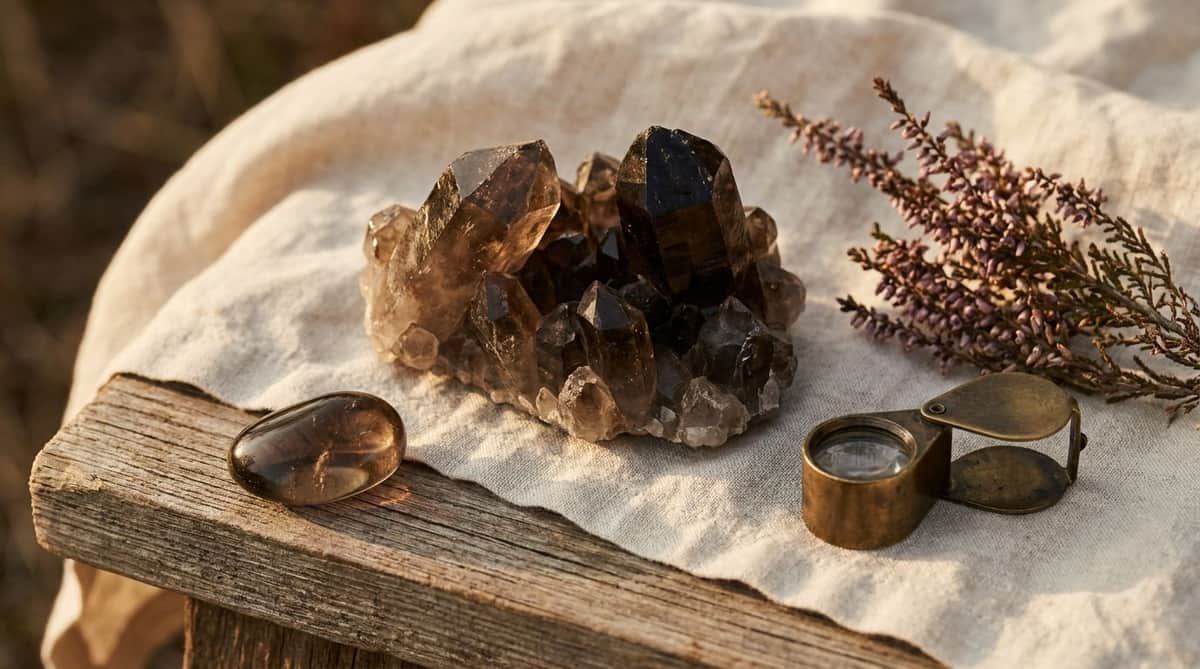
Smoky quartz is a color variety of ordinary quartz (SiO₂) — the same silicon dioxide mineral that makes up clear quartz, amethyst, and citrine, just with a different color history. Like all quartz, it's macrocrystalline (its crystals are large enough to see, unlike the cryptocrystalline chalcedony family that includes agate and carnelian) and forms in the trigonal crystal system, giving it the same six-sided prism habit as clear quartz. Mohs hardness is 7, and specific gravity runs about 2.65, both squarely in normal quartz range. What sets it apart from clear quartz is entirely optical: natural background radiation, over geological time, activates color centers around trace aluminum atoms sitting in the crystal lattice where silicon should be — the same defect mechanism, different trigger, behind amethyst's purple. The result is a translucent brown, gray, or near-black color that deepens the more radiation the crystal has absorbed underground. Heat it past roughly 200–300°C, or leave it in strong sunlight long enough, and that color fades — which is both how nature can partly undo the effect and how the trade deliberately reverses it, as the comparison section below explains. The near-opaque black end of the range has its own name, morion, a term borrowed from a mistranscription in the Roman naturalist Pliny the Elder's first-century writing on minerals.
Properties: Physical, Mental, and Metaphysical
Physical
Color is smoky quartz's whole identity — a range from pale champagne-grey through warm root-beer brown to the almost-black morion, usually translucent enough to glow when backlit. Clarity varies: some material is glassy clear apart from the color, while other pieces carry visible rutile needles or smoky internal "clouds," which most buyers treat as character rather than a flaw. At Mohs 7 it resists everyday scratching about as well as clear quartz, citrine, or amethyst, which is why it shows up in rings and bracelets as often as pendants.
Mental
In the modern wellness market, smoky quartz has one of the most consistent reputations of any stone: grounding. It's marketed as the crystal for staying present and steady under stress — a reading that leans heavily on the stone's own visual language (dark, earthy, unshowy) rather than on any tested mechanism. As with every claim in this section, that's a wellness and folklore tradition, not a scientifically demonstrated effect, and it's worth treating it that way.
Metaphysical
Older mineral lore ties smoky quartz to protection and specifically to the root chakra — the idea being that its dark, "earthed" color connects to stability and the base of the body rather than the crown or heart. None of this is measurable; it's a continuous folk tradition, kept alive today mostly through the crystal-healing market, not a property of the mineral itself.
Cairngorm: The Stone Scotland Built a National Identity Around
Nowhere took smoky quartz more seriously than Scotland. Crystals collected from Cairn Gorm, Ben Avon, and the surrounding Cairngorm mountains gave the stone its most famous nickname — cairngorm — and for a couple of centuries it became one of the defining materials of Highland dress: set into kilt pins, sporran cantles, and especially the hilt-top of the sgian dubh, the small knife tucked into a Highlander's kilt hose. According to National Museums Scotland, it's often described as Scotland's traditional or national gem, even though no act of law has ever formally declared it so — the status is cultural, built by generations of jewellers and wearers rather than by statute. What made a common mineral feel special wasn't rarity; quartz is about as common as minerals get. It was provenance — a crystal you could point to a specific mountain for, cut and set close to where it was found, at a time when Highland identity itself was being consciously performed through dress.
A Judge's Sunglasses: Smoky Quartz Through History
Long before Scotland claimed it, smoky quartz had a genuinely strange job in 12th-century China: cut into flat panes and worn over the eyes by court judges, not for the sun but to hide their expressions from witnesses and litigants while they listened to testimony — an early, mineral version of the poker face. It's one of the oldest documented uses of any smoke-toned lens, gemstone or otherwise. The deep-black morion variety picked up its own odd paper trail too: the name is a garbled transcription of "mormorion," the term Pliny the Elder used for it in the first century CE, which stuck through centuries of translation and mineral trade before mineralogists formalized it.
Smoky Quartz vs. "Smoky Topaz": The Name You Should Distrust
If you've shopped for this stone and seen it labeled "smoky topaz," you were looking at quartz. Real topaz is a separate mineral (an aluminum fluorosilicate) with its own hardness (8) and crystal structure — it has nothing to do with quartz chemically. "Smoky topaz," like the older trade term "Madeira topaz" for deep orange citrine, is a holdover from an era when brown and yellow stones of almost any kind got lumped under the more prestigious topaz name, and it survives today mainly because "topaz" still sounds more valuable to a buyer who doesn't know better. Reputable dealers have been trying to retire the term for years; if you see it on a listing, treat it as a reason to ask direct questions before buying, not as extra reassurance. The safest move is simple: ask what the stone actually is in mineral terms, and check that the price matches quartz rather than topaz.
Wearing and Caring for Smoky Quartz Jewelry
At Mohs 7, smoky quartz holds up fine to daily wear — rings included — with the same basic care as any other quartz-family stone: clean it with warm water, mild soap, and a soft cloth, and skip ultrasonic or steam cleaners if the piece has fracture-filled or heavily included stones, since heat and vibration can stress natural inclusions. For a full walkthrough of safe cleaning methods for any gem-set piece, see how to clean a gemstone ring safely. The one care point specific to this stone is light and heat exposure: because its color comes from radiation-induced defects that heat and UV can reverse, avoid leaving smoky quartz jewelry in direct sun for extended stretches or storing it somewhere that gets hot — a car dashboard, a sunny windowsill — if you want the color to stay as dark as it was the day you bought it. If you're building out a everyday gemstone collection alongside it, our birthstone necklaces collection is a good place to see how other colored stones are typically set for daily wear.
Frequently Asked Questions
Is smoky quartz natural, or is it always treated?
Both exist. Natural smoky quartz forms through millions of years of background radiation exposure underground, and plenty of untreated material is on the market, especially from classic localities like Brazil, Madagascar, and the Swiss and Scottish Alps. But because the same color mechanism can be reproduced with lab irradiation in hours, a large share of commercial smoky quartz — including most deeply colored, uniformly dark material — is irradiated clear quartz. Reputable sellers should disclose treatment; either way, you're getting the real mineral, just with a color assist.
What’s the difference between smoky quartz and "smoky topaz"?
Nothing links them mineralogically — "smoky topaz" is simply an inaccurate, legacy trade name for smoky quartz. Actual topaz is a different mineral entirely (an aluminum fluorosilicate, Mohs 8) and doesn't naturally occur in the same smoky-brown range that gave the misnomer its appeal.
Is smoky quartz durable enough for a ring worn every day?
Yes. Mohs 7 is the same hardness as clear quartz, amethyst, and citrine, all common ring stones, and it resists scratching from most everyday materials — only much harder stones like sapphire, ruby, or diamond can scratch it. The main risk to any brittle gemstone, regardless of hardness, is a hard direct impact.
Does smoky quartz have proven healing properties?
No controlled scientific evidence supports crystal-healing claims for smoky quartz or any other gemstone. Its "grounding" and protective reputation is a wellness and folklore tradition, not a medical or scientifically demonstrated effect — worth enjoying as symbolism, not relying on as treatment.
Is smoky quartz the same as Scotland's cairngorm stone?
Yes — cairngorm is simply the traditional Scottish name for smoky quartz found in and around the Cairngorm Mountains, historically prized for kilt pins and sgian dubh hilts. It's the same mineral as smoky quartz found anywhere else in the world; the name marks origin and cultural history, not a different stone.