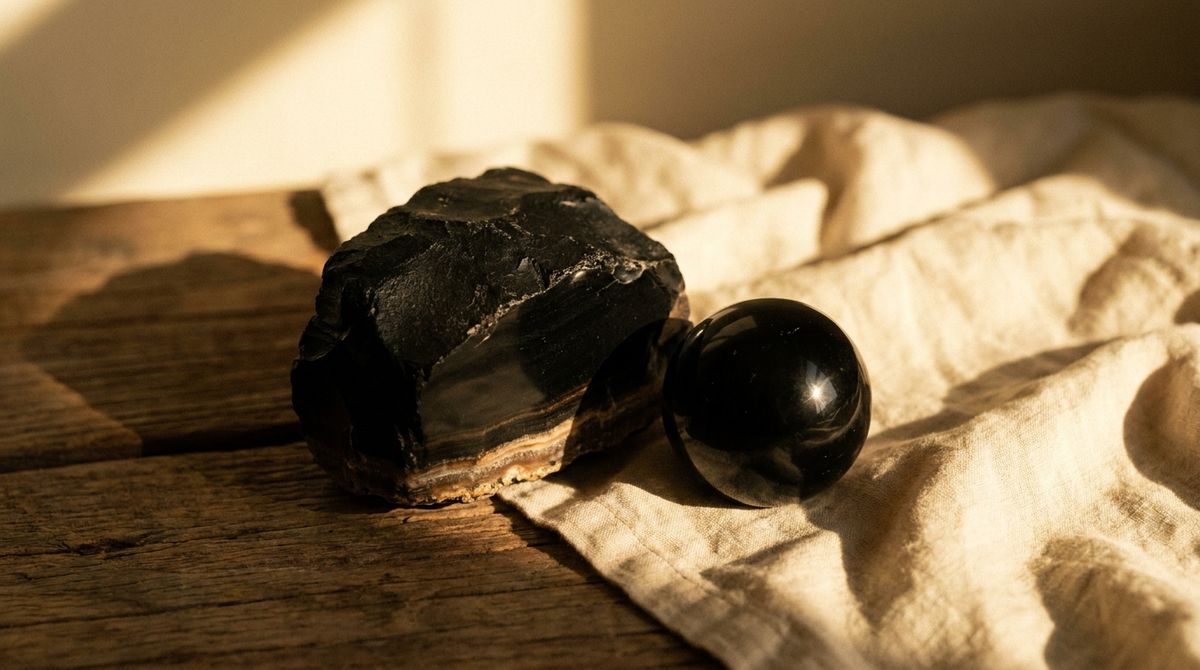
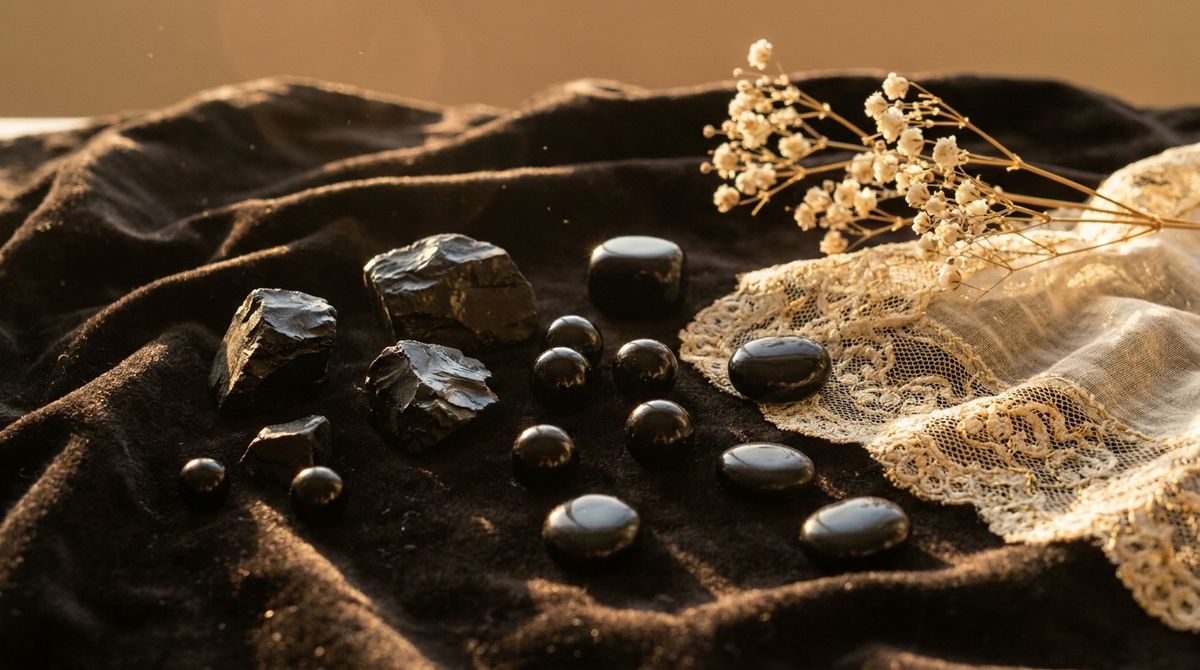
Jet looks and feels like a gemstone — deep black, capable of a glassy polish, carved into beads and brooches for centuries. It isn't a mineral at all. Jet is fossilized wood, chemically closer to coal than to any crystal, and that single fact explains almost everything else about it: why it's warm instead of cold to the touch, why real pieces are startlingly light, and why the Victorians built an entire mourning-dress code around it.
What Jet Actually Is — The Science Behind the "Stone"
Jet forms when wood from trees in the Araucariaceae family (relatives of the modern monkey puzzle tree) gets buried in anoxic, waterlogged mud, then compressed under pressure for millions of years without ever being exposed to the oxygen that would let it fully decay or turn to true coal. The result is a dense, organic material — technically a type of lignite — that takes a high polish and carves cleanly, which is exactly why jewelers started using it instead of discarding it as a curious kind of coal.
That organic origin is also the easiest way to separate real jet from almost every black imitation: jet is warm to the touch within seconds of handling it, and genuine pieces are noticeably light for their size — a large Victorian jet brooch can weigh a fraction of what the equivalent piece in glass or onyx weighs.
From Roman Amulets to Queen Victoria's Mourning Jewelry
Jet's jewelry history starts well before Victorian England. Roman jewelers carved jet into amulets, believing — along with several other black materials of the era — that it could deflect the evil eye and ward off illness. Amber traders along the English coast near Whitby, Yorkshire, were already working local jet deposits by the Iron Age, which is part of why "Whitby jet" became the specific, prized term for the highest-quality British material.
The material's defining moment came in 1861, when Prince Albert died and Queen Victoria entered a period of strict, prescribed mourning that lasted the rest of her life. Victorian mourning etiquette dictated exactly what could be worn at each stage of grief, and "full mourning" — the deepest stage — permitted almost no jewelry except jet. Whitby's jet industry boomed for decades on the strength of royal example alone, turning out mourning brooches, beads, and lockets by the thousand before cheaper substitutes and changing fashions ended the boom by the early 1900s.
Jet Meaning and Symbolism Today
Jet's symbolism is inseparable from its mourning history: protection, grounding, and comfort during grief are the meanings that show up most consistently, carried over directly from both the Roman amulet tradition and the Victorian mourning-jewelry era. In modern crystal-healing circles it's also described as a grounding stone, said to absorb negative energy rather than reflect it — a claim rooted in folk tradition and esoteric practice rather than anything scientifically tested, worth noting plainly since it's a belief system rather than a fact.
Real Jet vs. the Imitations: How to Tell Them Apart
Because genuine Whitby-quality jet became expensive and supply was limited, the Victorian era produced almost as many imitations as original pieces — and the habit continues today with modern synthetic stand-ins. Here's how the main black materials actually compare:
- Real jet: warm to the touch within seconds, very light for its size, carves with a slightly fibrous texture under magnification (a holdover from its wood origin), and can develop a faint static charge when rubbed against wool.
- "French jet" (black glass): despite the name, it's glass, not a gemstone at all — it was mass-produced in France and Bohemia as a cheaper Victorian substitute. It stays cold to the touch much longer than real jet and is noticeably heavier for the same size.
- Vulcanite and gutta-percha: early rubber-based mourning-jewelry substitutes. Both fade to a brownish-grey over time with UV exposure, while true jet keeps its black color — a fading piece is a strong tell that it isn't jet.
- Black onyx: a genuinely different gemstone (a banded form of chalcedony), cold to the touch, and notably heavier and harder than jet — a quick weight comparison between two similarly sized pieces usually settles it.
- Black tourmaline: another true mineral, much harder than jet (Mohs 7–7.5 versus jet's roughly 2.5–4) and cold to the touch; it also won't carve with jet's fibrous grain under a loupe.
If black stones generally interest you, black tourmaline and black obsidian are both worth reading next — both are true minerals with very different formation stories from jet's fossilized-wood origin, which makes a useful contrast for seeing how differently "black gemstone" can actually mean.
How to Care For and Wear Jet Jewelry
Jet is soft — roughly Mohs 2.5 to 4, well below quartz-family stones — so it scratches more easily than most jewelry-counter gemstones and shouldn't go through an ultrasonic cleaner or sit in water for extended periods, since prolonged moisture can affect the polish on antique pieces specifically. A soft cloth and occasional light buffing is the safest routine. Because antique jet pieces (especially true Whitby jet) carry real collector value, a piece inherited from a Victorian-era estate is worth having checked rather than cleaned at home with anything more than a dry cloth.
For a newer piece built to carry a name or date rather than mourning symbolism specifically, our engraved necklaces collection includes locket styles — the same format the Victorians used to seal jet keepsakes and a lock of hair inside, just updated for a different kind of sentiment.
Frequently Asked Questions
Is jet a mineral or a gemstone?
Neither, technically. Jet is an organic material — fossilized wood (lignite) — not a mineral with a crystal structure, which is why gemologists classify it as an "organic gem" alongside amber and pearl rather than true gemstones like quartz or corundum.
Why was jet used for Victorian mourning jewelry?
Queen Victoria wore jet almost exclusively during the strictest stage of mourning after Prince Albert's death in 1861, and Victorian mourning etiquette followed her example — "full mourning" permitted little to no jewelry except jet, which built a decades-long industry around Whitby, Yorkshire's jet deposits.
How can you tell real jet from fake jet?
Real jet is warm to the touch within seconds and noticeably light for its size. Black glass ("French jet") stays cold longer and is heavier; vulcanite and gutta-percha substitutes fade to brownish-grey over time where real jet does not; black onyx and black tourmaline are both true minerals that are colder and significantly harder than jet.
What does jet symbolize?
Protection, grounding, and comfort during grief — meanings carried over from Roman amulet traditions (believed to ward off the evil eye) and reinforced by its Victorian role as the material of mourning.
Is jet jewelry durable enough for everyday wear?
Not particularly. At roughly Mohs 2.5–4, jet scratches more easily than harder gemstones and should avoid ultrasonic cleaners and prolonged water exposure — it's better suited to occasional wear than daily use.
Where does real jet come from?
The most prized source is Whitby, on England's Yorkshire coast, where jet has been worked since at least the Iron Age. Smaller deposits exist elsewhere in the world, but "Whitby jet" remains the specific term for the historically significant British material.