Both stones glow with a soft, shifting light that makes them easy to mix up in photos — and in casual conversation, “that milky stone that changes color” gets used for both. But moonstone and opal are different minerals, with different optical effects, different hardness, and very different care needs. Here's how to actually tell them apart, and which one fits a given piece of jewelry better.
The “Glow” Is Two Different Optical Effects
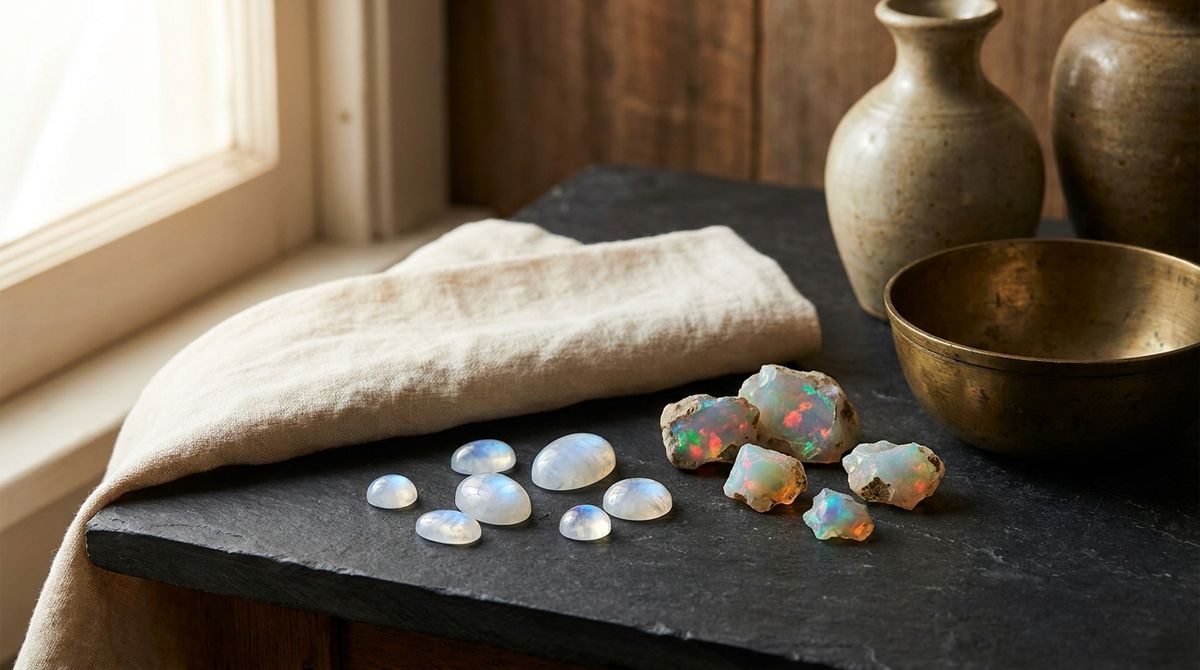
Moonstone's signature look is called adularescence — a billowy, blue-white sheen that seems to float just under the surface as the stone moves. It happens because moonstone is built from microscopically thin, alternating layers of two feldspar minerals (orthoclase and albite); light scatters off those internal layers rather than reflecting off the surface.
Opal's effect is called play-of-color: flashes of multiple distinct colors — red, green, blue, sometimes all at once — that shift as the stone tilts. That happens because precious opal is built from a microscopic, orderly lattice of tiny silica spheres, which diffracts light the way a prism splits it, rather than scattering a single soft sheen.
The practical tell: moonstone's glow is a single-color sheen (usually blue-white) that moves as one soft band of light. Opal's play-of-color breaks into multiple separate hues flashing independently. Side by side, they're not easy to confuse — the confusion mostly happens from a thumbnail photo or a quick glance.
Different Minerals, Different Hardness
Moonstone is a potassium feldspar (orthoclase), with a Mohs hardness of 6 to 6.5. Opal is amorphous hydrated silica — not a crystal at all in the strict mineralogical sense — at 5.5 to 6.5, and it holds roughly 3% to 21% water by weight, depending on where it formed. That water content is the single biggest practical difference between the two stones.
Why Opal Needs More Care Than Moonstone
Opal's water content makes it genuinely more fragile day to day: extreme dryness can slowly draw moisture out and cause fine surface cracks (called crazing), rapid temperature swings can shock it, and harsh chemicals or ultrasonic cleaners can damage it outright. Moonstone doesn't have that water-loss risk, but feldspar has perfect cleavage in two directions, meaning a sharp knock in the wrong spot can chip or split it even though the hardness number looks similar to opal's. Neither stone is a good match for a ring worn through daily manual work — both are better suited to pendants, earrings, or occasional-wear rings.
Price: Why Opal's Range Is So Much Wider
Moonstone stays relatively affordable across most quality grades, generally in the tens to low hundreds of dollars per carat, with the premium going to stones showing a strong, evenly distributed blue sheen. Opal's range is far wider: common white or Mexican opal can be inexpensive, while top-grade black opal — mainly from Lightning Ridge, Australia — can reach thousands of dollars per carat for stones with intense, full-spectrum play-of-color. If you've seen wildly different prices quoted for “a similar-looking stone,” that's usually opal's own internal quality range, not a mixup between the two gems.
Where Each Stone Actually Comes From
The finest adularescent moonstone has historically come from Sri Lanka, with additional sources in India, Myanmar, and Madagascar. Precious opal with strong play-of-color is most associated with Australia — Lightning Ridge is the source of the rarest black opal — though Ethiopia and Mexico have both become major modern sources, each producing opal with a distinct look (Ethiopian opal is often more porous and prone to crazing than Australian material, which is one more reason origin matters for care, not just romance).
Moonstone vs. Opal, Side by Side
- Mineral: moonstone is feldspar (orthoclase/albite) — opal is amorphous hydrated silica
- Optical effect: moonstone shows adularescence (one soft sheen) — opal shows play-of-color (multiple flashing hues)
- Hardness: moonstone 6–6.5 Mohs — opal 5.5–6.5 Mohs
- Water content: moonstone none — opal roughly 3%–21% by weight
- Main care risk: moonstone cleaves/chips from a sharp knock — opal dries out and crazes without humidity
- Typical price: moonstone tens–low hundreds per carat — opal from inexpensive up to thousands per carat (black opal)
Are They Ever Actually the Same Stone?
No — they're unrelated minerals that happen to share a general category jewelers call “phenomenal gems,” stones valued for an optical effect rather than pure color or clarity. Labradorite and moonstone are close cousins (both feldspar, both can show a shifting sheen called labradorescence or adularescence depending on the specific effect), but opal isn't related to either. The visual overlap that causes the mix-up is coincidental: both happen to look “glowy” in a way few other common gems do.
Which One Fits Which Piece of Jewelry
Because opal needs more protection from knocks and dryness, it tends to work best in pendants and earrings, where it isn't exposed to the same daily contact a ring takes, or in a bezel setting that shields the edges if it is set in a ring. Moonstone's wider hardness margin and lack of water sensitivity make it a somewhat more forgiving everyday stone, though its cleavage still means a protective setting is worth choosing over an exposed one. Neither is the right pick for a stone that needs to survive manual work or frequent impact — for that, a harder, cleavage-free stone (or a lab-grown diamond or moissanite) holds up better.
Picking a Stone for Your Own Jewelry
If moonstone's softer, single-tone glow is what drew you in, our Moonstone Meaning guide covers its history, symbolism, and how to buy one with strong adularescence.
Opal is October's birthstone alongside tourmaline — our birthstone guide for the month covers what separates a higher-grade opal from a dull one, and the traditions behind pairing it with tourmaline.
Either stone works best set somewhere it won't take daily knocks. FARUZO's birthstone rings collection sets stones like these in a 316L stainless steel band built for everyday wear, with the stone itself as the part that still needs the gentler care described above.
Frequently Asked Questions
Can moonstone and opal be the same color?
Their base color can overlap — both come in whitish or pale blue-grey tones — but the effect moving across the surface is different. Moonstone shows one soft sheen; opal flashes multiple distinct colors at once.
Is moonstone a type of opal?
No. Moonstone is a feldspar mineral; opal is hydrated silica. They're unrelated minerals that both happen to produce a light-based optical effect, which is why they get grouped together in conversation even though they're chemically nothing alike.
Which is more durable for an everyday ring?
Moonstone generally holds up better day to day, since it isn't vulnerable to drying out the way opal is. That said, moonstone's cleavage planes mean it can still chip from a hard knock, so both stones do best in a setting that protects the edges, or in earrings and pendants rather than a ring worn constantly.
Is moonstone or opal more expensive?
It depends entirely on quality grade. Typical moonstone and typical opal are similarly affordable, but opal's ceiling is far higher — top-grade black opal can run thousands of dollars per carat, well above what even a fine moonstone commands.
Can you tell them apart without a lab test?
Usually, yes, by watching the stone move under light. If you see one soft band of blue-white light sliding across the surface, that's moonstone's adularescence. If you see separate flashes of multiple colors appearing and disappearing as you tilt it, that's opal's play-of-color.