Walk into any crystal shop and the big, glassy, pyramid-tipped clusters near the register are very often apophyllite. Most buyers never learn that the name isn't for one mineral at all — it's for a small family of closely related ones, named for a trick it performs when heated. Here's the real mineralogy, what it's said to mean, and how to tell it apart from the other pale, glassy stones it keeps getting confused with.
What Apophyllite Actually Is
“Apophyllite” comes from the Greek apo (“away from”) and phyllon (“leaf”) — literally “it flakes off,” a reference to the way the mineral exfoliates in thin, leaf-like flakes when heated, as water trapped in its structure escapes. That's not a metaphor; it's the literal basis for the name mineralogists gave it.
It's also not a single mineral. Apophyllite was redefined in 1978 from a specific mineral name into a group name covering a solid-solution series of closely related phyllosilicates, including fluorapophyllite-(K), fluorapophyllite-(Na) and hydroxyapophyllite-(K) — chemically similar minerals that differ mainly in which ion (fluorine or hydroxyl, potassium or sodium) fills a particular site in the crystal structure. What's sold as “apophyllite” in a shop is almost always one of these, not identified down to the specific species.
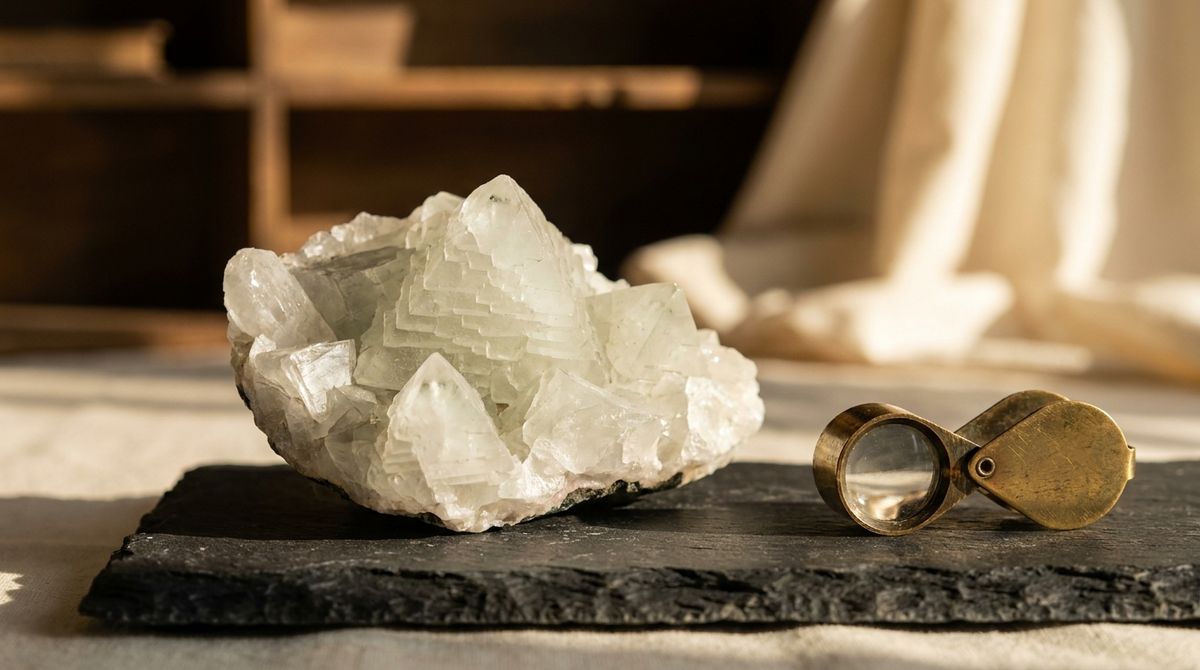
It's usually white or colorless, though it also occurs in blue, green, brown, yellow, pink and violet. Hardness runs 4.5–5 on the Mohs scale — distinctly softer than quartz-family stones at 7. Its crystal system is tetragonal, and its most recognizable trait is a stepped-pyramid termination so geometric it can look machine-cut, even though every face is a natural crystal plane.
A Mineral That Had Two Names
Apophyllite's history runs through two different names. Material now recognized as apophyllite was first grouped loosely among the “zeolites” by Swedish chemist C. Rinman in 1784, from a find at Utö, Sweden. In 1800, Brazilian naturalist José Bonifácio de Andrada described it under a different name entirely — ichthyophthalmite, Greek for “fish-eye stone,” a reference to its pearly, slightly fish-eye-like luster on cleavage faces.
That name didn't stick. In 1805–06, French mineralogist René-Just Haüy — one of the founders of modern crystallography — renamed the mineral apophyllite, after observing the same flaking-under-heat behavior the Greek root describes. Haüy's name replaced ichthyophthalmite and is the one that stuck through to today's mineral databases.
Where It Forms
Apophyllite is a secondary mineral: it doesn't crystallize directly from molten rock, but forms afterward, lining the gas-bubble cavities (vesicles) left behind in basalt and other volcanic rock as it cools. Those same cavities are classic zeolite territory, and apophyllite is very often found growing alongside zeolite minerals like stilbite, sharing the same pocket in the rock rather than forming in isolation.
The Deccan Traps basalt formations around Pune and Nashik, in Maharashtra, India, are among the world's best-known sources of large, clear, well-formed apophyllite specimens — which is why so much of what reaches crystal shops internationally traces back to Indian basalt quarries rather than a single mine.
Apophyllite Meaning and Symbolism
Apophyllite has no meaning in the scientific sense — the associations below come from crystal-healing tradition, not mineralogy, and are presented here as what that tradition claims, not as fact. Within that tradition, apophyllite is most often linked to the crown and third-eye chakras, associated with clarity, intuition and calm. Its colorless, almost-transparent appearance is usually the starting point for those claims — the same way selenite's glow gets tied to “clarity” imagery elsewhere in crystal lore.
Apophyllite vs. Danburite vs. Selenite: How to Tell Them Apart
All three show up in the same “pale, glassy, high-vibration” corner of a crystal shop, and beginners mix them up constantly. The real mineralogy separates them cleanly:
Apophyllite — Mohs 4.5–5, tetragonal system, classic stepped-pyramid termination, one perfect cleavage direction, forms in volcanic-rock cavities alongside zeolites.
Danburite — Mohs 7 (notably harder and more durable than the other two), orthorhombic system, grows as elongated, vertically striated prisms, typically forms in metamorphic skarn deposits rather than volcanic cavities.
Selenite — Mohs 2, the softest of the three by far — a variety of gypsum that can be scratched with a fingernail and will slowly dissolve if left sitting in water. Forms flat, bladed or fibrous crystals, not pyramidal points.
Why You Won't See Apophyllite Set Into Jewelry
Apophyllite's own name describes its weak point: that one perfect cleavage direction means it splits along flat planes under fairly light pressure, and real heat makes it flake apart outright. Combined with a Mohs hardness of 4.5–5 — well below the 7+ that most jewelry-counter stones need to survive daily wear — that's why apophyllite is sold almost entirely as raw or polished display clusters and points, not faceted into rings or pendants. For a similarly pale, display-only volcanic-cavity mineral, see our guide to celestite, which forms the same way and has the same durability problem.
If you like the idea of a stone that carries real meaning but still needs to survive being worn every day, a durable birthstone or an engraved piece is the more practical route — browse FARUZO's personalized necklaces collection for options built to actually be worn, not just displayed on a shelf.
Caring for an Apophyllite Specimen
Because most apophyllite stays in raw or polished-cluster form rather than being set in jewelry, care is closer to mineral-specimen handling than gemstone cleaning. A few practical points follow directly from the mineralogy above:
Keep it away from heat and direct sun. The mineral's name literally describes what happens when it's heated — water trapped in the structure escapes and the crystal flakes. A sunny windowsill over months can produce a milder version of the same effect.
Dust, don't scrub. At Mohs 4.5–5 with one perfect cleavage direction, a soft brush or air blower is safer than wiping, which can catch and chip a pyramid tip.
Skip the ultrasonic cleaner and long water soaks. Specimens are frequently sold still attached to co-formed zeolites like stilbite, which are softer and more water-sensitive than the apophyllite itself — a cleaning method safe for one can damage the other.
Frequently Asked Questions
Is apophyllite one mineral or several?
Several. “Apophyllite” was redefined in 1978 from a single mineral name into a group name for a solid-solution series of closely related phyllosilicates — fluorapophyllite-(K), fluorapophyllite-(Na) and hydroxyapophyllite-(K) — that differ in which ions fill specific sites in the same basic crystal structure. Specimens sold as “apophyllite” are rarely identified down to the specific species.
What does apophyllite mean or symbolize?
In crystal-healing tradition (not mineralogy), apophyllite is most often linked to the crown and third-eye chakras and associated with clarity, intuition and calm. These are cultural and metaphysical claims, not scientific ones.
Is apophyllite the same as selenite?
No. They're often sold in the same “pale and glassy” display section, but selenite is a gypsum variety at roughly Mohs 2 — soft enough to scratch with a fingernail and prone to dissolving in water — while apophyllite is a harder (Mohs 4.5–5) phyllosilicate with a distinctive pyramidal crystal habit that selenite doesn't share.
Can you wear apophyllite in jewelry?
Not practically. Its one perfect cleavage direction means it splits along flat planes under light pressure, and its Mohs hardness of 4.5–5 is well below what most daily-wear jewelry stones need. It's sold almost entirely as raw or polished display specimens rather than faceted or set stones.
Where does apophyllite come from?
It forms as a secondary mineral lining gas-bubble cavities in basalt and other volcanic rock, often alongside zeolite minerals like stilbite. The Deccan Traps basalt formations around Pune and Nashik, India, are among the world's best-known sources of large, well-formed specimens.